






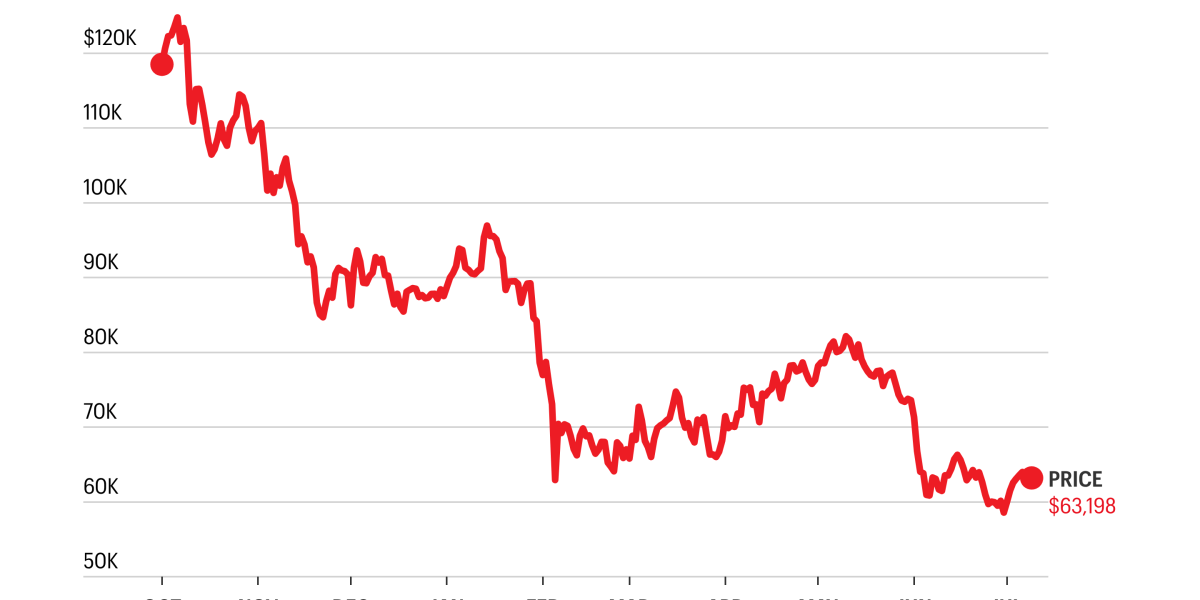
Bitcoin has seen better days. In October, the world’s largest cryptocurrency plummeted—and it hasn’t recovered, trading at around half of its all-time high of $126,000. Despite brief glimmers of upward momentum, the token continues to tread water amid a deep bear market.
The last time Bitcoin experienced such a prolonged drop was in 2022, when several of crypto’s largest players—including the crypto exchange FTX—collapsed and brought the digital assets market down with them. That period saw Bitcoin plunge 76% from its then–all-time high in 2021 to $16,000 in 2022.
In 2026, the backdrop is different. President Donald Trump has become one of the industry’s biggest boosters, and Wall Street titans like BlackRock and JPMorgan Chase are announcing blockchain-based products left and right. So, why is Bitcoin tanking?
Here are three reasons why the world’s largest cryptocurrency remains mired in a bear market, according to four industry analysts:
Four-year cycles
For over a decade, Bitcoin has seen three years of significant price appreciation followed by one year of decline. Before the 2022 collapse, the cryptocurrency experienced a downturn in 2018, following the boom and bust of initial coin offerings, or token-based fundraises; and in 2014, following the catastrophic collapse of Mt. Gox, the sector’s largest exchange at the time.
Because the four-year cycle has repeated itself multiple times, investors are now conditioned to expect it, according to Matt Hougan, chief investment officer at the crypto asset manager Bitwise.
“One of the primary reasons for that four-year cycle is actually investor psychology,” Hougan told Fortune. “As we got towards the tail-end of 2025, we started to see some long-term Bitcoin holders… beginning to lighten up on their position.”
Rising inflation
But, this time around, the collapse of an exchange isn’t keeping Bitcoin down. Macroeconomic conditions are to blame, said Zach Pandl, head of research at digital asset manager Grayscale.
In June, year-over-year inflation rose to 4.1% amid increases in oil prices linked to the U.S. conflict with Iran, according to the U.S. Commerce Department. That’s more than double the Federal Reserve’s long-term target of 2%.
Increasing inflation has led institutions like Bank of America to predict that Fed chairman Kevin Warsh will raise interest rates later this year, which is bad for Bitcoin. Riskier assets like cryptocurrencies usually see outflows as investors buy up less-risky debt that promises higher yields.
“[We] have seen that pattern play out with Bitcoin’s price over the last several years,” Grayscale’s Pandl told Fortune. “When the Federal Reserve cut interest rates to zero in COVID, Bitcoin’s price increased. When [it] decided that interest rates were too low and sharply raised [them], Bitcoin’s price declined.”
Excess leverage
Crypto wouldn’t be crypto without risk-taking, and leveraged trading has also led to the current downturn in digital assets, said Bitwise’s Hougan and Julio Moreno, head of research at CryptoQuant.
Bull markets tend to encourage investors to take on leverage, or borrow against their positions to buy more assets. For example, Strategy, the world’s largest digital asset treasury, ramped up purchases in 2024 and 2025 to accumulate about 4% of Bitcoin’s total supply, financing much of that buying spree with new equity and debt issuances.
The company’s Bitcoin funding approach spurred similar playbooks across the market, with other firms raising capital to build up their own digital asset stockpiles. But as Bitcoin’s price declined, that model came under pressure. Since October, Strategy’s stock price has fallen by 75%.
“What’s happening now is that leverage is getting squeezed out of the system now that we’re in a bear market,” said Hougan, pointing to declining open interest in derivatives and a pullback in digital asset treasury companies.
The pressure is also evident in Strategy’s recent decision to sell part of its Bitcoin holdings, a step that has likely further weakened demand for the asset.
“Strategy is basically the only company that actually keeps buying Bitcoin,” he said, adding that a return to repeated purchases may take time as the firm builds its cash reserves.
Worse—than better
Before, and if, Bitcoin returns to its 2025 highs, prospects for the world’s largest cryptocurrency could get worse, said the analysts.
The token has traded around $60,000 for the past month, but Pandl projects a bottom of $58,000. Potential interest rate hikes, Strategy’s impact on investor confidence, and the U.S. Senate’s progress on a key crypto bill are all weighing on Bitcoin’s short-term price moves, Pandl said.
Adrian Fritz, chief investment strategist at the crypto asset manager 21Shares, expects Bitcoin to find a bottom sometime in the summer and projects a rebound toward $100,000 by year-end, citing eventual rate cuts and an end to the Iran war.
“Our price target seems like a stretch for a lot of people… but once the tables turn and that momentum builds,” he said, “the upside capture happens quite quickly.”
