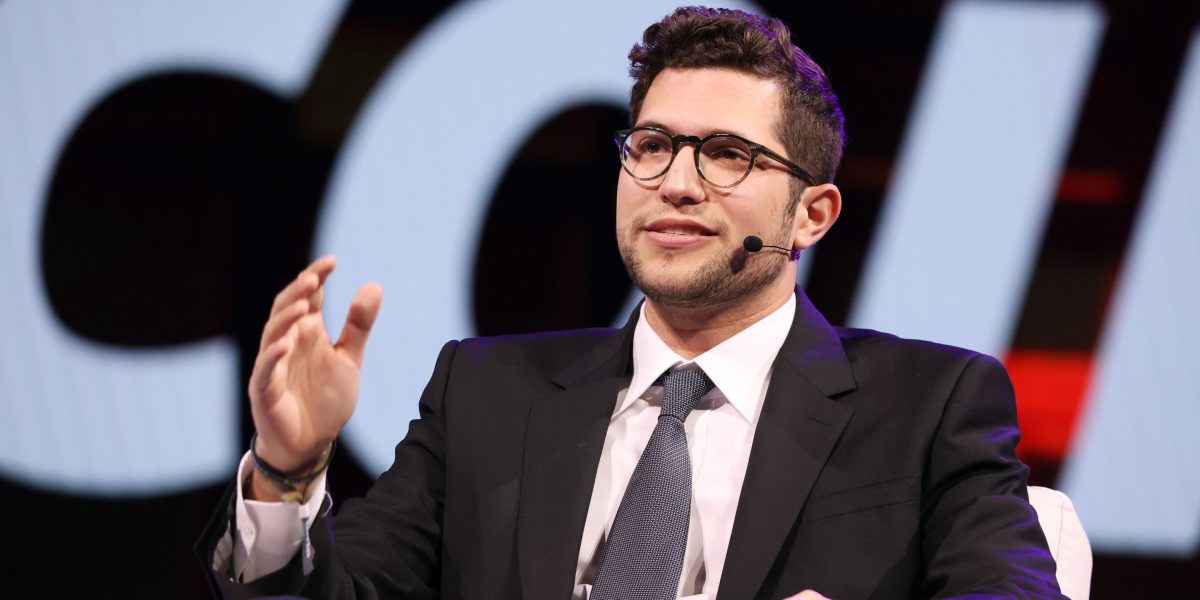




At the end of February, Rep. Jamie Raskin, ranking member of the House Judiciary Committee, sent a letter to Commerce Secretary Howard Lutnick and his son Brandon Lutnick, who took over as chair of financial services firm Cantor Fitzgerald, replacing his father as top brass when Lutnick took a spot on President Donald Trump’s cabinet.
Raskin demanded an investigation into Cantor Fitzgerald, which he alleged had engaged in buying the rights to tariff refunds from U.S. companies, offering those firms a fraction of how much they had paid in levies in exchange for the entirety of their tariff refund sum.
The letter cited reporting from Wired from July 2025, which said internal documents revealed the firm not only had “the capacity to trade up to several hundred million of these presently and can likely upsize that in the future to meet potential demand” but it has already put through a trade representing about $10 million of IEEPA rights.
Howard Lutnick was an early champion of tariffs who advocated for the levies to replace some income taxes. As a result of the Lutnicks’ close ties with both the Trump administration and Cantor Fitzgerald, the bank could have had access to nonpublic information that would have informed a decision to trade tariff refunds, Raskin claimed.
“That potential conflict of interest raises some troubling questions of federal ethics and insider trading,” he wrote. “Was the Lutnick family’s cornering of the market in this doomed endeavor a mere coincidence or something more orchestrated?”
Cantor Fitzgerald denied taking part in any trades on the tariff refund secondary market.
“Cantor Fitzgerald has never executed any transactions or taken any position on tariffs refund claims,” a spokesperson told Fortune in a statement. “In July 2025, certain Cantor salespeople explored brokering tariff trades, but Cantor never executed any transactions. All reports to the contrary are false. We will reiterate these points in our response to Ranking Member Raskin.”
Raskin’s scrutiny of the Lutnick family has brought to the surface an entirely legal and growing secondary market for tariff refunds that has quietly emerged as the levies under the International Emergency Economic Powers Act have come under fire, culminating in the Supreme Court striking down the tariffs last month.
With the likelihood of up to $180 billion in tariff revenue on the table to be refunded to U.S. firms and consumers—who have been shown to have paid for the majority of the import taxes—investment firms, hedge funds, and liquidation specialists are salivating at the opportunity to make millions from the mere potential of these refunds happening.
“Speculative markets are gambling, right?” David Warrick, executive vice president of supply-chain risk management firm Overhaul, told Fortune. “They basically look at it and say, ‘Is it going to be red or black?’ And they obviously saw an opportunity whereby, ‘If this goes the way we think it might go, the money that we could make is tremendous.’”
Betting big on tariff refunds
Like any speculative trade, the secondary tariff refund market was a result of traders deciding to take a gamble, in this case on the IEEPA tariffs being deemed illegal, necessitating the distribution of the tariff revenue. Importers approached hedge fund and other investment firm brokers, and in return for about a quarter, give or take, of the money they spent on tariffs, sold the rights to their refunds. If the refunds came, those investors would see the entirety of the returns.
For some U.S. companies hit hard by tariffs and subsequent supply-chain woes in need of cash flow, the prospect of immediate relief was appealing, said Alex Hennick, president and CEO of A.D. Hennick and Associates, specializing in distressed asset recovery and liquidation strategies. For others, the decision to sell the refund rights was worth it to not deal with shelling out resources for a legal team or the headache of understanding and then undergoing the process to receive the refunds.
“These hedge funds and these firms are really working closely with the government,” Hennick told Fortune. “They’ve done some of these processes in the past. It’s not something that’s brand new.”
This market emerged in earnest last fall, following the Supreme Court deciding to hear the case against IEEPA tariffs in September, signalling to speculators there was a real shot of the tariffs being struck down. The Supreme Court’s ruling, however, sealed the deal for these investors.
“The ruling pretty much said that they were right,” Hennick said. “It’s just a matter of going through that process and trying to recover as much as possible.”
There’s no exact dollar figure on the size of the market at this point, but Hennick told Fortune that anywhere between 15% to 50% of the claims could be sold or assigned to liquidation specialists or hedge funds. Overhaul executive Warrick said the market could swell to as large as $100 billion.
Chances of seeing returns
The Supreme Court’s ruling doesn’t mean the risk in this market is gone. The decision omitted any details about the refunds, leaving it up to lower courts, such as the Court of International Trade, to outline the process of how they would be doled out. Trump, for his part, has signalled he would fight the refunds, saying they could take years to litigate in court. Judge Richard Eaton of the U.S. Court of International Trade ruled on Wednesday that importers were entitled to tariff refunds.
“It’s very difficult to define a probability of success for the likelihood that folks will receive refunds,” Wes Harrell, a broker and head of a trading group at Seaport Global, told Fortune. “While I do believe that it will ultimately occur, I think that the big question is in what form and the timing, and how contentious it may be in the roadblocks or impediments that they may put up in order to receive a refund.”
Rathna Sharad, CEO of logistics platform FlavorCloud, said whatever the process, it will have some arduous components because of the sheer size of the dollar amount. The U.S. has had to dole out tariffs following lapses in the Generalized System of Preferences (GSP), which outlines import tax reductions for certain countries, though these refunds have historically been much smaller, about $3 billion at a time.
“There is no precedent to having done anything like this before,” Sharad told Fortune. “So it’s not going to be any kind of automated mailing checks back to folks that paid.”
How onerous this process is will help determine for companies if they want to seek a refund, sell tariff refund rights, or just not bother at all. Importers are the entities eligible for refunds, and many times, merchants are not the direct importers. There may be handshake deals or contracts that determine refunds companies are eligible for. Without proper record keeping from a company (which may also have seen tariff rates on their product change over the course of the year), the process of applying for refunds may also become more challenging.
“People are still trying to figure out where they shake out on this. Let the dust settle. Do some work. Talk to attorneys,” Harrell said. “It just feels like early days.”