








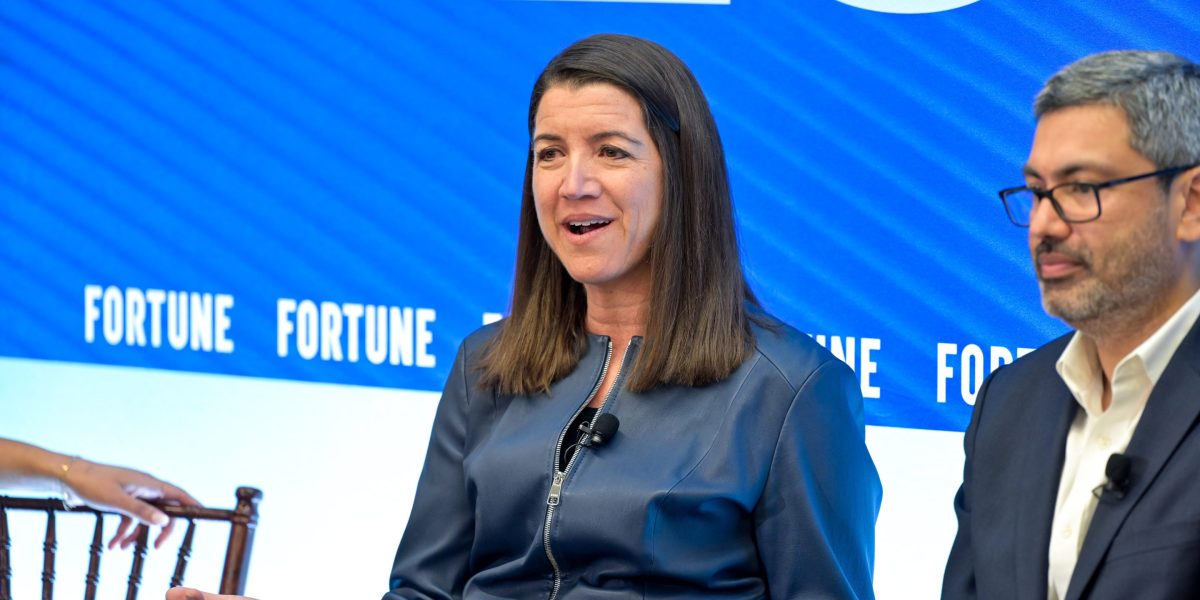
“To be able to trust, you need to be able to see what is happening.” This seemingly simple maxim is at the heart of today’s AI rollouts across the business landscape, according to Laura Heisman, the chief marketing officer of Dynatrace.
“That’s probably the biggest conversation that everybody is having across all industries. We hear it from our customers every day,” Heisman said recently on a panel at Fortune’s Brainstorm Tech conference. “The big question is, can you trust it? Is it right? And if it’s wrong, can you stop it?”
As businesses contemplate letting AI agents chain together sequences of tasks, each based on the output of AI models, trust is more important than ever. And the only way to build that trust, according to Heisman and other business leaders on the panel, is to build visibility and control into systems.
“For us visibility, traceability, is not optional, it is foundational. It is how we look at every decision,” said Nikhil Joshi, the chief information officer in the markets division at Citi, the financial giant that moves trillions of dollars every day across more than 100 countries
Citi spent much of 2024 building a centralized technological foundation for all its apps and agents, Joshi said. That foundation has made the company much more comfortable bringing agents into production.
“There’s only one single way to deploy an agent at Citi, and that’s through this central framework,” Joshi said. “That means every agent is registered through this process, every agent is monitored, every agent is audited, every agent is governed.”
At a time when everyone else seems to be plowing full speed ahead into AI, Citi’s deliberative and centralized tech system might strike some as too conservative. But, Joshi said, it actually helps you move faster in the long run. “Being AI conservative is not a bad phrase,” he said.
Experian Chief Innovation Officer Kathleen Peters concurred, and explained how the consumer credit reporting firm has created a system to manage the various agents being deployed, tracking the provenance of each agent, the human employee who created the agent, and the specific permissions to access data or carry out tasks that each agent has.
“When everyone in the ecosystem can understand those pieces, you build the trust that lets you scale, and run fast,” said Peters.
In the automobile industry, where the average time to introduce a new vehicle from design to production can take years, Ford is using AI to speed up certain parts of the process and to “fail fast,” said Sammy Omari, Executive Director, Advanced Driver Assist Systems and In-Vehicle Infotainment at Ford Motor Company.
The key, Omari said, is to have the right guardrails in place.
By way of example, Omari said that non-engineering employees such as designers can now contribute computer code for new car features that were developed through AI-powered “vibecoding” tools. That speeds up the time it takes to see what the new feature looks like in a test version of the car, and to quickly cut bait and move on if it’s a non-starter. If the idea proves to be a winner, the engineers then write the code from scratch, and that code goes into the car that ships to consumers. The designer’s vibecoding served only as an initial proof of concept.
“So the actual speed to market is going to accelerate,” Omari said, “but the QA process at the end, before we actually ship something to the customer, hasn’t necessarily changed.”
