

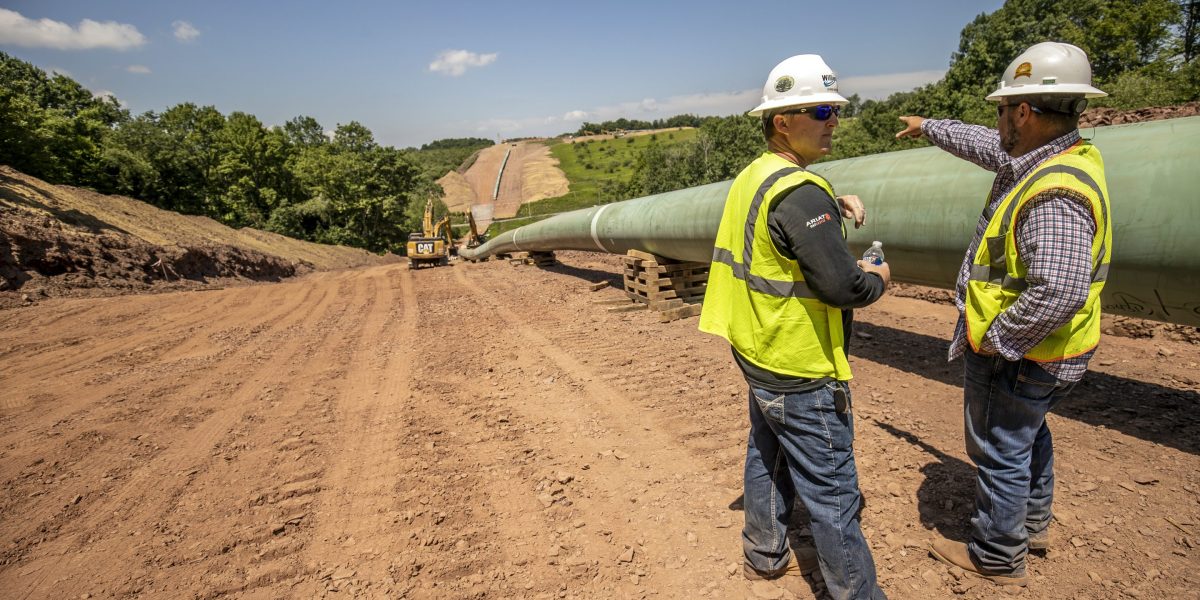



New pipeline construction is almost as hard to find in New York and New England as the Loch Ness Monster is in Scotland. But there’s now a NESE (pronounced “Nessie”) sighting in Brooklyn.
Oklahoma-based Williams Companies will break ground April 14 on the Northeast Supply Enhancement pipeline that expands its Transco natural gas network in New York, New Jersey and Pennsylvania.
“That’s the first pipe in New York in over a decade,” Williams CEO Chad Zamarin told Fortune. “What you’re seeing now is very broad [growth] across the U.S. footprint.”
Courtesy of a convergence of the AI data center power wave, rapidly growing export facilities, and population growth, the nation’s natural gas pipeline buildout is looking at its biggest growth surge in nearly 20 years—since the beginning of the shale gas boom.
While massive, long-haul pipelines are underway to liquefied natural gas (LNG) export hubs in Texas and Louisiana, a huge backlog of smaller gas pipelines or expansions is rising throughout the country from the Pacific Northwest to the Rockies and Midcontinent to the Southeast to connect data centers with gas-fired power.
“We’re trying to bring our capabilities to places where American companies and hyperscalers can’t get access to power and otherwise wouldn’t be able to build,” Zamarin said.
U.S. natural gas production was largely flat from 1970 to 2010, and then volumes spiked nearly 70% in a decade to about 100 billion cubic feet per day by 2020. Already having risen another 20% since then, production is projected to keep surging to about 160 billion cubic feet daily by 2040, driven by data centers and exports. The ample domestic supply is why the war in Iran hasn’t affected natural gas prices in the U.S., even while oil and fuel prices have spiked.
And, in order to keep the gas flowing and the data center dots connected, more and more pipe must plow into the ground.
“A few years ago, people were saying we don’t need more gas—ever,” said Hinds Howard, energy analyst for CBRE Investment, citing the pivot to renewable energy. “Now, technology companies that were the most net-zero people are clamoring for any power they can get, no matter if it’s gas or not.”
There are the obvious environmental concerns, but the overall demand surge and the need for power as soon as possible mean that both natural gas and renewable energy will continue to grow quickly.
The energy infrastructure analytics firm Arbo is tracking more than 150 gas pipeline projects nationwide that would provide about 150 billion cubic feet daily of gas supplies.
“I’d say there’s a far greater number of projects that are smaller in this buildout,” Arbo CEO Chip Moldenhauer. “But we’re sort of in the early innings when you look at the number of projects and the stages in which those projects are at right now. There’s a significant number…still in the very early stages. A lot more of this game has to be played.”
There’s still a big unknown about how large the AI boom will ultimately grow, and many more pipelines could still be built as new data center campuses commence construction, he said.
For now, the new pipeline construction isn’t close to meeting the projected demand, said Williams’ Zamarin. And the historical goals for a “boring, but very profitable” industry now has the potential for pipelines to take center stage.
“This is definitely an upcycle,” he added. “To get low-cost, abundant natural gas supplies to demand markets that really, really need it and want it, It’s all about the infrastructure in between—not just for the next five to 10 years, but for a very long time for our country. It’s going to be exciting; it’s not going to be boring.”
Growing market recognition
Just as stock market values have spiked for many utilities and power generators, so are the market caps for the gas pipeline developers. And Williams is the “poster child” for that growth, Howard said.
Williams focuses almost exclusively on natural gas—not the more stagnant oil and refined products markets—and expanded last year into the power business, including building power plants for hyperscaler Meta in Ohio.
As such, Williams’ market cap has surged about 90% in two years to nearly $90 billion, the highest for any U.S. pipeline player and second industrywide only to Calgary-based Enbridge.
In an increasingly consolidated industry, other pipeline players such as Kinder Morgan, Energy Transfer, Enterprise Products, TC Energy and the smaller DT Midstream also are on the rise. Others with less of a natural gas focus were being left behind. The crude oil-focused Plains All American Pipeline, for instance, had slumped, but is now seeing a bump from supply shocks from the Iran war. The growth story now and longer term, however, is focused on gas, analysts said.
The big differentiator for Williams of late is offering a “one-stop shop” for gas and power with both the gas pipeline growth and the gas-turbine procurement experience to now start building power plants. Williams has already announced $7.3 billion in power projects in Ohio and Utah with the potential to grow much more.
“This next five-plus-year period of growth is going to be very much focused on pipe and power,” Zamarin said. “That’s why we are focused on pipeline and storage projects, and we’re focused on bringing tailored power generation solutions directly to…data centers for hyperscalers.”
Williams also announced a goal of 10% or higher compound annual growth in adjusted EBITDA from 2026 through 2030, an admittedly high bar to achieve.
To wax philosophical, Williams is currently building the Project Socrates power project for Meta in New Albany with two gas-fired power plants—Plato North and Plato South—and a 20-mile pipeline slated to come online late in 2026. Williams also is developing the Apollo and Aquila power projects in Ohio and Utah, respectively. And, most recently, it announced the Socrates the Younger project in Ohio. All these combined would be enough to power nearly 1.5 million homes.
In terms of pipelines, Williams continues to focus on expanding its crown jewel Transco network, which runs more than 10,000 miles from southern Texas into the deepwater Gulf of Mexico and all the way up the Atlantic Coast to New York.
The Southeast Supple Enhancement expansion on Transco is Williams’ biggest project ever from an earnings contribution perspective in the company’s 118-year history, Zamarin said. The expansion will serve all the population and data center growth in Virginia, Georgia, Alabama, and the Carolinas, he said.
Expansions also are underway on Williams’ MountainWest Pipeline network in the Rockies and the Northwest Pipeline system, including for new demand from AI hubs.
“When you think about the Pacific Northwest, we haven’t had significant growth projects in 20 years,” Zamarin said. “That’s a market that hadn’t been open for any kind of growth and, now, is recognizing it really needs more gas supply.”
The Trump effect
Outside of gas-abundant and regulatory-lenient Texas and Louisiana, the last major gas pipeline built in the U.S., the Mountain Valley Pipeline, took more than a decade and a literal act of Congress before it came online in Virginia and West Virginia.
So, building enough pipelines to meet the potential data center demand won’t happen easily. A pipeline-friendly Trump administration helps, but Zamarin and industry advocates want more tort reform and congressional permitting reform, expediting everything from pipelines to electric transmission to renewable energy projects.
When President Donald Trump started talking in February 2025 about building the defunct Constitution Pipeline in New York, it caught former Williams CEO Alan Armstrong by surprise, he confessed.
After all, Constitution is a large Williams gas pipeline project that would service New York and the entire New England region. Williams had canceled the project in 2020 because of regulatory and permitting woes in the difficult-to-build region. And Trump hadn’t spoken with Armstrong before he talked about reviving it.
Williams also had killed the Northeast Supply Enhancement project in 2024 for similar reasons.
Although New York Gov. Kathy Hochul denied any quid pro quo, after the White House removed its block on New York’s Empire Wind project, Hochul decided to support NESE, which Williams initially prioritized reviving over Constitution largely because it’s smaller and easier. Williams also wants to resuscitate Constitution.
Even though NESE has some unresolved permitting issues in New Jersey and pending environmental lawsuits, the groundbreaking is moving forward. Earthjustice, the Natural Resources Defense Council, and others are suing.
Energy analysts see NESE’s success—or potential failure—as a litmus test for building more pipelines in the Northeast, including Constitution, and even nationwide.
“NESE would be a bellwether for litigation,” Arbo Chief Operating Officer Craig Heilman said. “That would be symbolic of what the current disposition of the large environmental opposition groups are. There’s been such a big sentiment change globally from energy transition to energy dominance, or all-of-the-above energy.”
In the meantime, the Federal Energy Regulatory Commission is fast-tracking pipeline projects to the extent its staff is able. But the real goal for industry is Congress approving permitting reform, which has tried and failed multiple times in recent years.
“I think there’s this growing recognition that we have a lot of potential as a country,” Zamarin said. “I’ve been calling it our superpower: our ability to produce natural gas. But we have this infrastructure limitation that is holding us back from reaching our full potential.”
Zamarin took over as CEO from a retiring Armstrong in July. In March, Armstrong was sworn in as the new Republican junior senator for Oklahoma, filling in on an interim basis for Markwayne Mullin, who vacated the seat to become the new U.S. secretary of Homeland Security.
Armstrong’s top priority as new senator? Permitting reform, of course.
“We need to retool American industry and its ability to scale up and build things,” Zamarin said.