



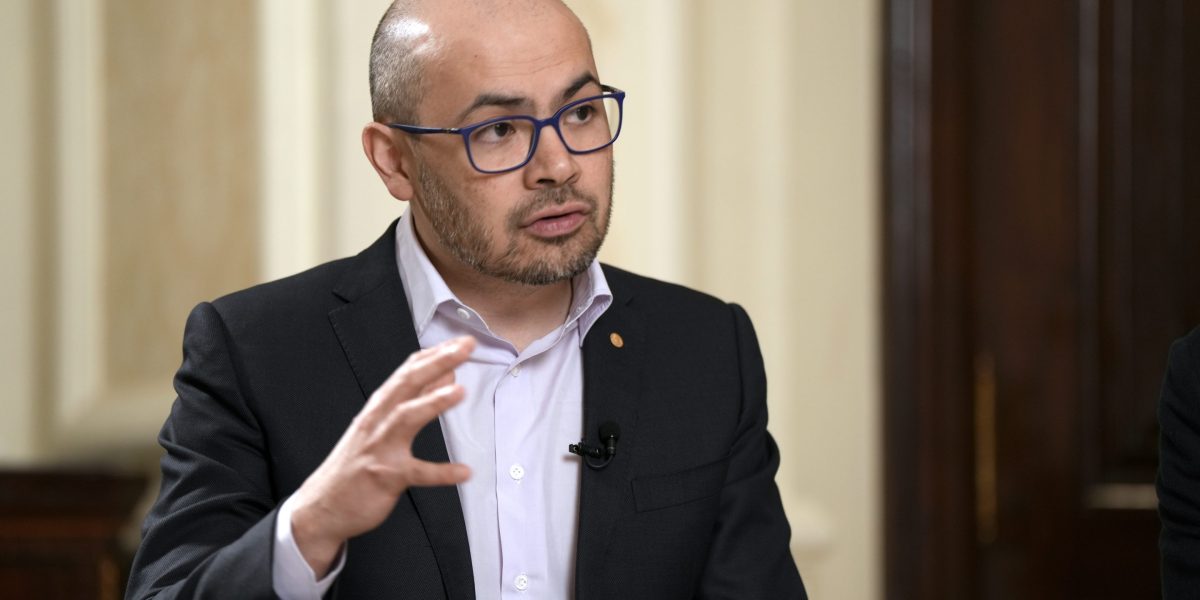
Good morning. Not every CEO will have a book written about them. But if they do, what should they try to get out of it? For Demis Hassabis that moment has arrived with the publication of The Infinity Machine, the new biography written by Sebastian Mallaby (author of More Money Than God on hedge funds and The Man Who Knew, the biography of Alan Greenspan).
Hassabis, co-founder of DeepMind and Isomorphic Labs, knows that the book changes his relationship with the public. “I am a pretty private guy,” he said at a launch event in London this week. The 1,000-seater venue was sold out, filled with a mix of young people keen to know about the future of work and older generations concerned that artificial intelligence will upend the world as we know it.
I was there, alongside the academics and senior technology executives, to listen to one of the few Tech Gods to work outside the hothouse of the U.S. and, more specifically, Silicon Valley.
Here are my three takeaways from the 60-minute conversation:
AI leadership needs to be dispersed. Hassabis finds London attractive as the headquarters for Google DeepMind because it is not in America. He has nothing against Americans, of course; Alphabet has owned DeepMind since 2014. But he believes we need different centers of excellence around the world to mitigate the risk of AI becoming a product of a certain way of thinking. “The people that are making artificial intelligence shouldn’t just be from 20 square miles of the U.S.,” he said. “It’s going to affect the entire globe. So I think a global perspective on AI, what it should be used for, how it should be deployed, the ethics of it, the technology itself, [is important].”
The commercial race isn’t the most important one. Amid all the commercial noise on who is winning the chatbot war—Anthropic, OpenAI, Google, Perplexity, a host of others—we are probably missing something more fundamental. Who is providing the guardrails to mark the boundaries of acceptability? “At the back of my mind, I’ve got this gnawing feeling that there’s something much more important, much bigger than the commercial race, which is getting AGI safely over the line for humanity and to make sure that the benefits fully outweigh the risks. And, you know, I’m going to try,” Hassabis said. In the present geopolitical environment, he admits such a task is going to be “very hard.”
Education needs a rethink. It sounded like a throwaway point but actually wasn’t: Hassabis argued that we need to completely upend education so that learning in the classroom is a collaborative process between pupils and teachers (how to solve problems, find new pathways) rather than a traditional place to “learn” facts and figures. “We should be really reconsidering education from the ground up…invert the classroom, so that it becomes more about collaboration and project-based and creative problem solving,” Hassabis said. “Then you do the rote learning outside of the class, where you do it with your AI systems and it is personalized to you.”
The first takeaway is fact, and it works. The second is a hope that is one almighty challenge. And the third is a suggestion about the future that should happen, and if it doesn’t we should be asking politicians and teachers why. For my full piece on Hassabis and the future of AI—and what he thinks “doing his best” really means—read more here. —Kamal Ahmed
Contact CEO Daily via Diane Brady at diane.brady@fortune.com
Top leadership news
Everyone’s got ‘AI anxiety’
It’s not just workers who are anxious about AI. Founders are too. The fear of not moving fast enough is consuming Silicon Valley founders, according to Andreessen Horowitz co-founder and general partner Ben Horowitz. The most anxious are those who built their companies before AI and now are in a rapidly-changing market with new rules of competition.
Allbirds pivots to AI
Two weeks ago, Allbirds, the wool sneaker makers once valued at $4 billion, sold itself for $39 million. Naturally, on Wednesday, it pivoted to AI and unveiled a new name, NewBird AI, despite having no history in the field. The result? Its stock quickly surged over 600%.
How much will the Iran war cost?
One expert is sounding the alarm on the ultimate cost of the Iran war. Linda Bilmes, a Harvard Kennedy School public policy lecturer and author, says she is “certain” the U.S. will spend $1 trillion for the war, adding: “Perhaps we have already racked up that amount.” The estimate dwarfs initial spending projections on the conflict.
The markets
S&P 500 futures are up 0.14% this morning. The last session closed up 0.80%. The STOXX Europe 600 was up 0.23% in early trading. The U.K.’s FTSE 100 was up 0.21% in early trading. Japan’s Nikkei 225 was up 2.38%. China’s CSI 300 was up 1.10%. Hong Kong’s Hang Seng was up 1.74%. South Korea’s KOSPI was up 2.21%. India’s NIFTY 50 is down 0.40%. Bitcoin was up to $75K.
Around the watercooler
Exclusive: Artemis raises $70M to help fight AI-powered attacks with AI by Sharon Goldman
How a free tax filing system from the government went from 296,000 users to zero in just one year by Catherina Gioino
The hidden menace behind Big Tech’s AI arms race: Meta, Amazon, and others are spending billions on hardware that’s worthless in 3 years, says CEO of Research Affiliates by Shawn Tully
Economists warned California not to raise the minimum wage to $20. They were wrong in almost every way so far, another economist says by Sasha Rogelberg
This CEO has teamed up with Google, Microsoft, and McKinsey to build an AI degree that could rival Harvard—and it will only cost $10,000 to attend by Preston Fore
CEO Daily is curated and edited by Andrew Wyrich, Jason Ma, Claire Zillman, and Lee Clifford.