



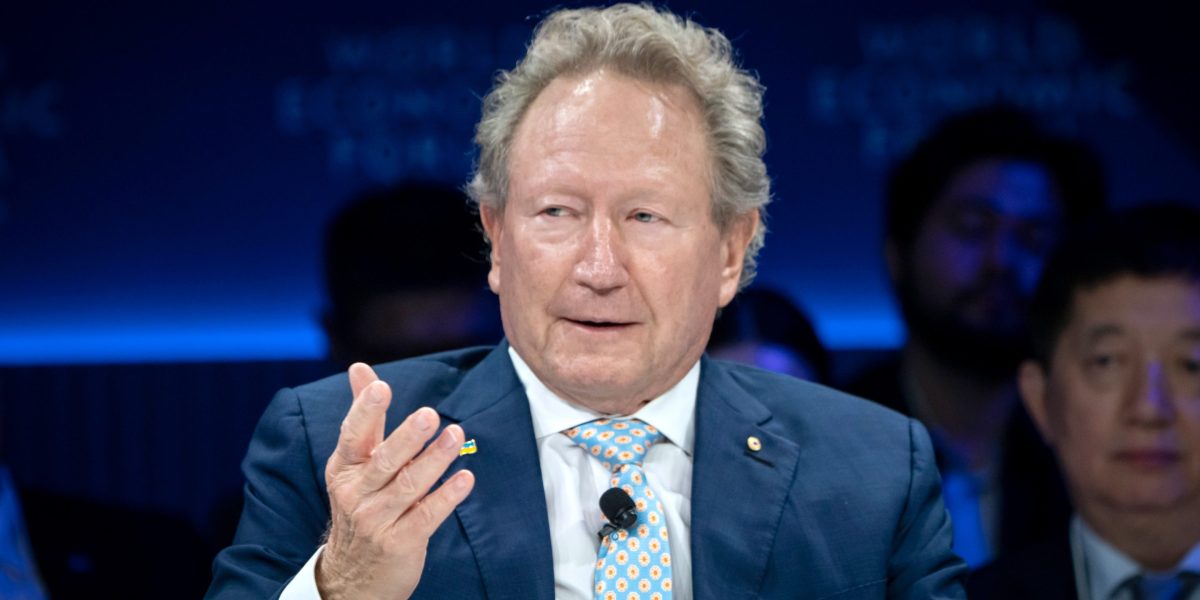
It was late 2015 when Fortescue CEO Andrew Forrest was hiking through a remote region of Australia known as the Kimberley, and slipped into a gorge. The freak accident left Forrest, the founder and chairman of the metals giant, facing many months of recovery, and prevented him from running his $56 billion mining company.
Fortescue’s leadership now comes with the insight from a PhD in marine ecology, a four-year course which Forrest took during his recovery that reshaped the way he runs one of the world’s largest iron ore producers.
Speaking on the “In Good Company” podcast with Norges Bank Investment Management CEO Nicolai Tangen, Forrest recounted the accident a decade ago, which happened as he was hiking through remote canyons.
“Part of this climb involved going around a ledge over a large pool of water and the ledge gave way, and I slipped into the water,” he said. “My leg got caught on a tree root … and it snapped my leg like you would snap a matchstick. But it went the wrong way, it went the opposite way to how knees normally bend.”
Forrest believes he passed out from the pain, saying when he came to, he was “looking up at the surface of the water, and it had gone still, like a mirror. I realized that a) I was on my own, b) I was drowning, and c) I’d been there for a little while because there were no ripples in the water.”
The CEO recalled that in order to haul himself out of the ravine—in an area infested with crocodiles—he had to break his leg even further to extract himself from the bank and get his head above water.
Forrest was then found and flown by helicopter for surgery, and it took years for him to fully recover. The former stockbroker said at that point, he was unsure whether he would walk again, or whether his leg would need to be amputated.
At the time of writing, Forrest and his family are worth more than $24 billion, per Bloomberg, and the entrepreneur is back at the helm of Fortescue (recently hit with a class action lawsuit alleging sexual harassment on remote work sites).
A turning point
The “unhappy” time after the gorge fall was reframed by Forrest’s three daughters, he recalled, who reminded him he had always wanted to study the oceans.
Forrest and his ex-wife, Nicola, had previously expressed their intention to support social and environmental causes. The pair signed The Giving Pledge in 2013, writing to founders Bill Gates and Warren Buffett that they planned to give away the majority of their wealth. The Minderoo Foundation, named after the cattle and sheep ranch where Forrest grew up, supports everything from deep-sea preservation to the performing arts.
Initially, Forrest intended to study for a master’s in marine studies but was told his work meant he was already overqualified: A PhD was the only option.
“And so, I applied for a four-year PhD,” Forrest added, saying he wanted to study oceans “because it’s the most important part of the planet by a mile … from top to bottom, it’s full of life. It doesn’t matter if it’s in the bottom of the Mariana Trench or on the coast of Norway, it’s full of life.”
Forrest’s studies made him want to change the way his company operated with regard to the environment, he told Tangen, but in the mining and heavy industry sector, that is no small task. The CEO brought in new targets: “real zero”—a bid to decarbonize all operations.
“If you don’t believe in climate change, well, you’re an idiot. But if you don’t, fine,” Forrest said. “But believe in a better life. Believe in a lower cost of living, believe in a lower cost of energy, that’s green.”