




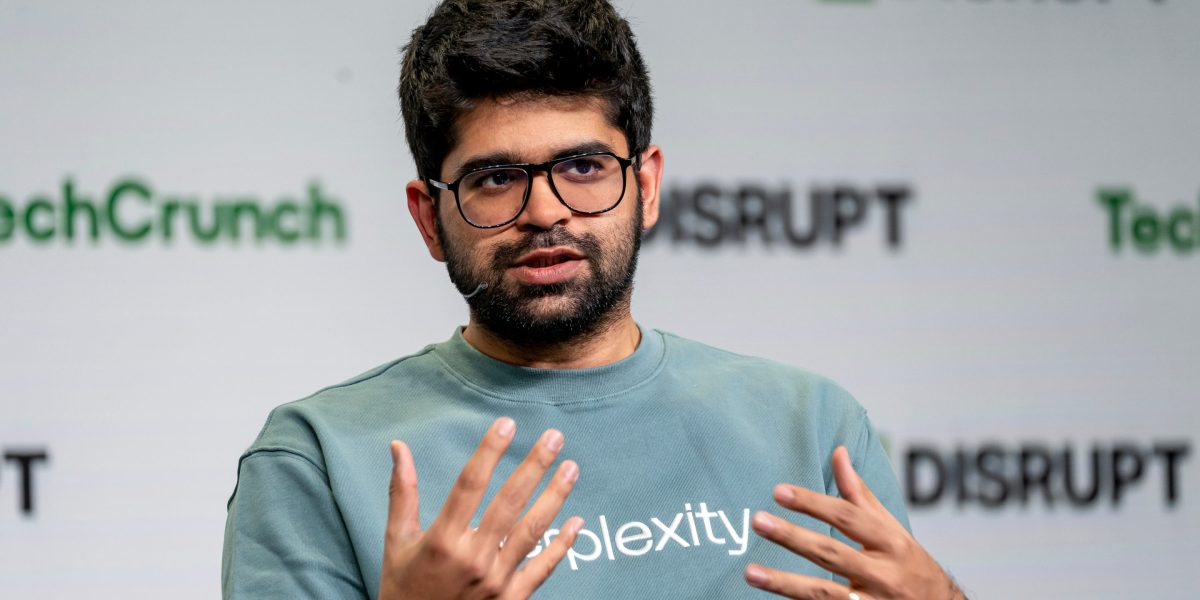
As workers grapple with layoffs, AI disruption, and the constant pressure to prove their worth, self-doubt can feel like an unavoidable part of building a career. But Aravind Srinivas, the CEO of AI giant Perplexity, says that operating under the fear of failure only holds back success. He carved out his place in the trillion-dollar tech race by focusing on the thrill of winning.
“I have nothing to lose,” Srinivas recently said on the 20CV with Harry Stebbings podcast. “I came from nothing. I never even imagined myself to be doing all this. So my life has already been extraordinary beyond any level of imagination.”
In 2022, he cofounded the 30-year-old founded Perplexity, which has since reportedly raised at least $1.5 billion in total funding, its market cap estimated to be around $18 billion, or even potentially $20 billion, as of 2025.
But growing up in Chennai, India, in a financially lower-middle-class family, he said that simply having a job was the bar for success.
And the AI prodigy outshined in every measurable way, receiving a bachelor’s degree with a specialty in electrical engineering at the esteemed Indian Institute of Technology (IIT). The year after he graduated, Srinivas landed a research internship at OpenAI, then at Google DeepMind—the job most coveted by his family. So now, anything more is just the cherry on top of an already extraordinary career.
“All we wanted to do was get a job in [sic] Google. Being an engineer at Google was considered a win,” the CEO continued. “I’m already doing remarkably well compared to that ambition we had as a family, so there’s really nothing for me to lose.”
“That’s why anytime I try to act like I’m trying to avoid failure, I’m being on the defense, I remind myself that like that’s the stupidest thing to do,” Srinivas said. “It’s better to go all in and try your best. Be on the offense all the time. Attack, attack, attack.”
Leaders find success by taking risks and getting comfortable with the uncomfortable
Ryan Smith, the former CEO and founder of cloud-based software platform Qualtrics, agrees that it’s critical to push boundaries in order to succeed. In fact, he winces at past memories of not following his own advice. If every company’s new hire, products, and acquisitions are all “safe,” then it’s clear nothing revolutionary is on the horizon. Smith says taking smart risks to stay on the cutting edge is essential.
“My biggest fear as a CEO is that people will stop pushing the boundaries,” Smith wrote for Fortune in 2016. “Some of my biggest regrets are when I had a big idea and didn’t hop on it fast enough or go all the way because I was afraid of failing.”
Even being put in uncomfortable and fierce work environments can be a huge growth opportunity.
Amit Walia, the CEO of software company Informatica, said being “pushed around” earlier in his career set him for success as the boss of a $7.6 billion business. Walia spent nearly five years at consulting giant McKinsey as a senior engagement manager, and looks back on his stint as “intense” and daunting. However, Walia says it was immensely rewarding in advancing his skills as a tech leader.
“You really get pushed into difficult situations [at McKinsey]…You have to always have a clear bent of mind to be very analytical, to really distill out the problem to its core,” Walia told Fortune earlier this year. “You become a better person by being pushed around by the environment of a lot of other smart people.”
Joanna Griffiths, the CEO of $400 million intimates company Knix, has even worked with a hypnotherapist to help “rewire” her brain—particularly, on her fear of failure. Through their hour-long biweekly sessions, Griffiths has been learning how to make smarter decisions “out of a place of optimism, instead of fear.”
“We put so much emphasis on the fear of failure,” Griffiths told Fortune earlier this year. “We often don’t allow ourselves to think it the whole way through and be like, ‘Okay, if this actually did fail, what’s the thing that’s going to happen? Do I still have my family? Do I still have my health? Do I still have my internal knowledge?’”