





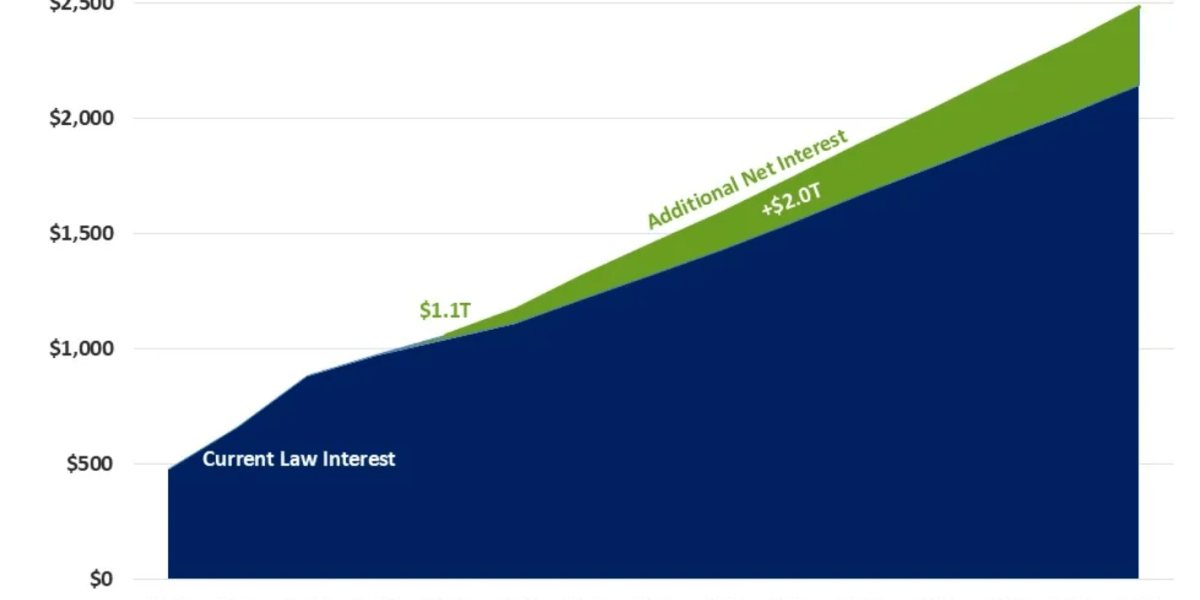
The federal government already spends more on debt interest than on Medicaid, national defense, or all non-defense discretionary programs combined. Now, with the 30-year Treasury yield surging past 5.19% — its highest level in almost 20 years — a leading fiscal watchdog is warning that what was already a crisis could turn into something far worse.
According to the Committee for a Responsible Federal Budget (CRFB), interest costs consumed a record 3.25% of GDP and roughly 19% of all federal revenue in fiscal year 2025. If Treasury yields remain elevated at current levels — roughly 55 basis points above Congressional Budget Office projections across the yield curve — interest costs would grow 2.5-fold, climbing from $880 billion today to $2.5 trillion by 2036. That would push debt interest’s share of federal revenue to almost 30% — nearly triple its historical average over the past half-century.
A compounding spiral
The numbers are staggering in their own right. But CRFB warns the real danger lies in the mechanics behind them. When the average interest rate on the national debt exceeds the economic growth rate — what economists call r>g — debt can begin rising rapidly and uncontrollably. Under the elevated-rate scenario, that gap would reach 75 basis points by 2036, making it increasingly difficult for even responsible fiscal policy to stop the spiral. The combination of high debt levels and a large gap between r and g can lead to a debt spiral — where rising interest costs boost debt, rising debt boosts interest rates, and rising rates boost interest costs further.
The bond market has been climbing for weeks, with the 30-year Treasury now sitting at 5.198%. Part of the pressure comes from the Strait of Hormuz closure, which rattled energy markets and stoked inflation fears. About two-thirds of investors surveyed by Bank of America Research now believe the 30-year yield could break 6% within the year.
There’s also a wilder card in play: Kevin Warsh. Trump’s pick to chair the Federal Reserve is, in the words of University of Virginia economics professor Eric Leeper, an unknown quantity — and markets are pricing in the uncertainty. “It’s not so much that people have no confidence in Warsh,” Leeper previously told Fortune. “It’s that they’re not sure what they’re getting”.
A recent Treasury auction of 30-year T-bills at a 5% rate drew only “middling” demand, according to the Financial Times — a weak signal from investors who fear inflation will slowly erode their returns over the long end.
The fiscal consequences extend well beyond the government’s own ledger. Higher Treasury yields push up interest rates across the economy, including mortgages, car loans, and business financing. A 55-basis-point increase in mortgage rates would add almost $200 per month to a $500,000 30-year mortgage — and nearly $65,000 in lifetime costs. For a million-dollar mortgage, the same rate shock adds $350 per month and nearly $130,000 over the life of the loan.
By 2027, under the high-rate scenario, interest costs would overtake Medicare spending to become the second-largest government program — eclipsed only by Social Security. By 2036, the government would be spending nearly as much on interest as on Social Security’s entire retirement program.
CRFB’s prescription is blunt: lawmakers must work to bring interest rates down and prevent high rates from crowding out other priorities or sparking a fiscal crisis. The most effective lever, the group argues, is deficit reduction — which can ease near-term inflationary pressure, take downward pressure off long-term yields by reducing economic crowding-out, and shrink the debt stock on which the government pays interest. “With debt approaching record levels,” CRFB writes, “there is little time to lose”.