




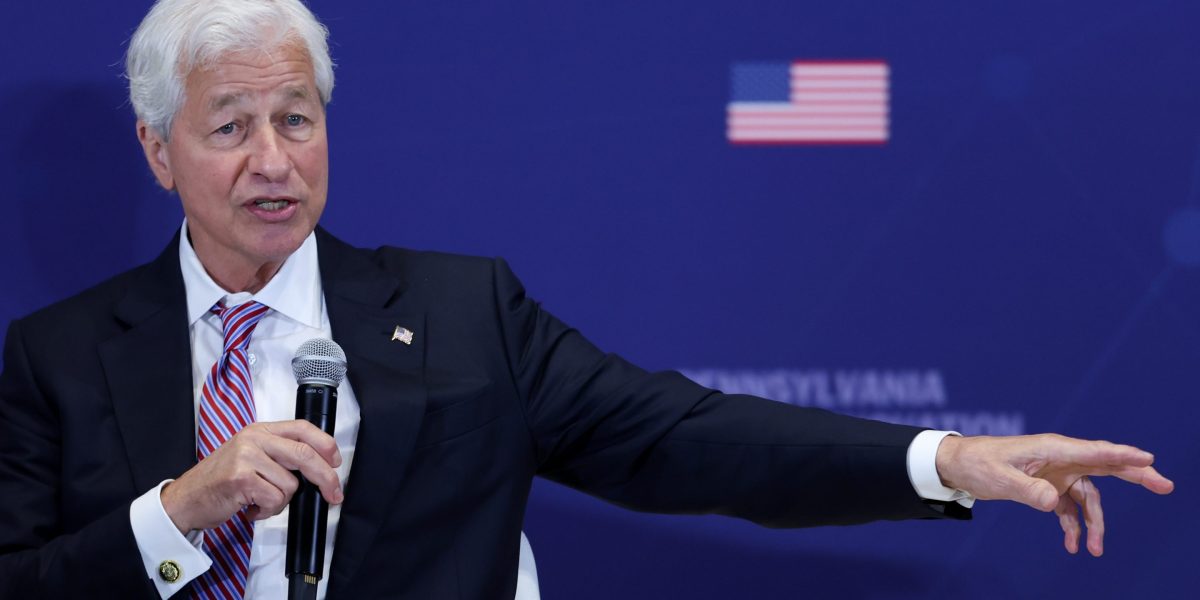
Jamie Dimon has a warning for Americans accustomed to the dollar sitting atop the global financial system: U.S. military supremacy may be one of the things keeping it there.
The JPMorgan Chase CEO said the U.S. risks losing the dollar’s status as the world’s reserve currency if the country can no longer boast the world’s strongest military and economy in the future.
“If we’re not the strongest military in 25 years and the strongest economy, we won’t be the reserve currency either,” Dimon told PBS over the weekend. “The world will be fragmented, and it’ll be very dangerous for us.”
While it might initially seem like the armed forces have nothing to do with the greenback, American military and economic might are “tied up inextricably together with the dollar,” according to Daniel McDowell, Syracuse’s Moynihan Institute of Global Affairs Associate Director.
“He’s more or less saying that a weak military is a sign of a weak economy, and you would expect that the currency would kind of follow suit,” McDowell told Fortune. “If you think of the economy as being the underlying foundation of dollar dominance, the military is the icing on the cake.”
While the international finance expert emphasized that economic strength is the strongest indicator of the dollar’s strength, he also outlined several scenarios in which dollar dominance could take a hit even with a strong U.S. economy because of a weakened military. One of them is international relations: If allies believe that the U.S. is vulnerable to attack and isn’t capable of defending itself, they’d start to worry about their dollar-denominated assets there.
“A strong military makes a currency more appealing because it’s a signal to foreign investors that their assets are safe,” McDowell said. “It matters because a strong defense projects security of assets in a way that is distinct from the financial regulations in a country.”
Similarly, if the U.S had a weaker military and U.S. allies worried it wouldn’t be able to come to their defense if needed, they wouldn’t have the same incentive to buy Treasury bonds and invest in the country.
“The argument would be that if the United States can no longer defend other countries, those countries see the dollar as a bit less appealing because in the current state, loaning dollars to the United States government helps the U.S. pay for the defense that you benefit from,” McDowell said.
Another scenario is if the U.S. entangled itself in an all-out conflict with a rival like China or Russia and “loses decisively”. Markets would react and the world could view the country as diminished, an attitude that “might leak into the dollar.”
“I don’t think Iran’s a great case here because it’s not an all-out war, but in the future scenario where the United States does get engaged or would get engaged theoretically in an all-out conflict, and and with with a major power, and come out without a victory,” McDowell said, “I think that would have implications for the U.S–both its its political, but also its economic reputation, and that would have implications for for the dollar in terms of how overseas investors view that.”
But institutions and economic dynamism—how fast an economy innovates and shifts resources—also play a role in the dollar’s strength. Eswar Prasad, a senior fellow in economic studies at the Brookings Institution, told Fortune those factors “are far more important to a reserve currency’s status than an economy’s size or military power,” but acknowledged their role.
“Of course, a weakening of U.S. economic and military power and an erosion of its domestic institutions as well as geopolitical influence will hurt the dollar’s dominance, even though the lack of any serious rivals will prevent it from being displaced as the dominant international payment and reserve currency,” Prasad said.