



In 2023, Cognizant researchers made a prediction that, by their own admission, made people think they’d lost their minds: by 2032, 90% of jobs would be affected by generative AI, with roughly 10% facing transformational change.
“Everyone thought we were crazy,” said Ollie O’Donoghue, the firm’s head of research, speaking at Fortune’s COO Summit in Scottsdale, Arizona. But turns out, they weren’t crazy enough.
Three years later, O’Donoghue and his colleague Sushant Warikoo, chief business officer of AI, presented data showing that 93% of jobs are already AI-capable — and 30% are now facing existential change. The 2032 threshold arrived in 2026.
Even the plumber or electrician, those blue-collar careers recently advertised as AI-proof, aren’t found to be so in Cognizant’s analysis. “Nobody’s safe,” O’Donoghue said.
Plumbers, for example, will still be needed to physically repair pipes, but much of the work surrounding the job—from diagnosis to paperwork—could increasingly be reshaped by AI.
“You’ll still need someone to turn the wrench, no doubt, but the actual process of plumbing and the value that’s added will change a little bit,” O’Donoghue added. “One of the things is the massive integration of AI into manual work—and as we start exploring things like physical AI, it makes things even more comp
The plumber remains a useful example of why even careers considered “AI-proof” may not be immune. The physical work itself may remain human, but many surrounding tasks could increasingly be automated or AI-assisted.
“However, a multimodal reasoning agent today could notice a damp patch on a wall, infer a leaking joint, draft a repair plan and even generate an invoice or parts list,” the report stated. “The plumber still fixes the pipe, but the inspection, diagnosis and supportive actions that lead up to or follow it can increasingly be assisted by AI.”
Even with AI-driven layoffs, more jobs are on the horizon, according to Cognizant exec
While companies like Meta, Microsoft, and Amazon have cited AI-driven efficiencies as part of recent workforce reductions, not everyone sees the technology as a net negative for jobs.
Warikoo argued that artificial intelligence is more likely to reshape work than eliminate it altogether—creating entirely new opportunities in the process.
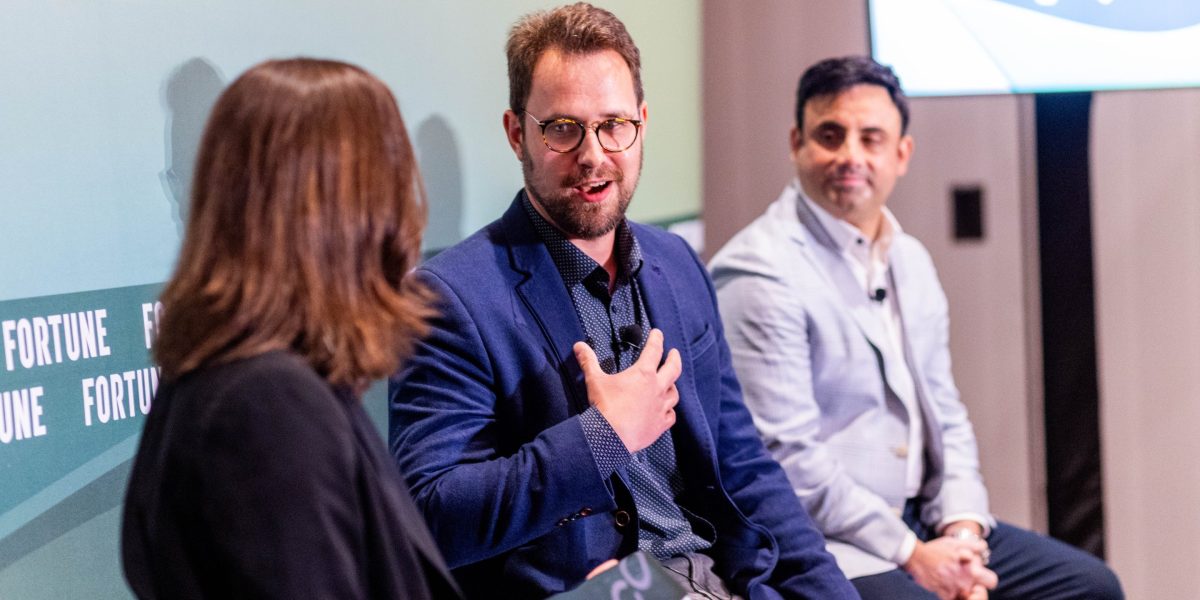
“We believe that it’s going to create and expose new value pools that are not visible to us,” Warikoo said in conversation with Fortune’s Kristin Stoller. “This is the underdraft of the market. And when that happens, it creates a lot more social economic development–that creates new jobs, new roles in the market.”
The pace of those new opportunities may not come as quickly as some workers hope. But, Warikoo argued, job creation will stem from people and businesses learning how to adapt to technological change and reimagine how work gets done.
“The 80% left comes from the misprocessed reimagination and the change management that’s needed for an enterprise to truly adopt the technology. This is a big change. It’s an operating model change.”
In other words, AI is not just changing what people do at work—it’s reshaping how organizations function, how employees collaborate, and how businesses are built.