



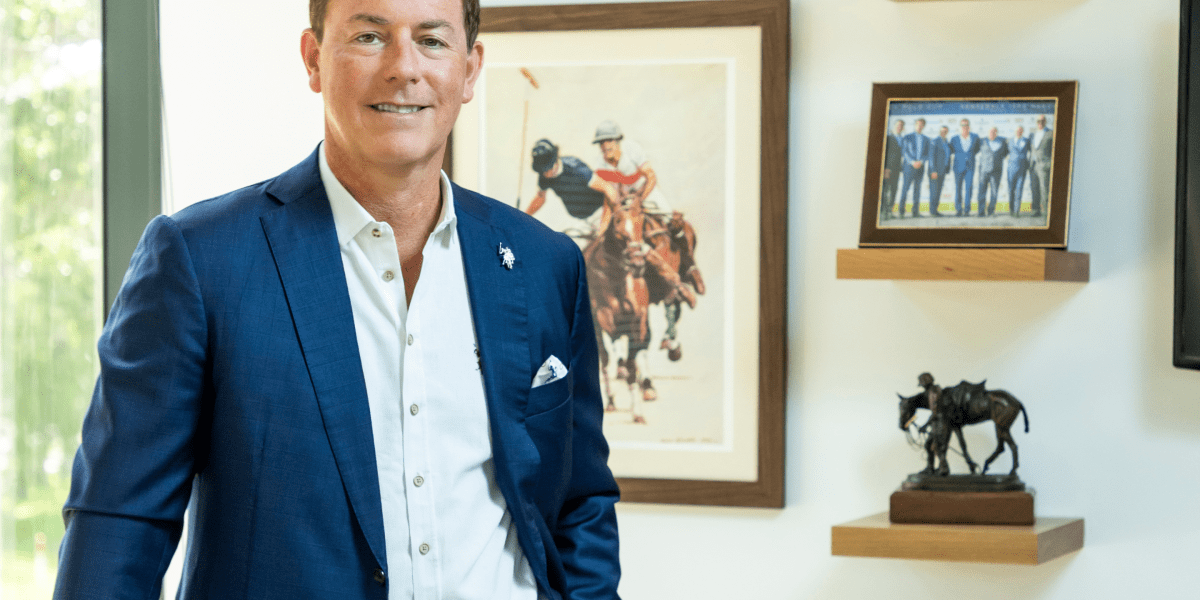
Today, he hosts polo events with Prince William and runs a $2.7 billion empire—but J. Michael Prince’s first taste of leadership was a complete accident. Not only that, he was almost passed over entirely.
When the CFO role opened up at Converse in 2005—then freshly acquired by Nike—Prince had been on the payroll for barely half a year. The company made it plain he wasn’t in the running; he was simply there to keep the seat warm while they headhunted. But instead of feeling rejected, the now-CEO of US Polo Assn. treated it as a deadline to prove them wrong.
“They literally told me, ‘You’re not our person, you’ve been at Nike for six months… you’re not really one of us, and we’re going to pull someone from the inside that’s been with us for a long time,’” Prince exclusively told Fortune.
“You’re not going to get the opportunity, but we need you just to kind of keep the ship going until we figure out who’s going to be in that position,” he added. “And I thought, I’ve got six months to prove myself.”
“I’m going to outwork anybody they’ve ever seen in any of these roles, and I’m just going to make it happen on my own.”
That he did, grinding 90-hour weeks, sometimes pulling all-nighters to prove himself.
“It was one of those where, when big opportunities and big challenges presented themselves, that’s when you say, I really have to step up and put in the extra time…. I’m going to take it on, I’m going to do it with a smile on my face, and I’m going to do my best to deliver excellence,” he recalled.
Many would have walked away from being told they’re not enough, feeling defeated. Prince saw it as a challenge. “When you’re in that position, it makes you want it that much more. It makes you work that much harder,” he says. “It’s a motivator—that little chip on your shoulder to prove everyone wrong.”
It worked. Nike gave him the role, and that same relentless drive followed him to US Polo Assn., where he joined as COO in 2017 and was promoted to CEO just eight months later.
The U.S. Polo Assn. CEO grew up in one of America’s poorest regions—here’s his career advice for Gen Z
That accidental CFO role turned out to be the foot in the door of an industry Prince admits is notoriously hard to crack from the outside. From Converse, he climbed to CFO of Nike Affiliates—overseeing a $4 billion portfolio including Cole Haan, Hurley, and Umbro—before crossing into luxury fashion as COO of Guess, then US Polo Assn. Today, he oversees 1,200 retail stores spanning 190 countries, and co-hosts charity polo events at Windsor Castle alongside Prince William.
And he did it from southeastern Oklahoma, one of the poorest corners of America, with a degree from a small regional university most hiring managers had never heard of.
When asked what made him stand out amongst his peers, Prince doesn’t hesitate: “A great work ethic. Being respectful and considerate of others,” he said.
“Where I grew up, I had this personality where you try to find common ground with people, you try to get along. A lot of companies had people who were always challenging in a negative way—I just felt like I brought a positive energy.”
It’s why he recommends that Gen Z who want to emulate his success take on whatever challenge is thrown at them—with a smile on their faces, just like he did.
“You’re going to get a handful of opportunities in life—both personally and professionally—always be looking forward and be thoughtful when you see those opportunities about how do I maximize that opportunity that’s in front of me? Because it may not be there six months from now,” he added.
According to CEOs, the secret to success is simple
CEOs consistently agree that being in the right place at the right time can open doors, but simple, good old-fashioned hard work is what ultimately determines success. As Prince said: “A lot of great stories have come from seeing that opportunity, jumping on it, and making the most of it. I feel fortunate that I was able to do that.”
Likewise, Kurt Geiger’s CEO got his big break while his manager was out of town. Neil Clifford pinned down the company’s chief to get career advice—and immediately took it, saying yes to moving to a whole new city for a promotion. But when he got there, the store was failing, and the staff was stealing merchandise. He swiftly climbed the ladder after leading the shop’s turnaround.
And then there’s L’Oréal U.S. CHRO Stephanie Kramer, who said that saying yes to every single opportunity thrown her way played a big role in her career to the corner office at the world’s largest beauty company.
Meanwhile, Doug McMillon scaled Walmart’s ranks, from unloading trailers for $6.50 an hour at 17 to becoming the company’s youngest CEO since its founder, Sam Walton. By the time he announced his retirement earlier this year, he was earning a $26.3 million salary. And it was all thanks to volunteering to cover his boss.
“One of the reasons that I got the opportunities that I got was that I would raise my hand when my boss was out of town, and he or she was visiting stores or something,” McMillon once recalled in an interview with Stratechery.
He’d offer to step in for his boss in meetings and would put himself in leadership positions so consistently that he eventually became, in his own words, “a low-risk promotion”—because people had already seen him do the job.
But even when he was eyeing up a promotion, he kept his head down and made sure to prove himself in the role he was in. “The next job doesn’t come if you don’t do the one you’ve got well,” McMillon added.