





Liaquat Ahamed has spent his career studying the moments when the world’s financial system breaks down — the bad bets, the collective delusions, and the geopolitical accidents that tip economies into catastrophe. Right now, he says, he doesn’t like what he sees.
“Where we are today is frightening,” Ahamed, the Pulitzer Prize-winning author of Lords of Finance: The Bankers Who Broke the World, told Fortune in an interview. The historian, whose landmark 2009 book chronicled how four central bankers helped cause the Great Depression, was speaking about America’s national debt — now hovering around $39 trillion — and the mounting risks he sees in the global financial system.
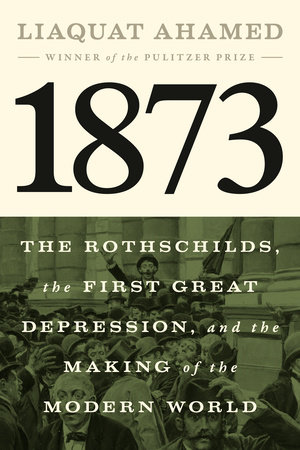
His new book, 1873: The Rothschilds, the First Great Depression, and the Making of the Modern World, examines a forgotten financial crisis that swept the United States, Central Europe, and the emerging markets of the Ottoman Empire and Egypt simultaneously — a global contagion that most people have never heard of. The parallels to the present, he says, are hard to ignore.
A clear similarity, he said, is the “craziness that markets develop when they’re in bubbles,” citing a quote from Cornelius Vanderbilt that, essentially, “building railroads from nowhere to nowhere is not a viable business.” You can sort of feel, he added, that one day “we will discover that building data centers, you know, willy nilly spending a trillion dollars a year on data centers for the next three years is bound to end in tears in the same way as the dotcom bubble ended in tears.”
But that’s not what really alarms Ahamed, he clarified.
The doomsday scenario
The scenario that worries Ahamed most isn’t abstract. It has a precedent — and it nearly happened once before in living memory.
In 2008, at the height of the global financial crisis, then-Treasury Secretary Hank Paulson was in Beijing when he learned that Russia had approached China with a proposal: dump their massive holdings of U.S. agency debt, and accelerate the financial meltdown already underway on Wall Street. “The Chinese very sensibly said no,” Ahamed recounted. But the episode left a mark on him. If the next financial crisis played out against the backdrop of extreme tension with China, he added, “you could imagine a lot of things happening that would not be … that would not work out.”
“Can you imagine, in the middle of a financial crisis, if one of our major foreign holders of our national debt decides, this is an opportune time to launch an attack on U.S. financial supremacy?” he said. It didn’t happen with China and Russia in 2008, he added, but he did stumble across a parallel in the research for his book. “That’s essentially what happened between Germany and France in 1873. And it damaged the world for 20 years.”
After defeating France in the Franco-Prussian War of 1870–71, as explained in the book (and which this author would recommend checking out), Germany sought to press its advantage financially — deliberately targeting France’s silver reserves in a bid to destroy its economic standing. The move triggered a global collapse of silver prices, froze half the world’s precious metal reserves, and helped ignite the cascading crises of 1873. The resulting depression lasted two decades.
Much like Lords of Finance explained how a fixation on gold in the 1920s led to central banking mistakes that would be laughed at today, Ahamed said he was shocked to discover silver’s essential role in the epic crash of 1873, now mostly forgotten. “The world ended up dispensing with silver, purely because of a geopolitical accident — in the middle of the crisis, Germany decides to double down by attacking France’s hoard of silver, thinking this is the way, you know, we already beat them in a military fight, now we’ll get them in a financial fight. And it had the totally unintended effect of causing everyone to bail out of silver, causing silver prices to collapse.” Germany may have gotten one over on France, but it also had the effect of essentially freezing half the world’s precious metal reserves. Oops.
Ahamed, who speaks with a clipped, distinguished British accent that sounded to this American’s ears like the BBC’s Received Pronunciation, explained that he grew up in Africa before moving to the U.K. and the U.S., and that he’s struck by how different the economic history is for his kids. The famous “cross of gold” speech by William Jennings Bryan holds a central place in American history that it doesn’t elsewhere.
“That came as a real light bulb going off in my mind,” he said excitedly. “Suddenly, I understood why there was such a giant debate about silver in the the last 20 years of the 19th century.” Ahamed added that this world featured many colorful characters and commentators, as a young Mark Twain commented on the financial panics of the day but also it was one of the few times that Karl Marx was right in prognosticating the downfall of capitalism, for once. Ahamed laughed when I asked if Marx was something like the Michael Burry of his day. “He had a dour view of the future,” he allowed, adding that it’s “hard to imagine Karl Marx as Michael Burry.”
The question Ahamed was left with after his research is how Germany and France set off a butterfly effect in the 1870s. Could China do the same to the United States, at a moment when Washington is least able to absorb it?
Financial crises, he said, “don’t occur in a geopolitical vacuum.”
The slow build, the sudden snap
Ahamed was careful not to predict a timeline. He’s been studying financial history too long for that.
“Things take much longer to happen than you imagine,” he said, invoking the late MIT economist Rudi Dornbusch‘s famous adage. “And once they happen, they happen much quicker.”
That dynamic, he argues, is the common thread running through every major financial crisis he has studied — from the gold-standard delusions of the 1920s to the railroad mania and silver crash of the 1870s. The debt reckoning, when it comes, will likely arrive the same way. “Everyone predicts that at some point it will kick in with a vengeance,” he said. “Suddenly, everyone will say, this is crazy — we’ve got a national debt that we cannot afford to service. And it’ll happen very quickly.”
He pointed to the brief, chaotic tenure of British Prime Minister Liz Truss in 2022 as a small-scale preview of what’s ahead for America. When Truss announced plans to fund sweeping tax cuts with borrowed money, bond markets revolted within days, yields spiked, and the pound cratered. She resigned 45 days into the job — outlasted, as one cruel tabloid pointed out, by a head of lettuce. “There are examples in today’s world of the market suddenly waking up.”
History offers a narrow escape hatch
Ahamed is not, by temperament, an apocalyptist. He draws a careful distinction between countries that have faced down catastrophic debt and survived — and those that have not.
Britain, after the Napoleonic Wars, carried a national debt of roughly 200% of GDP, he noted — and spent the next half-century methodically paying it down while the British Empire expanded. The United States itself emerged from World War II with debt exceeding 100% of GDP and grew its way out of that over 25 years. “There have been examples of countries growing themselves out of a national debt,” he said. “And there have been examples of countries that failed.” The national debt is now roughly 100% of GDP, crossing that threshold in late April, and is projected to climb to 120% by 2036.
Historically, the difference has come down to political discipline, institutional credibility, and the absence of an external shock. In today’s environment — with geopolitical tensions elevated, the dollar’s reserve-currency status quietly under challenge, and fiscal consensus in Washington essentially nonexistent — Ahamed said he sees fewer of those buffers in place than he would like.
A historian’s unexpected optimism
For all his alarm, Ahamed says that studying history has made him — counterintuitively — more optimistic, not less.
Having worked for years as a professional investment manager, including a stint at the World Bank, Ahamed now finds himself a bona fide financial historian. Lords of Finance not only won the Pulitzer Prize for History, but also the Council on Foreign Relations Arthur Ross Gold Medal and the Financial Times Best Business Book of the Year Award. He rather likes studying history, and the gloomier the better, he explained to Fortune.
The benefit of history, he said, is that it “takes you away from the day to day” and he finds himself less obsessed by current events. Being a historian is a tonic for people who are always complaining about how bad the world seems today, because, after all, things have always been rather bad if you look closely enough.
“The more depressing the history, the more optimistic I get,” he said. “You could say, ‘God, we went through much worse times.’ And we came through.”
The question, then, isn’t whether to get frightened by what’s happening in the world today, but to ask, why weren’t you frightened in the first place?
Liaquat Ahamed’s new book, 1873, is out June 2 from Penguin Press. He will appear at the 92nd Street Y in New York on June 10.