


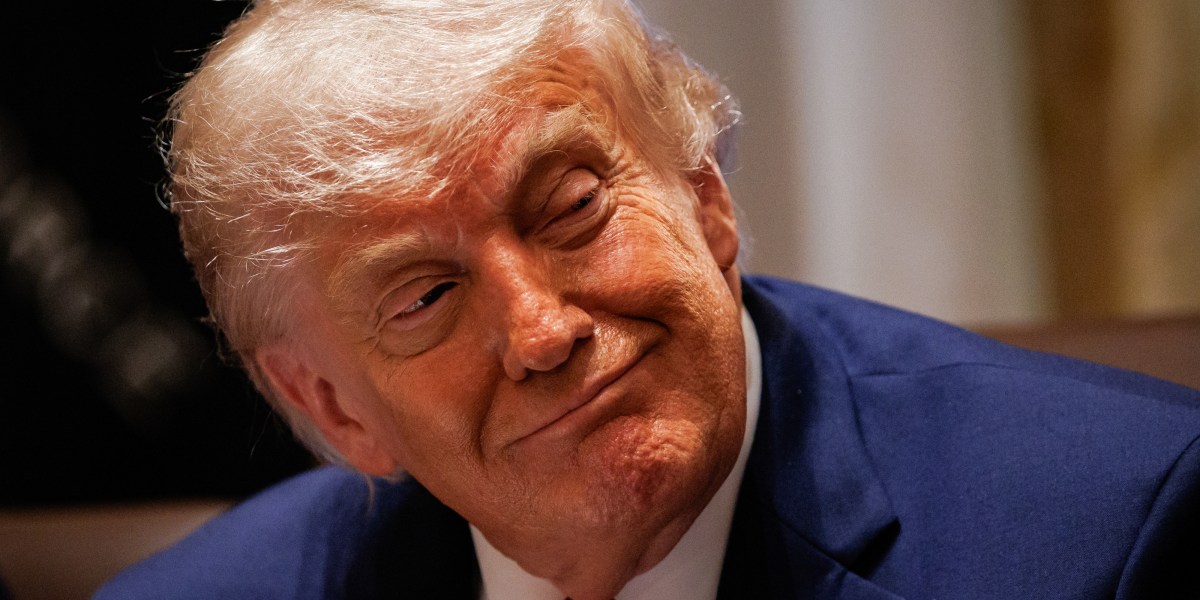
The disclosure of President Trump’s 2025 income—$2.2 billion, more than $1 billion of it from crypto—is shocking to the old D.C. establishment. But it’s not surprising.
The numbers are categorically different from anything American public life has seen before, and the institutions meant to respond to that fact are largely failing to do so.
Every source reached for a historical comparison, and every comparison collapsed under the weight of the current numbers. Norm Eisen, who served as President Obama’s White House ethics czar and is currently chair and cofounder of Democracy Defenders Action, called the filings “the most shocking presidential financial disclosures in the history of our country,” adding that “we’ve never seen a president exploit the presidency, exploit the White House in this fashion.” Even this veteran of tracking presidential ethics violations said he was “startled” by the “sheer scope and scale of the corruption here.”
When Fortune asked if he’d rolled up his sleeves and prepared a hot cup of coffee to go through the filing, Eisen responded that “even the most highly caffeinated coffee beverage would not be enough.” He added that he needed a “stiff drink. It’s outrageous—it makes your blood boil.” (He later clarified that he did not literally have a stiff drink that morning, but would be having one to celebrate America’s 250th birthday.)
Former House Majority Leader Dick Gephardt reached back nearly a century for a comparison and still came up short. “We’ve had scandals in the past, and we’ve had Teapot Dome and on and on,” he told Fortune, referencing the infamous early 20th-century corruption scandal involving President Warren G. Harding’s administration. “But it was frankly nothing [compared with this]. It was small potatoes. This is gigantic numbers.”
Jeffrey Sonnenfeld, the Yale management professor, calibrated the scale against the last major presidential-family financial controversy to dominate headlines, arguing the current disclosures run “many thousand times beyond the worst suspicions ascribed to Hunter Biden.”
And Rob Lalka, a Tulane scholar who studies the intersection of wealth and political power, situated the number against the office itself rather than against past scandals: “There are many perks that come with being president. Adding a couple of billion to your net worth shouldn’t be one of them.” Where earlier presidents might have stretched norms, Lalka argues, “what’s unprecedented is the scale, and who’s doing it: a sitting president just reported earning $2.2 billion in a single year. This is abnormal, and that should be stated directly and clearly.”
Conflicts compound
Beyond the raw dollar figure, sources converged on a specific structural problem: Trump isn’t merely profiting from the presidency in the abstract; he’s profiting from decisions his own administration is actively making. Eisen zeroed in on the crypto windfall as the clearest example, calling it “highly conflicted because he’s raking in hundreds of millions in crypto cash while regulating crypto.” He extended the same logic to alleged stock trading, citing reports that Trump personally traded Paramount and Warner stock “while he and his administration are openly favoring” those companies, and said he remains “in search of more evidence and proof” of administration claims that Trump isn’t personally directing the trades.
Gephardt independently arrived at a similar diagnosis. “Talk about insider information. He’s a walking insider information factory,” Gephardt said. “If he can make decisions and know about them before they’re made and announced, that’s ultimate insider information. I don’t know how you can conclude anything else.”
Lalka’s contribution sharpens our understanding of where some of that conflict originates. He points to a network linking crypto investment to administration personnel: Peter Thiel, he notes, “was the first person to bet big on Trump in 2016,” and Thiel and former White House AI and crypto czar David Sacks have both been active in crypto investing long before Trump, and later boosted JD Vance’s Senate run and vice presidential ascent. Lalka pointed to his award-winning book, The Venture Alchemists: How Big Tech Turned Profits Into Power, and said Trump’s latest disclosure was “exactly my research.”
Different diagnoses for failure
Where the sources diverged more meaningfully is in explaining why institutions haven’t intervened—and each offered a different piece of the puzzle. Sonnenfeld’s diagnosis is the most granular, naming specific institutions and explaining their paralysis one by one. He predicted that CEOs and senators will privately argue that “it needs to be investigated” while publicly staying silent, “afraid of the vindictiveness of the president.” He extended the indictment outward—“Where are the trade unions, where are the attorneys general from the blue states? Where are the clergy?”—arguing unions in particular are “afraid of their own membership, which they think might be MAGA,” and are therefore “showing complicity through complacency.”
Sonnenfeld framed the lack of civic response as part of a broader civic “balkanization,” pointing to roughly 300 advocacy organizations with “virtually the same name” as evidence of fragmented, diluted opposition rather than coordinated resistance. Leaders of these groups have displayed their own Trumpian self-dealing, he argued, paying themselves seven-figure salaries, and have diluted the formerly unified public response to scandal.
Gephardt’s explanation is more structural and less institution-specific: He traces the paralysis to voters themselves. “Congress is a reflection of the American people,” he said. “The people are deeply polarized, as polarized as I have ever seen them in my lifetime.” He attributed that substantially to social media algorithms optimized for engagement rather than consensus—“It’s a hate machine”—a dynamic he sees as the deeper structural cause beneath the institutional paralysis that Sonnenfeld describes at the congressional level.
Eisen vowed to go down fighting, treating the paralysis as a legal problem rather than a purely political one, and putting his faith in litigation. “Republicans in Congress should do something about it, and they won’t because they’re afraid of him,” he said. “But the American people will make him pay … It’s all heinous, and it’s going to be dealt with, if not by his congressional enablers, congressional Republican enablers, then by the American people at the ballot box.”
Noting that he had just prevailed in three Supreme Court cases in the past several days, Eisen argued that this is “very much like the other scandals that we have worked on and shut down,” noting Trump’s $1.8 billion slush fund for the Department of Justice, the Epstein files, the Kennedy Center renaming, and the renovation of the reflecting pool as matters where his organization has moved the needle. He confirmed that this disclosure is also on his agenda: “You can anticipate that we’ll be looking at legal remedies for this startling state of affairs.”
Eisen insisted that the American people won’t take this lying down. “It’s a witches’ brew that I think will break through and make a profound impact on Americans.”