




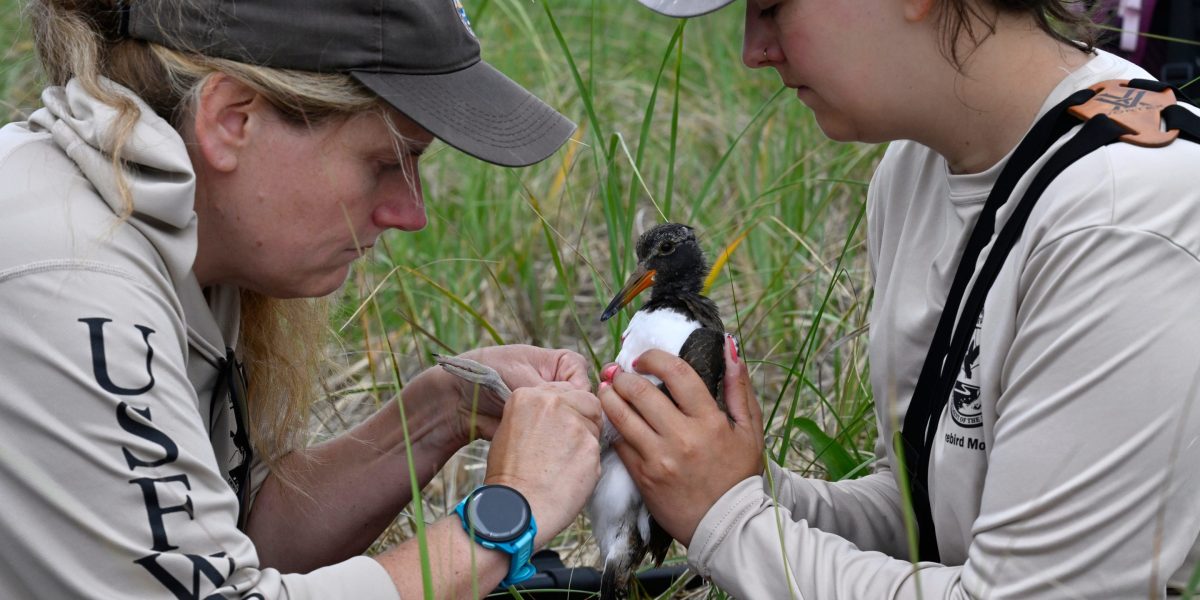
On a pristine Rhode Island beach teeming with noisy seabirds, a group of biologists armed with nets sneak up on a pair of American oystercatcher chicks.
But just as they move in to capture them, one of the football-size birds, with bright-orange bills and long legs, scampers into a coastal salt pond. The other briefly takes to the air, sending the team running across the mile-and-a-half-long (2.4-kilometer-long) beach in pursuit.
“There is a problem. They can fly,” Alan Kneidel, a senior conservation biologist with the environmental group Manomet Conservation Sciences, said as he watched the team go after the chicks.
Eventually, the U.S. Fish and Wildlife Service biologists tracked down both birds. They bundled them each into white pillow cases and gingerly carried them to a sand dune where body measurements were taken and bands clipped onto their long, peach-colored legs.
Birds starting to recover
The banding in the 787-acre (318-hectare) Trustom Pond National Wildlife Refuge is part of a nationwide effort to restore the oystercatcher’s population along the coasts of the Americas. The birds were largely wiped out in New England by the turn of the 20th century due to hunting and egg collecting but their numbers are rising.
About $10 million was raised over a decade and 35 coastal organizations in 16 states joined in the effort. Much of the campaign focused on educating beachgoers about the presence of the quirky birds known for their piercing calls and habit of using their razor sharp bills to crack open oysters and mussels. Measures were also implemented to protect their ground nesting sites from predators and pets on beaches, sand dunes, salt marshes or tide wrack deposits.
From 2008 to 2023, oystercatcher numbers increased by 45% along the Atlantic and Gulf coasts. Their recovery is especially significant, given a 2023 study found that most shorebird populations in North America were declining.
“It’s amazing and it’s a great conservation success story,” said Maureen Durkin, a federal wildlife biologist who led the banding effort and works at the Rhode Island National Wildlife Refuge Complex.
“It does really demonstrate how much you can accomplish when there is a dedicated group of partners that can come together and identify the needs of the species and implement conservation actions,” she said, adding that it also showed conserving imperiled species “is not easy and takes a sustained and committed effort.”
Targeting threats
Kneidel said a critical part of the conservation plan was determining that “chick survival was the big thing driving the declines.” Then, individually-tailored plans were drawn up from organizations in the American Oystercatcher Working Group, which was led by Manomet’s Shiloh Schulte, a conservation biologist and field scientist who died last year in a helicopter crash in Alaska while on a mission to protect shorebirds. His initial aerial survey showed their numbers had declined by double-digits.
“At one site, it might be recreational disturbance, at another site it might be predators, at another site it might be sea level rise or loss of dune structure that’s causing overwash events that are causing nest failure,” Kneidel said as he walked along the rocky Moonstone Beach, the sky filled with squeaking, least terns.
On Martha’s Vineyard, a low-lying fence with chicken wire is installed seasonally at the entrance of a key breeding site for oystercatchers and other seabirds and shorebirds, which has kept skunks and raccoons that eat their eggs off the beach. Colorful signs have also been installed educating the public about oystercatchers.
Focused attention on oystercatchers
The birds also benefit from federal protections given to piping plovers, a threatened shorebird that nests in some of the same areas. During the nesting season of piping plovers, vehicles and dogs are limited or banned near beach nesting sites.
“With a little bit of focused effort and attention on this really charismatic bird, you can teach the public how to share the shore,” said Luanne Johnson, a wildlife biologist who founded the nonprofit BiodiversityWorks, one of the groups working on the oystercatcher’s recovery. The island was the first place to have nesting oystercatchers in Massachusetts when they began to recover and has seen the numbers of breeding pairs increase 77% since 2009.
In South Carolina, nearly 30 breeding sites are roped off to protect nesting habitat. Georgia and North Carolina also rope off breeding sites along with trapping and euthanizing predators like foxes, raccoons and coyotes during breeding season.
“If you focus conservation efforts on a species, especially before it becomes endangered to the point that you’re considering listing, you can actually sort of head off trouble at the pass,” said Lindsay Addison, a coastal biologist with Audubon North Carolina, adding the state’s breeding pairs have increased nearly 20% to 403. Some birds, like Dark Green 06 and Yellow 25, were banded as far back as 2004 and have become minor celebrities.
Ted Simons, a retired emeritus professor at North Carolina State University who began studying the birds on North Carolina’s Outer Banks in 1995, said their recovery was a testament to the species’ resilience. He noted American oystercatchers have been found nesting on rooftops in the United States and other oystercatcher species in Europe are nesting in pastures and eating worms. One pair, he recalled, was found nesting in a bus station pothole in Iceland.
“If these were really highly specialized birds that needed an exact prescription for survival, that would have been harder,” Simons said. “But what we found is that these birds are incredibly adaptive.”
Climate change, weakened protections pose dangers
Despite their strong recovery, threats remain.
Chief among the dangers is climate change that has led to rising seas and erosion washing out oystercatcher nests. That has prompted states such as Georgia to build elevated nesting platforms of oystershells for the birds and use dredged material from shipping channels to create and maintain nesting islands. Along the Cape Fear River in North Carolina, Audubon is replenishing shell rakes — beds of old oyster shells where the oystercatchers nest.
“ Climate change, sea level rise, it’s a big challenge not only for oystercatchers but for all kinds of interests on the coast,” Addison said. “There’s going to be loss of habitat due to sea level rise so we have to make sure that we do what we can to provide the habitat that we can so they can get through this next bottleneck.”
There are also concerns that changes this month to the Endangered Species Act could impact nesting sites, especially where state protections are weak. Environmental groups, which sued Tuesday to block the changes, fear breeding grounds could be disturbed by everything from vehicle traffic to unchecked development.
The changes would allow oil and gas drilling, mining, logging and other development on critical wildlife habitats so long as the animals themselves aren’t killed or injured. Environmentalists warned the move could cause some species to go extinct by opening the door to habitat destruction.
“It’s a direct attack on the protections that have allowed many of these shorebird species to recover,” Kneidel said.
___
The Associated Press’ climate and environmental coverage receives financial support from multiple private foundations. AP is solely responsible for all content. Find AP’s standards for working with philanthropies, a list of supporters and funded coverage areas at AP.org.