


The American electric-vehicle revolution, which until recently seemed imminent, is moving far more slowly than many in Detroit and Washington expected. A few years ago, automakers were preparing for an environment in which 40% to 50% of their vehicles would need to be electric by 2030. But then the Trump administration unwound key incentives and rules that had encouraged EV adoption, and consumer habits proved more stubborn than PowerPoint presentations had suggested.
GM CEO Mary Barra, once bullish in forecasting that self-driving cars would arrive quickly, is more measured now. “I’m done making predictions,” she told Fortune. “I don’t think it’s shifted our mission,” Barra said, surrounded by gleaming Cadillacs in a Manhattan showroom. “We still think EVs are the endgame.”
She is making one forecast, however: In 2028, GM will offer eyes-off-the-road highway driving on the Cadillac Escalade IQ, allowing drivers to take their hands off the wheel and feet off the pedals. “And that will be the start of then getting to full autonomy,” she said.
MORE FROM FORTUNE
The Return of Uber’s Ousted Founder | Fortune Daily
Billionaire George Soros has donated $102 million ahead of the midterms—and now the Democrats are coming out ahead – Mia Osmonbekov
I study tribal psychology and build AI agents for my business students—the rogue OpenAI ‘swarm’ alarmed me – Michael Morris
‘Europe needs to shed its naivety’: Vestas CEO Henrik Andersen on Chinese competition and the energy issue that keeps him up at night – Sam Birchall
Larry Fink on the lost ‘bedrock of America’ and ‘a big divide’ between wages and investment wealth – Nick Lichtenberg
‘You need to clean up the mess your generation has left’: Volkswagen’s guilty boomer gets real about sustainability, China—and his spam folder – Nick Lichtenberg
THE WAR ON AI
How a John McPhee student turned GPTZero into a $30 million AI-detection business
Edward Tian built GPTZero over winter break of his senior year at Princeton, in the disorienting weeks after ChatGPT went mainstream, and put it up on a free Streamlit hosting page. The site crashed within a week as 30,000 people flocked to a program that could tell you how much of a piece of online writing was produced by AI.
Less than four years later, GPTZero has more than 20 million registered users, $30 million in annual recurring revenue, and a new parent company. Superhuman, the productivity company formerly known as Grammarly, agreed in June to acquire GPTZero for undisclosed terms. PitchBook data valued GPTZero at more than $88 million, but a source familiar with the matter said the deal represented at least a 10x return on the $13.5 million the company had raised in total.
THE MARKETS
Bond traders tap the brakes, stocks hit the gas
Bond investors applied the brakes this morning, and prices rose globally, ending several days of sovereign debt selling that had pushed yields to levels last seen in the 1990s. The yield on the 10-year U.S. Treasury fell back to 5.23%, after hitting 5.34% earlier in the week.
Stock traders took the cue to buy equities globally. Markets in Europe and Asia largely rose, and U.S. futures were solidly up after the S&P 500 made gains yesterday.
- S&P 500 futures were up 0.5% this morning. The index rose 0.19% yesterday.
- In Europe, the Stoxx 600 was up 1.09% in early trading, and the U.K.’s FTSE 100 was up 0.57% before lunch.
- Asia: South Korea’s KOSPI was up 0.46%. Japan’s Nikkei 225 was down 0.94%. India’s Nifty 50 was closed today for a national holiday, as was China’s CSI 300.
- Brent crude fell to $99 per barrel this morning from $102 yesterday.
- Bitcoin was at $86,137.
We’re inches away from Bank of America’s ‘sell’ warning
Bank of America’s sell-side indicator—which tracks investment strategists’ recommended allocations of equities in a “balanced” fund—is just 0.3 percentage points from sounding the “sell stocks” signal. The indicator recommends that when strategists’ equity allocations climb too high, they are too bullish, and therefore you should sell. Conversely, if allocations fall below a certain level, the market is too bearish, and you should buy.
In the 12 months following a sell signal, “S&P 500 returns have historically been below average but still positive at 7% and 3%, respectively,” the bank’s Victoria Roloff and Savita Subramanian said in a recent note. “When the indicator has been at this level or higher, [next 12-month] S&P 500 returns were negative 36% of the time vs. 17% overall since 1985.”
Only a market crash can slow down the American consumer
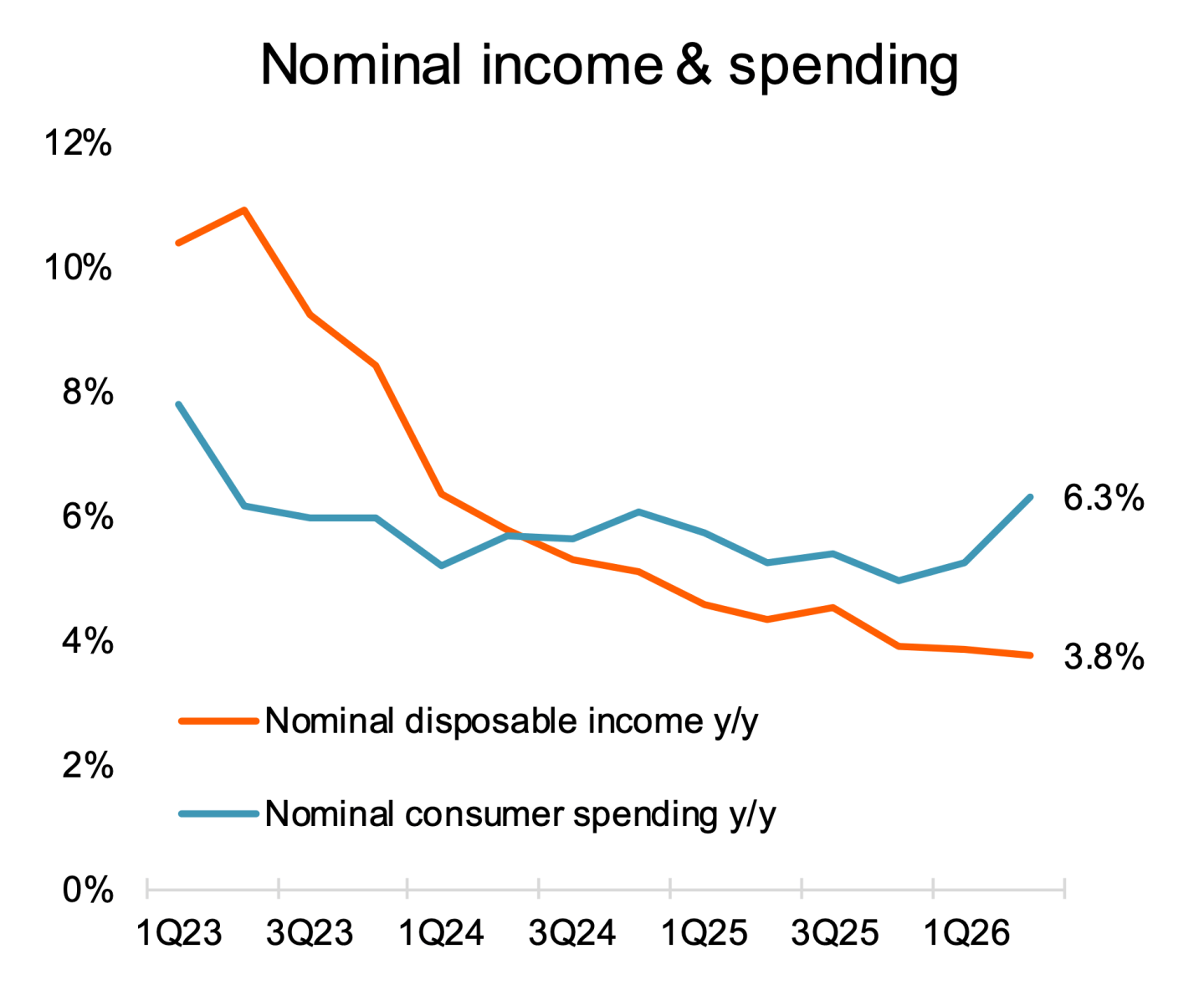
Americans notoriously refuse to stop spending, which drives up to 70% of GDP. But as this chart from Piper Sandler’s Jake Oubina and Nancy R. Lazar shows, their spending is increasing at a faster rate than their disposable income, implying that they are saving less.
Only a market crash would change their spendthrift ways, they said. The trend is “enabled by record-high household net worth (housing & stocks). The effect is so strong, it would take a 30% drawdown in asset prices to stall out consumption.”
Ignore all the bad news—the job market is just fine, Jefferies says
In the week ended Sept. 26, 197,000 people made new claims for unemployment insurance in the U.S., down 1,000 from the prior week. Continuing claims fell to 1.701 million. This is the lowest level since 2023, Jefferies’ Thomas Simons and Blake Birkins said in a note, and people should stop complaining!
“Despite extremely pessimistic views expressed in consumer confidence surveys regarding the economy overall, countless headlines describing job cuts from a variety of businesses, and the phantom job-stealing power of AI, the claims data suggests that labor market conditions are stable,” they said. “Given demographic trends, with nearly 11,000 people turning 65 years old every day, this is a good place for the labor market to be in.”
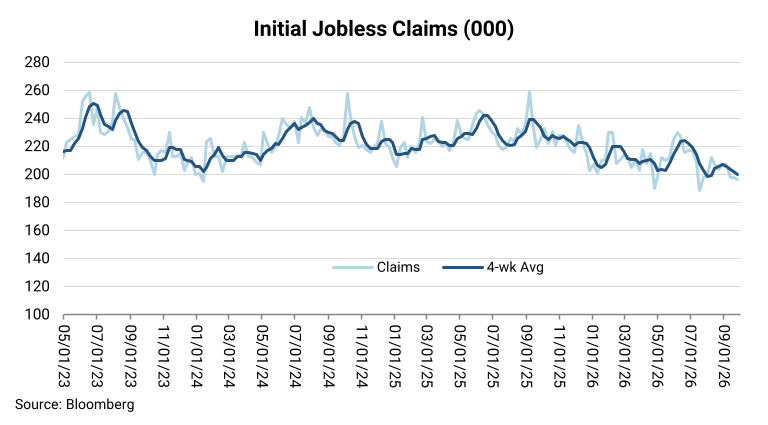
CHART OF THE DAY
Our dumb world: Tech is making us stupider
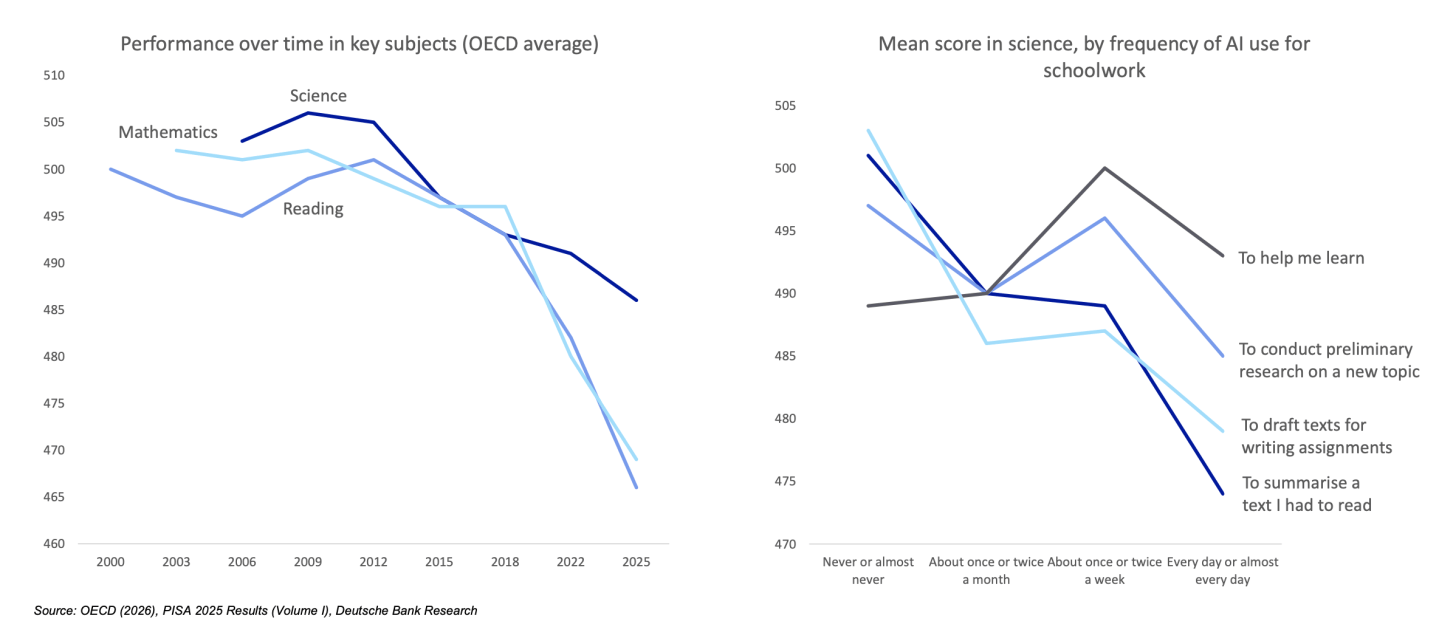
There is no proof that the smartphone era and the advent of AI made us worse at thinking. But there’s lots of anecdotal evidence. As these charts from Deutsche Bank show, test scores in schools measured by the OECD show that academic achievement was on the decline before AI arrived, but after that it got even worse. The more students use AI, the lower grades they get.
“AI may be accelerating a fall that started with widespread smartphone diffusion from [circa] 2010,” Deutsche’s Adrian Cox said in a recent note.
NUMBER OF THE DAY
€91 million ($102 million)
The largest financial penalty ever handed out to a soccer club, per WinSportsOnline, a sports betting odds calculator. The fine went to Chelsea F.C., which broke two financial rules in the 2024-25 UEFA season.
The implication is that Manchester City F.C. faces a far, far greater penalty, given that it has been found guilty by the Premier League of 115 separate counts of financial cheating over a years-long period. Notably, City was fined €60 million ($67 million) in 2014, also for breaking UEFA’s financial rules.
THE FRONT PAGES TODAY
U.S. urges Europe to ‘immediately’ release diesel reserves as Iran war fuels record prices – CNBC
Nike Plans a Smaller Company as Sales Slide Deepens – WSJ
U.S. sent more Patriots to protect Saudi, Qatari energy sites – Axios
Ex-HSBC banker banned for dodging £5,900 in train fares – FT
France’s Troubles Are Deepening as Investors Head for the Exit – Bloomberg
Will CNN’s New Owner Want to Change Everything? Not for Now. – NYT
Self-driving big rigs roll into California as driverless future comes into focus – NY Post
ONE MORE THING
Thieves stole two Nvidia-branded trucks only to discover they were full of sand
Nvidia’s chips can cost up $40,000 each. So it is unsurprising that they are targets for black-market thieves. Two trucks owned by autonomous trucking company PlusAI were stolen from its Fremont, Calif., warehouse recently, perhaps because they had Nvidia logos on the outside, Fortune’s Sasha Rogelberg reports.
But when the hijackers opened the trailers, all they found was that each truck contained 20,000 pounds of sand. PlusAI uses the sand as ballast in its test vehicles. Supply-chain risk management firm Overhaul has tracked more than $150 million in AI equipment cargo losses since it began tracking the data.