



The curious trade came a little past 9 p.m. on Jan. 17 — a $1,096,109 bet less than two minutes after the soon-to-be president of the United States posted on his social media account that his family had issued a cryptocurrency called $Trump.
In those first minutes, a crypto wallet with a unique identification code beginning 6QSc2Cx secured a giant load of these new tokens — 5,971,750 of them — at the opening sale price of just 18 cents each, starting a surge in the $Trump price that would soon reach $75 per token.
This early trader, whose identity is not known, walked away with a two-day profit of as much as $109 million, according to an analysis performed for The New York Times.
But the fast profits for early traders, whose names are unknown but some of whom appear to be based in China, came at the expense of a far larger number of slower investors who have cumulatively suffered more than $2 billion in losses after the price of the token crashed.
As of the middle of this week, more than 810,000 wallets had lost money on the bet, according to an examination that the crypto forensics firm Chainalysis performed for The New York Times. The total losses are almost certainly much larger: The data does not include transactions that took place on a series of popular crypto marketplaces that started offering the coin only after its price had already surged.
The price of $Trump hovered around $17 this week, less than a quarter of its $75 peak value.
Whether people made or lost money, it was stellar business for the Trumps. Nearly $100 million in trading fees have flowed to the family and its partners, although most of that has not yet been cashed out, the Chainalysis data shows.
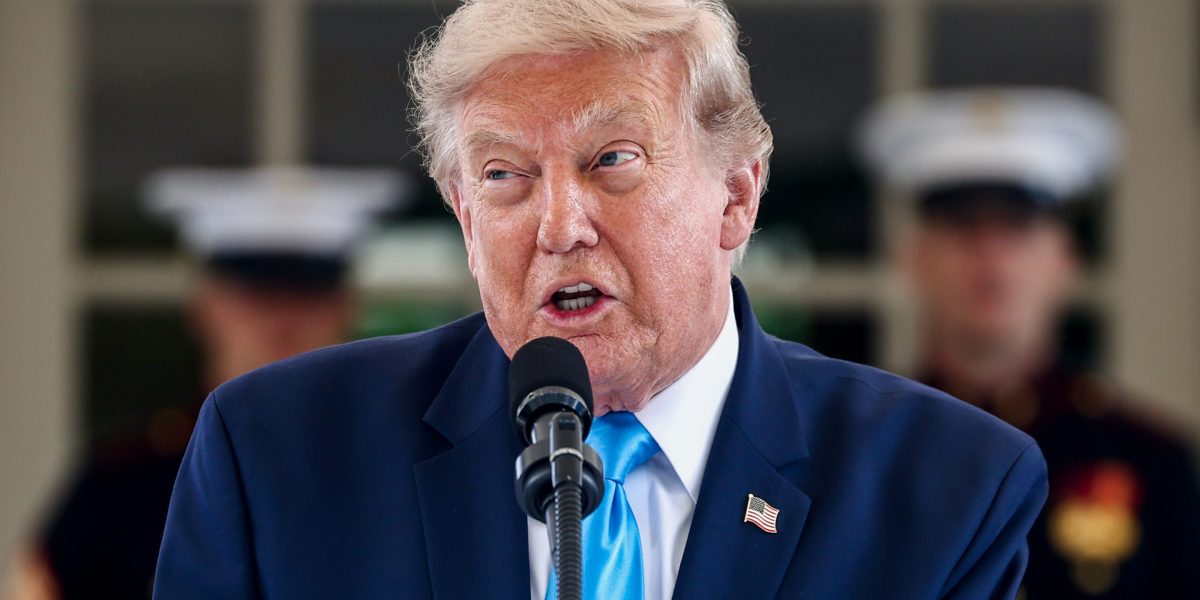
President Trump set off this scramble three days before he was inaugurated, triggering a rapid boom-and-bust sequence that has now raised broader questions about the speculative dangers of so-called memecoins, a type of cryptocurrency based on an online joke or celebrity mascot.
He promoted the coin on his own social media platform, as well as Elon Musk’s X, saying: “Join my very special Trump Community. GET YOUR $TRUMP NOW.”
The chain of events is hardly surprising, several former state and federal financial regulators said.
It is effectively a part of the design of the entire memecoin industry, which is legal but largely unregulated. The trading is built on large early buys by sophisticated traders who pump up the price, only to sell their holdings as less experienced retail investors follow their lead and buy in, and often end up with losses.
What makes this situation particularly troubling, to government watchdogs and former regulators, is that the Trump family is profiting from this exploitative pattern at the same time that Mr. Trump is rapidly moving to bring an abrupt end to a regulatory crackdown on crypto by several government agencies.
“The president is participating in shady crypto schemes that harm investors while at the same time appointing financial regulators who will roll back protections for victims and who may insulate him and his family from enforcement,” said Corey Frayer, who recently left a post as a crypto adviser to the Securities and Exchange Commission.
The losses on the $Trump bet were very real for hundreds of thousands of investors, including some who are vocal supporters of Mr. Trump.
In the days before Mr. Trump was sworn in, Shawn M. Whitson, 40, of Walnut Cove, N.C., owner of a small computer repair business, had celebrated Mr. Trump’s return to the White House. “Today, we take our country back!” Mr. Whitson wrote, with a photo of Mr. Trump, on Inauguration Day. He also expressed hope that $Trump would rise in price.
But by the end of January, Mr. Whitson was fed up. “Done with this $Trump crap,” he wrote in a social media posting. Mr. Whitson, reached by The Times on Friday expressed disappointment. “That coin is a joke.”
Over the past six months, President Trump and his sons have made a series of aggressive forays into the crypto industry. As Mr. Trump promoted crypto on the campaign trail, he also helped start a company called World Liberty Financial, which offered a digital currency called $WLFI to certain wealthy investors with experience in financial markets.
Last week, Trump Media & Technology Group, the parent company of Mr. Trump’s social media platform, Truth Social, announced that it was moving into the financial services industry by creating a brand known as TruthFi that will offer investment products tied to Bitcoin.
Trump Media’s chief executive, Devin Nunes, called the offerings “a competitive alternative to the woke funds and debanking problems that you find throughout the market.”
But the debut of the $Trump memecoin was the first time the Trump family had marketed a new crypto token directly to ordinary investors.
At the request of The Times, crypto experts reconstructed some of the early trades made by buyers of Mr. Trump’s token, examining their profit taking and how, once the initial buyers started to dump their holdings, the price of $Trump then crashed, hurting other investors.
The analysis of crypto transaction records was executed by the forensic firms Nansen and Chainalysis as well as by Molly White, an independent crypto researcher who is often critical of the industry. The data was then reviewed by The Times.
This pattern of big, fast buyers entering and then selling out of their memecoin holdings is part of the reason that state regulators in New York recently warned consumers about these offerings, saying that “creators or their associates artificially inflate the price of the coins and then sell their own coins rapidly at an inflated price, reaping substantial profits while causing the price to crash.”
New York regulators called these maneuvers “pump-and-dump schemes” and said they can leave buyers who come in late with big losses.
No evidence has emerged that Mr. Trump or his associates artificially inflated the coin’s price or engaged in insider trading. Asked about the early $Trump trades and profit taking, the president’s middle son, Eric Trump, declined to comment.
The Starting Gun
In the crypto world, every transaction is recorded on a publicly viewable ledger known as a blockchain. Typically, the names of the people making trades remain hidden, with each account identified only by a long chain of letters and numbers.
The blockchain allows crypto analysts to go back and look at new offerings and decipher what each wallet did — when it first invested, when it transferred any tokens or sold them off, and what the ultimate profit and loss turned out to be for every play. This analysis can also point to anomalies in trades that raise questions.
For example, blockchain records show that the $Trump token was “minted” at 9:01 a.m. Eastern time on Jan. 17, creating a so-called contract address. It was not announced by Mr. Trump for another 12 hours.
But the account behind the first large public purchase — the $1,096,109 bet — was created about three hours before Mr. Trump launched the coin, an analysis of public crypto transaction records found. It had been filled that evening with virtual currencies, seemingly ready to pounce on a new offering.
The well-timed trades, and the fact that the wallet received its funding shortly before Mr. Trump’s coin launched, immediately drew skepticism from crypto analysts, who speculated that a trader had been acting on inside information.
In the crypto world, pinning down the person behind a trade is sometimes impossible. It is common for people to post big and sometimes unverifiable claims on social media before abruptly disappearing, making it difficult for amateur investors to distinguish legitimate investments from scams.
This month, an X account claiming to represent a Dubai-based crypto trader named Syed Sameer posted that he was the owner of one of the wallets that had orchestrated the first giant $Trump trade worth $1.1 million.
Mr. Sameer, who also claimed to be an investor in World Liberty Financial, was subsequently accused on X of using insider information to get in early on the $Trump token.
But the examination by The Times found inconsistencies in the claims on Mr. Sameer’s website and X account. After he was confronted with those issues, Mr. Sameer said in messages on the chat app Telegram that he did not actually control the wallet.
Mr. Sameer had lied about it “for clout, to be honest with you,” he said. “I know it’s stupid and childish but yeah, I was messing about.”
The Lucky 31
What is clear, based on blockchain records, is that the person behind that $1.1 million trade is a big player among the hordes of professional traders who rapidly buy up and then sell off new memecoins, trying to cash in on speculative surges as the coins are issued.
After making the purchase, the owner of the account then rapidly moved to sell the coins, generating a profit of at least $50 million, according to the analysis of the transaction by Aurelie Barthere of Nansen. Further sales brought the total profits to $109 million, according to the review by Ms. White.
Other large $Trump trades have also drawn attention, including one by a trader who started buying the coin about two minutes after it was launched. The trader then sold those $Trump tokens in less than a half an hour, with a net profit of $2.7 million, the blockchain shows.
Just under 700,000 wallets recorded gains on $Trump, the examination by Chainalysis shows. The early trades were some of the most profitable: 31 of these large early traders made $669 million in profits in a matter of days, according to the Nansen analysis.
But for every winner, there were even more losers.
Across the first 19 days of trading, a total of 813,294 wallets registered losses, either by cashing out at a loss or holding onto coins that had plummeted in value.
The losers — those who paid more for the token than it is now worth — cumulatively have lost $2 billion, in actual or paper losses. Still, many of these traders are holding on to their money-losing tokens, perhaps hopeful that the price will rise again, the data shows.
The profits mostly secured by the early buyers were enormous: a total of $6.6 billion in cashed-out profits, according to Chainalysis.
This is a familiar pattern for crypto traders. A few weeks before the $Trump launch, some of the same wallets that bought the president’s token also traded a memecoin called Hawk Tuah, promoted by the social media influencer Haliey Welch.
The Hawk Tuah coin surged in December after it was first introduced to a $490 million market capitalization, and then crashed to $10 million as of this week, leaving thousands of investors with losses and generating a lawsuit claiming it had “created a speculative frenzy” and violated federal law. (Ms. Welch said on X that she was “fully cooperating with and am committed to assisting the legal team representing the individuals impacted.”)
“This is similar to sports betting or gambling,” said Gareth Rhodes, a former deputy superintendent at the New York State Department of Financial Services, which helps regulate the crypto industry and other financial services companies. “The retail customer putting in their funds is doing so at risk of losing most if not all of it with the hope of an outsize payoff.”
Sheelagh McNeill contributed research.