



On a frigid day in early January, as she worked in her office in the Boston suburb of Billerica, Mass., Siyu Huang received a two-word text message.
“Spinning wheels,” it said. Attached was a short video clip showing a car on rollers in an indoor testing center.
To the untrained eye there was nothing remarkable in the video. The car could have been getting its emissions tested at a Connecticut auto repair shop (except it had no tailpipe). But to Ms. Huang, the chief executive of Factorial Energy, the video was a milestone in a quest that had already occupied a decade of her life.
Ms. Huang, her husband, Alex Yu, and their employees at Factorial had been working on a new kind of electric vehicle battery, known as solid state, that could turn the auto industry on its head in a few years — if a daunting number of technical challenges could be overcome.
For Ms. Huang and her company, the battery had the potential to change the way consumers think about electric vehicles, give the United States and Europe a leg up on China, and help save the planet.
Factorial is one of dozens of companies trying to invent batteries that can charge faster, go farther, and make electric cars cheaper and more convenient than gasoline vehicles. Transportation is the biggest source of man-made greenhouse gases, and electric vehicles could be a potent weapon against climate change and urban air pollution.
The video that landed in Ms. Huang’s phone was from Uwe Keller, the head of battery development at Mercedes-Benz, which had been supporting Factorial’s research with money and expertise.
The short clip, of a Mercedes sedan at a research lab near Stuttgart, Germany, signaled that the company had installed Factorial’s battery in a car — and that it could actually make the wheels move.
The test was an important step forward in a journey that had begun while Ms. Huang and Mr. Yu were still graduate students at Cornell University. Until then, all their work had been in laboratories. Ms. Huang was excited that their invention was venturing into the world.
But there was still a long way to go. The Mercedes with a Factorial battery hadn’t yet been taken out on the road. That was the only place the technology really mattered.
Many start-ups have produced solid-state battery prototypes. But no American or European carmaker has put one into a production vehicle and proved that the technology could survive the bumps, vibrations and moisture of the streets. Or if any have, they have kept it a secret.
In late 2023, Mr. Keller, a veteran Mercedes engineer, proposed to Ms. Huang that they try.
“We’re car guys,” Mr. Keller said later. “We believe in things really moving.”
Roots in China
Ms. Huang stands out in a niche dominated by men from Silicon Valley. Some brag about their 100-hour workweeks; she believes in a good night’s sleep. “Having a clear mind to make the right decision is more important than how many hours you work,” she said.
She is approachable and laughs easily, but also projects determination. She works from a sparsely decorated office in Billerica that looks out on a patch of forest crossed by power lines. The furnishings include a plain black bookcase, stocked with a few technical volumes, that she inherited from a previous tenant. Her diplomas from Cornell — a Ph.D. in chemistry and a master’s in business administration — hang on the wall.
Ms. Huang grew up in Nanjing, China, where she was in an elementary school program that had her gather environmental data. The program instilled an interest in chemistry and an awareness of the vehicle exhaust and industrial pollution choking Nanjing’s air. She realized, she recalled, that “we need to grow a planet that’s healthier for human beings.”
In a dormitory at Xiamen University on China’s southern coast, where she studied chemistry, she saw an advertisement for a Swedish exchange program. After spending two years there, she and Alex, whom she had known since they were students in China, were both accepted to doctoral programs in Cornell’s chemistry department. She arrived in Ithaca, N.Y., in 2009 with $3,000, which she had managed to save from her Swedish scholarship. They have both since become U.S. citizens.
They were star students, said Héctor Abruña, a professor at Cornell known for his research in electrochemistry. He still has a picture on his office bookshelf of himself with Mr. Yu and Ms. Huang in their commencement robes.
With an idea that grew out of Dr. Abruña’s lab and some seed money from the State of New York, Mr. Yu and Ms. Huang founded the company that later became Factorial while she was still completing her business degree.
“They are extremely dedicated and extremely bright,” said Dr. Abruña, who continues to advise Factorial. “Straight shooters — zero BS.”
Mr. Yu is now Factorial’s chief technology officer. The company is, in that sense, a family operation. Ms. Huang is reticent about their private life, declining to say even how many children they have.
Initially the company focused on improving the materials that allow batteries to store energy. That changed after Mercedes invested in Factorial in 2021. Mercedes was looking for a bigger technological leap and encouraged Factorial to pursue solid state.
The technology has that name because it eliminates the liquid chemical mixture, known as an electrolyte, that helps transport energy-laden ions inside a battery. Liquid electrolytes are highly flammable. Replacing them with a solid or gelatinlike electrolyte makes batteries safer.
A battery that doesn’t overheat can be charged faster, perhaps in as little time as it takes to fill a car with gasoline. And solid-state batteries pack more energy into a smaller space, reducing weight and increasing range.
But solid-state batteries have one big drawback that explains why you can’t buy a car with one today. Such battery cells are more prone to grow spiky irregularities that cause short circuits. Vast riches await any company that can overcome this problem and develop a battery that is durable, safe and reasonably easy to manufacture.
Despite obvious differences between Factorial and Mercedes — the start-up has a little more than 100 employees, compared with 175,000 — Ms. Huang’s working style meshed with the culture at Mercedes and its roots in Swabia, the region around Stuttgart where people are known for their no-nonsense approach and restraint.
Mr. Keller found Ms. Huang’s low-key, factual manner to be a welcome contrast to the hype and unfulfilled promises that are pervasive in the battery and technology industries. Factorial, he said, “has not been announcing, announcing, announcing and not delivering.”
‘Production hell’
It’s an axiom in the battery business that producing a cool prototype is the easy part. The challenge is figuring out how to make millions of solid-state batteries at a reasonable price.
Factorial confronted that problem in 2022, setting up a small pilot factory in Cheonan, South Korea, a city near Seoul known for its tech industry. The project became, in Ms. Huang’s words, “production hell” — the same phrase Elon Musk used when Tesla was struggling to mass-produce a sedan and nearly went bankrupt.
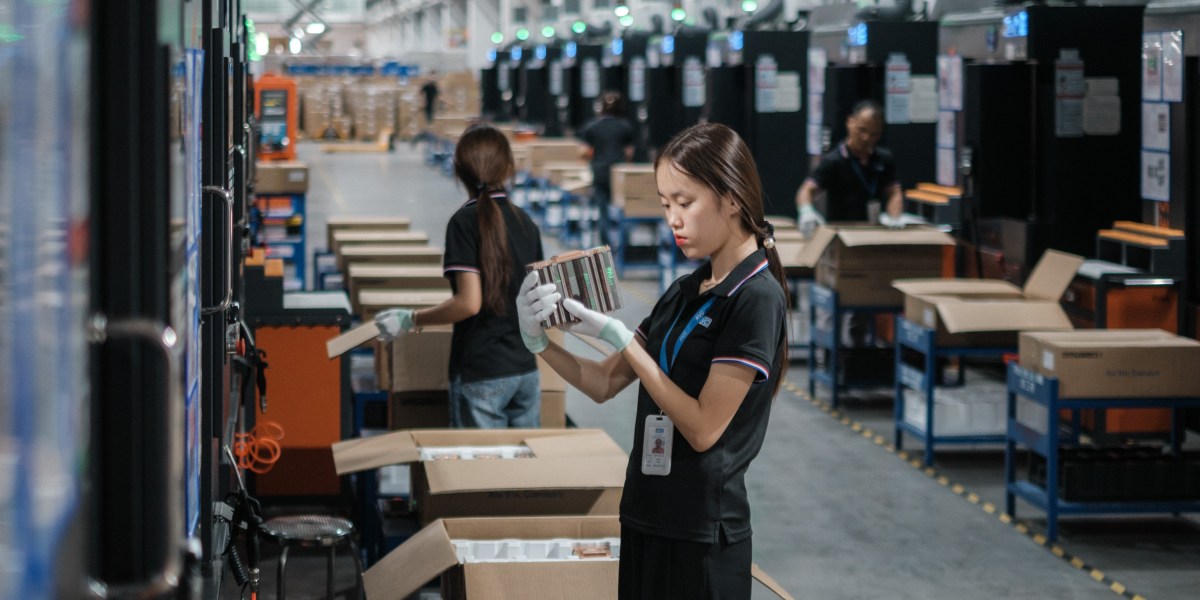
To make money, a battery factory can’t produce too many defective cells. Ideally the yield, the percentage of usable cells, should be at least 95 percent. Hitting that target is devilishly difficult, involving volatile chemicals and fragile separators layered and packaged into cells with zero margin for error. The machinery doing all this is encased in Plexiglas chambers and overseen by workers dressed in head-to-toe protective gear to prevent contamination.
Dozens of companies are trying to mass-produce solid-state cells, including big carmakers like Toyota and smaller ones like QuantumScape, a Silicon Valley start-up backed by Volkswagen. Mercedes, hedging its bets, is also working with ProLogium, a Taiwanese company.
Nio, a Chinese carmaker, sells a vehicle with what it advertises as a solid-state battery. Analysts say the technology is less advanced than what Factorial is developing, offering fewer advantages in weight and performance. But there is little doubt that Chinese companies are investing heavily in solid state. Nio did not respond to a request for comment.
Every company has its own closely guarded recipes and manufacturing processes. “It’s difficult to say which technology will win,” said Xiaoxi He, a technology analyst at IDTechEx, a research firm.
Partly because solid-state batteries are so difficult to manufacture, many auto executives are skeptical that they will make commercial sense anytime soon. Shares in many solid-state battery start-ups have plunged, and management turmoil is common.
Factorial has insulated itself from the harsh judgments of Wall Street by never selling stock. Its funding comes from private investors including WAVE Equity Partners, a Boston firm, and partners that include the South Korean automaker Hyundai; LG Chem, a South Korean company that makes battery materials; and Stellantis, which next year plans to test Factorial batteries in Dodge Charger muscle cars.
Projections of how soon solid-state batteries would be available have proved overly optimistic. Toyota displayed a futuristic prototype in 2020, but the company is still years away from selling a car with a solid-state battery.
Kurt Kelty, a vice president at General Motors in charge of batteries, is among those who will believe it when they see it. “We’re not banking on solid state,” Mr. Kelty said.
‘I don’t even know if we can make it’
In the beginning, Factorial’s prototype assembly line in South Korea had a yield of just 10 percent, meaning 90 percent of its batteries were faulty. Despite her preference for a good night’s sleep, Ms. Huang often had to wake up at 4 a.m. to deal with problems at the factory, which was operating around the clock. She was in South Korea at least once a month.
“There were always issues,” she said. “There was a point, I was like, I don’t even know if we can make it.”
By 2023, Factorial had produced enough cells suitable for an automobile that Mr. Keller, a soft-spoken, amiable man who has worked at Mercedes for 25 years, began thinking about installing them in a car. The cost and the risk of failure were high enough that he sought approval from his bosses. Armed with PowerPoint slides, Mr. Keller went to Ola Källenius, an imposing Swede who is chief executive at Mercedes.
Mr. Källenius’s office is at the top of a glass and steel high-rise in the middle of a sprawling manufacturing and development complex beside the Neckar River in Stuttgart.
Mr. Keller argued that road testing would help determine, among other things, whether the batteries would work with air cooling alone. If so, that would eliminate the need for a heavier, more costly liquid-cooled system.
Mr. Källenius signed off on the project, reasoning that a tangible goal would motivate the team and hasten development. He drew an analogy to Formula 1 racing. “If you’re chasing the leader, and suddenly you can see him, you get faster,” Mr. Källenius recalled.
Ms. Huang was a bit surprised when, in late 2023, Mr. Keller told her that Mercedes wanted to put the cells in a working vehicle. “We didn’t realize it was coming so soon, honestly speaking,” she said with a laugh.
But by June 2024, Factorial had managed to produce enough high-quality cells to announce that it had begun delivering them to Mercedes. In November, the factory in South Korea hit 85 percent yield, the best result yet. Ms. Huang and the Korean team celebrated by going out to a barbecue joint.
Mercedes still had to figure out how to package the cells in a way that would protect them from highway dirt and moisture. And it had to integrate the battery pack into a vehicle, connecting it to the car’s control systems.
The Factorial cells had one big drawback that made them hard to install in a car. They expanded when charged and shrank when discharged. In Mr. Keller’s words, they “breathed.”
Mr. Keller turned to engineers on the Mercedes Formula 1 racing team, who are accustomed to quickly solving technical problems. They devised a mechanism that expanded and shrank with the cells, maintaining constant pressure.
By Christmas 2024, a team working at Mercedes’s main research center in Sindelfingen, outside Stuttgart, texted Mr. Keller those two words: “spinning wheels.”
‘Finally I see you’
Mr. Keller confessed that he got a little emotional when his team sent him the video of the car. He waited until after Christmas to forward it to Ms. Huang with the same two words.
Several weeks later, the Mercedes engineers took the car with Factorial’s battery, an otherwise standard EQS electric sedan, to a company track for its first road test.
The engineers drove the car slowly at first. They carefully monitored technical data displayed on the dashboard screen.
They drove faster and faster until, by the fourth day, they reached autobahn speeds of 100 miles per hour. The battery didn’t blow up. In theory, it can power the car for 600 miles, more than most conventional cars can travel on a tank of gasoline.
Mr. Keller had been keeping Ms. Huang apprised of the progress, but she was still surprised when, during a meeting on marketing strategy in February, people from the Mercedes communications department mentioned that they had written a news release announcing the achievement.
“Do you want to take a look?” they asked.
She certainly did. The first successful road test with a Factorial battery was an enormously important moment, one they had been anticipating for years. Yet the teams at Mercedes and Factorial did not throw parties to celebrate. They still had work to do.
The next step is to equip a fleet of Mercedes vehicles with batteries, perfect the manufacturing process and do the testing required to begin selling them. That will probably take until 2028, at least. Many experts don’t expect cars with solid-state batteries to be widely available until 2030, at the earliest.
In April, Ms. Huang finally found time to travel to Stuttgart and ride in the car herself.
It was a clear spring day, with greenery sprouting in the German countryside and flowers beginning to bloom. Mercedes employees escorted her to a garage in Sindelfingen, where the automaker also has a large factory complex.
Ms. Huang had seen many photos of the car, but she still felt a thrill when the garage doors opened. It felt “like a long-lost friend,” she said. “Like, ‘Finally I see you!’”
A Mercedes driver took her for a spin on the test track, zooming down an asphalt straightaway then around a banked curve that, Ms. Huang said, felt like a roller coaster.
Inside the car, there was no way to perceive the difference with the Factorial battery compared with a conventional one. “But it’s just so special because it’s with our battery.”