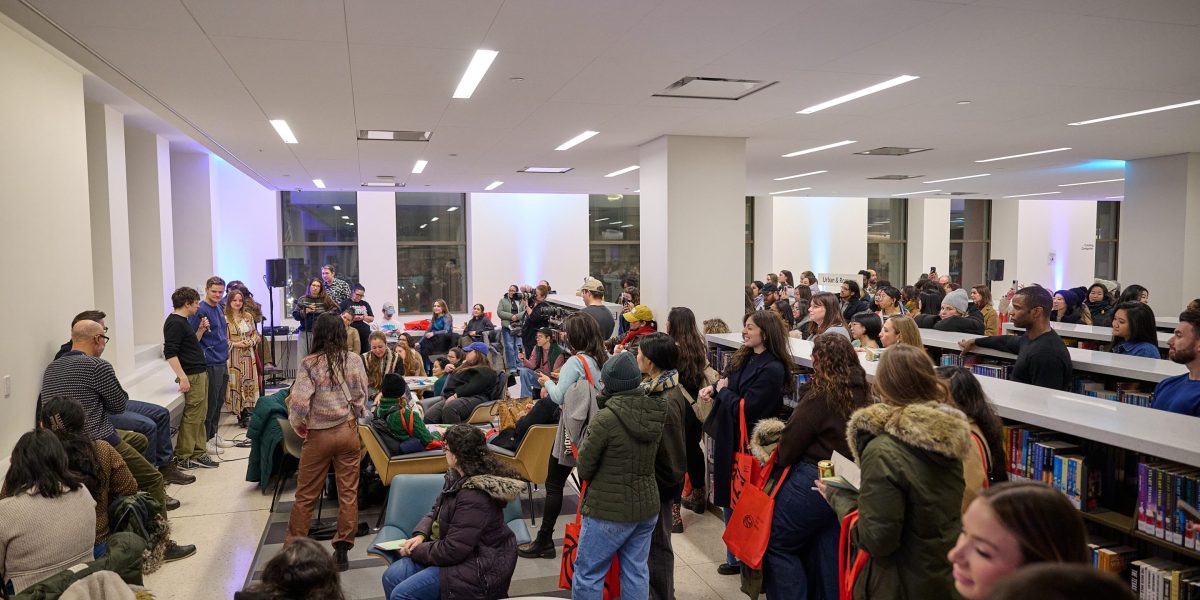




A few weeks ago Charles Rangel, the Lion of Lenox Avenue, was carried into St. Patrick’s Cathedral in New York City with a full military guard. Rangel, a longtime U.S. congressman from Harlem, was the chair of the Ways and Means Committtee in the House of Representatives, the committee with authority over taxes, tariffs, and benefits; many consider it to be the most important committee in the House. Until the election of Barack Obama, Rangel was arguably the most powerful African-American politician in the history of the United States.
As mourners gathered in the cathedral, two scandal-ridden New York politicians running to become the next mayor of the city, ex-governor Andrew Cuomo and current mayor Eric Adams, glad-handed up front with congresspeople and other notables. Zohran Mamdani, a left-wing politician who would soon win a shocking victory over Cuomo in the Democratic primary, worked the pews halfway back. State legislators compared notes on when they’d gotten home last night after the final vote on the budget.
Before the mass began, Gov. Kathy Hochul, House Minority Leader Hakeem Jeffries (currently the most powerful African American in U.S. politics), Senator Chuck Schumer, and former President Bill Clinton all got up to speak. They remembered Rangel’s commitment to the poor and to the people of Harlem, and how he did his greatest work on the Ways and Means Committee, through tax policy.
Taxes have been the government’s most effective tool to create the society we prefer. In the middle of the 20th century, the richest people in the United States paid back more than 90% of their income to the government every year, and that was redistributed in ways that built a large and strong middle class. Since the 1980s, taxes on the rich have declined dramatically. The chasm between rich and poor and the consequent collapse of social trust in American society seem to have followed almost automatically from changes in tax rates.
In his career in Congress, Rangel couldn’t stem the tide against taxing the rich, but he found ways and means to empower people through smaller nudges to the tax code. His greatest achievement might have been the creation of empowerment zones, communities designated by the federal government where businesses receive low-interest loans and tax credits for employing local people. In eight years, as President Clinton noted in his eulogy, the empowerment zone in Harlem cut unemployment from above 20% to 8%.
Unintended consequences
Today’s landscape of worker-friendly tax proposals looks pretty bleak, but if you’re a tipped worker, the end to taxes on tips in the Trump administration’s “One, Big, Beautiful Bill” probably looks good—more money in your pocket, less hassle on your tax forms.
Watch out. This is not the tax reform you’re looking for. Just like tariffs, untaxed tips are an invitation to fraud. With tariffs, it’s fraud against the government (all of us) when importers buy off inspectors and underpay customs duties. With tips, it’s your bosses defrauding you personally. Tip-skimming. Violating the rules of the tip-credit (not topping you off, as required by law, when your tips don’t bring your $2.13/hour subminimum tipped wage up to the $7.50 normal minimum wage). Putting non-tipped workers in the tipping pool and underpaying them. Tax-free tips are a weak substitute for an end to the $2.13 subminimum hourly wage and a full minimum wage (or more, much more) plus tips. State by state, legislative reforms banning subminimum tipped wages have decreased poverty and harassment wherever they pass.
And then there’s the other problem with ending taxes on tips. Historically, even when politicians and bureaucrats act in good faith to help workers earn more money, tipping policy changes have created unintended consequences because managers and customers have reacted to them in unpredictable ways.
As Michael Cecchi-Azzolina explains in Your Table Is Ready, his 2022 memoir of New York City restaurant work, a minor change to IRS rules destroyed one of the most important occupations in the industry. The maître d’ was the high-status leader of the dining room, “a god” at traditional hotspots like the Copacabana back in the day, and Cecchi-Azzolina writes that “becoming a maître d’ was the pinnacle of my restaurant career.” Then the IRS decided several years ago that the maître d’ was a manager, not a worker, and therefore could not be included in the tip pool and had to be paid a full salary. The goal of excluding the maître d’ was to put more money in the pockets of regular waiters, but there was a side effect. Not wanting to pay the extra salary to maître d’s, high-end restaurant managers canceled the occupation completely, replacing it with the low-status, low-paid host (or, more commonly, hostess)—“dimwits for minimum wage,” as Cecchi-Azzolina puts it—who stand at the door looking pretty. As a result, the quality of service, especially for regulars who like to be greeted with dignity at the door by someone who knows them, has declined. Management responded to a small change in tip policy with a large change in staffing policy, with serious consequences for customer service.
Or a change in enforcement can lead to the unintended consequence. In recent years, aided by the wider paper trail inherent in the shift from paper money to credit cards, the IRS started policing tip reporting on tax returns more carefully. This, in turn, upset a longstanding, tacit agreement between labor and management—managers would turn a blind eye to their employees’ underreporting of tips, and the workers in turn would accept a certain level of fraud and abuse from management—tip skimming, underpayment for overtime, yelling and belittlement. Once workers lost their end of the bargain, they were less willing to put up with managerial abuses, creating a more adversarial and litigious workplace. We are only just beginning to understand the effect this has had on customer service.
A sense of loss
This history of unintended consequences goes way back. The first major, controversial change to American federal tipping policy came in the 1940s, when railroad red caps, tipped workers who carry your bags around a railroad station, fought for and won a full minimum wage with tips. (Red caps are still around today in the larger stations—you can go look for them—and their descendants the skycaps often work the curbs of airport terminals.) The 1938 Fair Labor Standards Act mandated the first minimum wage, 25 cents an hour, but to win votes from racist white southern congressmen, the law excluded categories of traditionally Black work—agricultural, domestic, tipped. Red caps found a loophole in their status as workers on the railroad, the earliest and most heavily regulated modern industry. Unlike every other kind of tipped worker, including, for unclear reasons, the Pullman porters who actually worked on trains, the government designated them to receive a full minimum wage.
Railroad station managers, now on the hook for red cap salaries, responded with mass layoffs and a speed-up enforced by a network of spies. This was to be expected; when wages are forced up by the government or unions, bosses try other strategies to bring labor costs back down. Red cap union officials fought as hard as they could to protect members’ jobs and rights, and many of the laid-off were hired back again.
What was less predictable was the “accounting and guarantee” plan that managers invented to fulfill the new wage requirement. Stationmasters made red caps fill out their tip earnings on slips of paper, and if tips came in less than two dollars a day—eight hours at the 25-cent minimum wage—the station said it would make up the difference. It is remarkably similar to today’s tip-credit system, except that instead of a subminimum wage plus tips with a top-off when necessary, it was no wage at all plus tips and a top-off. This was a great way to avoid the requirements of the minimum wage law—if workers reported making less than two dollars a day, managers fired them, claiming they must have been bad at their jobs. To avoid this fate, most red caps started reporting exactly two dollars a day in earnings every day.
Red caps found themselves in an untenable position, between a public tipping less because of the new minimum wage and managers who refused to pay it. They falsified their tip-earning records downward, against their own interests, in order to keep their jobs. They were making less than ever before, and their union leaders complained. The press did little to publicize the problem, but federal investigators from the U.S. Department of Labor’s Wage and Hour Division held hearings and a case went all the way to the Supreme Court.
In the end the court ruled that management could satisfy the minimum-wage requirement however it wanted, but in the interim, because of all the trouble, the railroads changed their policy again, to the “check and charge” system. A red cap attached a perforated tag to each bag, gave half the tag to the passenger in order to redeem the bag later, and then dragged the luggage away on a trolley, ending the tradition of personal service that red caps had always provided.
Customers didn’t like it. Many misunderstood, underpaid, or acted abusively. As Cornelius Thompson from Broad Street Station in Philadelphia told investigators, “I had one man to curse the president, the Labor Act and me.” Even when they weren’t angry, Thompson noted, customers could feel the loss, and so could he. “We can’t give all that personal service that we did. Sometimes I would spend hours with one person…I was very cautious about those things, and I was rewarded. But now I have to do like the rest. I have to push right along in the crowd.” The reformers and union leaders who fought to give red caps a full minimum wage did not see this change coming, and they had trouble seeing it when it arrived. Their reports celebrated an end to red caps’ reliance on tips and ignored the sense of loss.
Tax code
If we end the tax on tips, what unintended consequences will reshape working conditions and customer service? Imagining the tax-free windfall for workers, will employers drop base wages and will customers decrease tips, making workers’ lives more precarious and more beholden to abusive customers? Or will the promise of untaxed tips have little impact on wages and tipping amounts? Will workers become more cautious and ingratiating in their manner? Or will a bonanza of untaxed tips give them greater confidence to put unruly customers in their place? Will occupations rise up or disappear? What are we not imagining?
A couple of weeks ago, walking up Broadway just north of the Manhattan courthouses, I came upon a scrum of political operatives and reporters. Near the middle I recognized the man who’d sat next to me in the pew, days earlier, at Rangel’s funeral. I tapped him on the shoulder and asked what was going on. He worked for Brad Lander, another candidate in the Democratic primary for mayor, who had just been arrested by agents of U.S. Immigration and Customs Enforcement (ICE), the federal agency responsible for finding and deporting undocumented immigrants. They seemed to think Lander was interfering with an arrest of an immigrant named Eduardo whom they wanted to deport. (The charges against Lander were later dropped.)
You fools, I did not say, though perhaps I should have. Didn’t you learn anything from the Rangel funeral? Immigration policy isn’t the path forward to justice and equality. It’s the tax code! But not this proposed tax code, and not an end to taxes on tips.
The opinions expressed in Fortune.com commentary pieces are solely the views of their authors and do not necessarily reflect the opinions and beliefs of Fortune.
Read more: