


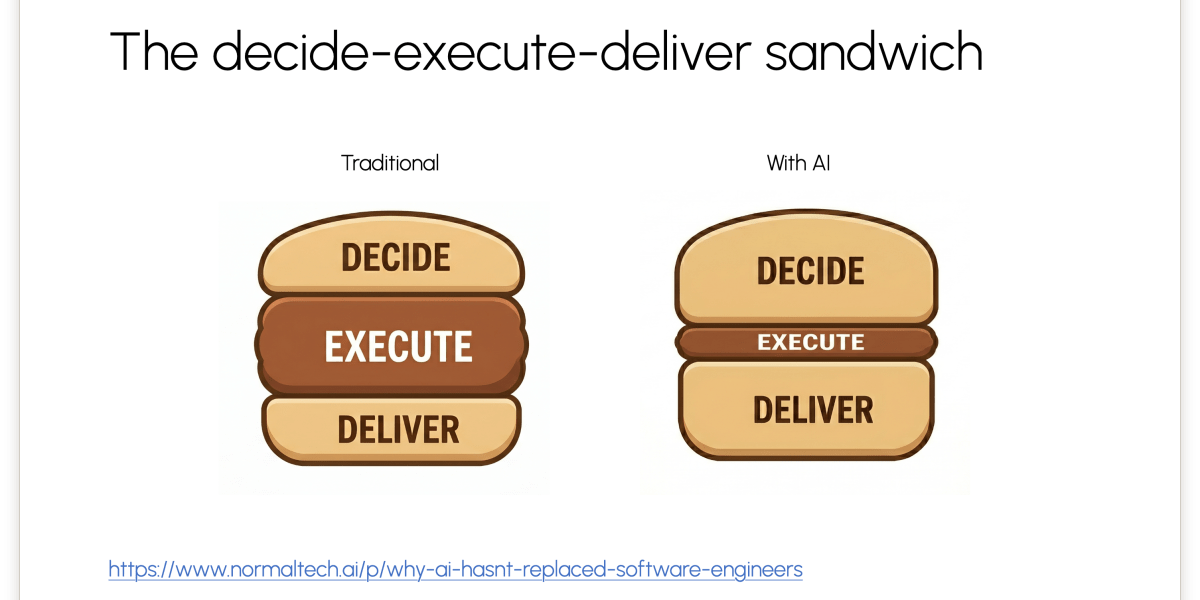
On a recent call with the Yahoo Finance product chief, I pulled up a slide that looked like two burgers, side by side, to represent eras of work before and after AI. Leimer leaned in. “It’s totally that,” he said.
The slide came from Arvind Narayanan, a Princeton computer scientist who just keynoted the International Conference on Machine Learning in Seoul. In his illustration, the burger on the left, labeled “Traditional,” shows a thick patty — the execute layer of work, the coding and debugging — sitting between modest buns. On the right, labeled “With AI,” the patty has shrunk to a sliver. The buns — “decide” on top and “deliver” on the bottom — have swollen in size.
Work used to be a fat hamburger with skinny buns, as the meat of the work was the actual doing of the task. Now, AI is collapsing the middle of the sandwich, but the top and bottom layers of human work are growing instead of disappearing. Work is increasingly talking about work — there’s a lot of bun to chew over.
“We come in and talk to each other and we make sure that we really have real confirmation and conviction about, like, these are the things we’re going to do. And this is how we’re going to unleash the agents.”
Leimer’s team led the development of a new investing product, AlphaSpace, that has been live in the market for about two months, as Fortune was first to reveal. In that short window, the team has shipped over 100 new features, illustrating how the execute layer has accelerated. Users are spending 3x more time in AlphaSpace than the average Yahoo Finance user, Leimer told Fortune, and the team has been able to respond quickly to user feedback, like its recent addition of real-time options data, in a partnership with Unusual Whales.
Sprints that used to run two weeks now run 24 hours, Leimer said: planning in the morning, shipping by end of day, retrospective at night. In one case, feedback arrived at 4:45 p.m. on a Friday; by 8:30 the same evening it was fixed, reviewed, and live.
“In the old days,” Leimer added, “that would have been, ‘We can’t launch it next week.’”
The decide‑execute‑deliver sandwich
Narayanan calls his framework the “decide‑execute‑deliver sandwich.” Most knowledge work, he argues, has three layers: a decide layer on top, focused on understanding what needs to be built and why; an execute layer in the middle that represents the actual implementation; and a deliver layer on the bottom, covering integration, testing, and long‑term accountability.
AI agents are compressing the middle layer. But Narayanan’s point is that the execute slice was only ever about a third of the job. The buns, he says, are not just holding steady; they’re expanding.
“The first and third layers are arguably expanding as AI compresses the middle layer,” he told the ICML audience — because once building gets cheap, it becomes easier to start projects and harder to keep up with deciding and verifying them.
When anyone can build, roles blur
For years, product squads at big tech firms were defined by what each person couldn’t do. Designers sketched static mockups and waited for engineers to turn them into working code. Product managers drafted requirements but needed developers to stress‑test a hunch. Analysts understood data but didn’t build production systems.
As AI automates more of the “syntax” of building software, Yahoo teams say those lanes are disappearing.
On the team behind Yahoo Scout, the company’s AI answer engine, principal product designer Nick Lockington began prompting Google’s Vertex AI directly, asking it to generate structured JSON logic for new features. An engineer on the team later remarked that Lockington had effectively created a functional API by prompt, bypassing the traditional build phase.
“It was a total ‘aha’ moment,” said David Grandinetti, a distinguished software apps engineer on the project, on Yahoo’s blog. “Nick became immediately the most leveraged engineer on our team, because he was working at the highest level of abstraction.”
Other team members followed. One designer prolific in code commits became known internally as a “design engineer.” An engineer with a strong eye for usability was dubbed an “engineering designer.”

Yahoo’s leaders say the point isn’t that job titles vanish, but that roles are increasingly defined by the decisions people own rather than the code they can manually produce. Designers still arbitrate user behavior and aesthetics. Engineers still own architecture and safety. But both can now build and iterate directly with AI.
“This is about increasing decision velocity and cutting the cost of experimentation, so teams can test a hundred ideas instead of five and quickly discard failures without the traditional burden of technical debt,” said Stephane Koenig, vice president at Yahoo. “It allows us to reserve human expertise for the hardest decisions where you need context AI doesn’t have.”
Leimer put it another way, in conversation with Fortune: work is now primarily a conversation about work. “We come in and talk to each other and we make sure that we really have real confirmation and conviction about like, these are the things we’re going to do.”
The danger, he added, and why you have to be “really thoughtful” on the top part of the bun of work now, is that AI makes it so easy to “just build whatever you want.”
Leimer repeated some advice from his manager, Yahoo Media Group President Ryan Spoon: “It’s important that you’re really convicted about what you build,” because you can build anything, almost instantly. “It used to be [that you] spent so much time on the top of the bun because the engineering resources were precious. You didn’t want to waste one second of an engineer’s time.” Now the risk is that you build things you don’t need to, and do it instantly — McKinsey’s global tech and AI leader Kate Smaje calls this the “false productivity” trap, as she told me several months ago.
Leimer added that when he sees sloppy work, what’s become known as “AI slop” out in the world, is “where there’s a really skinny bun, basically.” Humans haven’t been thoughtful enough about what they’re putting out as work product, because the hamburger/sandwich section has been compressed down to almost nothing.
There are real costs attached to this. Professionals have coined the phrase “workslop,” for when an AI-generated email or work product has been sent over for review without proper verification first. Experts in the Harvard Business Review have argued that this is more than annoying — it’s actually destructive to productivity. The Stanford Social Media Lab estimated the cost of this at $9 million per year for a company of 10,000 workers.
Decision fatigue is the new risk
Taken together, these stories reinforce Narayanan’s assessment that AI is, for now, more of a collaboration technology than an automation engine. He believes most AI agents still struggle with reliability in high-stakes environments, pushing companies toward human-in-the-loop rather than automation.
At Yahoo, leaders say this shows up as decision fatigue rather than job loss. Because AI lets teams test and build far more features, the limiting factor is how many choices product managers, designers, and engineers can thoughtfully make and shepherd.
Lockington noted that AI can’t solve the messiness of overlapping or layered roles in the workplace. “Traditionally, you might have someone ask, ‘Why is this engineer doing design work?’ or ‘Why is this designer doing my job?’” He credited Koenig with doing the difficult human job of creating psychological safety on the team to navigate these issues. “We’ve been able to break that down.”
Leimer said that once this safety is established, he’s found work to be “really fun,” a shift from his last 20 years in management, away from the actual building and writing code that he started out doing. “Now, everybody’s got the cool job” where they feel like they play a role in building things, he said. “It’s also been fun watching people get energized around the problem and the thing they’re building as opposed to spending more of their time on the process to get it built.”

The hamburger’s future — and the case for pizza
Narayanan cautions against assuming jobs will remain unchanged. He said he expects decades of structural adaptation as companies reorganize around AI, akin to the 40‑year transition factories underwent when electricity enabled assembly lines.
So far, though, the empirical pattern in fields like software, law, medicine, and content translation is that demand for human work shifts and grows as AI spreads. Radiologists have adopted AI while employment rises. Lawyers find themselves filing more suits thanks to easier drafting. Translators still have steady work years after computer translation approached human parity, because there is no ceiling on what can be translated or into how many languages.
Yahoo’s experience suggests that white‑collar work may be headed for a similar, if messier, future. As technical barriers fall, the company’s leaders say personal agency and judgment are becoming the differentiators: not who can write code, but who can decide which problems are worth solving and how to verify what AI builds.
I asked Leimer to really torture the metaphor and invoked his Philadelphia roots by bringing up that city’s famous sandwich: the cheese steak. Everyone knows the secret ingredient in a cheese steak isn’t really the meat, it’s the delicious Italian hoagie bread. Is that the point for the future of work?
The major bottleneck, he added, is the “bottom bun,” the delivery part. The work is done for you, almost instantly, after you decide what to do, and then delivery is just fiendishly difficult. “You’ve got to work through all the other stuff, you’ve got to review it,” he said, citing security risks, building out a deployment pipeline, all when the work seems like it’s finished and could be released with just the press of a button.
Is the promised land some kind of pizza or flatbread, where all the human work is about decision, all the tasks shrink down to the size of toppings, and the delivery is seamless? “Something like that,” Leimer laughed.
In Narayanan’s hamburger, AI has already made the patty thin. The bun is where the jobs — and the risks — now live. Whether companies can redesign work into something flatter and more sustainable, is the question for the coming years, even decades, to answer.