








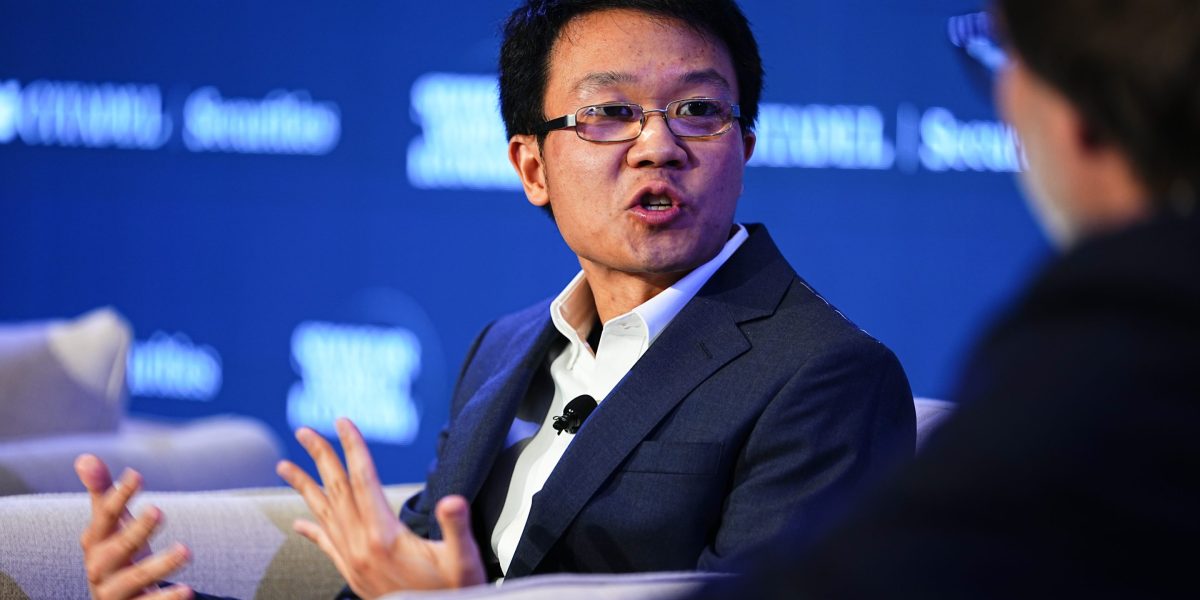
The trend of tokenmaxxing has gone too far. That’s at least according to Cognition CEO Scott Wu, who argues that as companies scramble to rein in AI spending, they should focus on employee productivity instead of AI use.
In an episode of the “Founders” podcast with David Senra, Wu said that as companies are shelling out on token budgets, there needs to be a push to identify how AI is creating real value, which comes from defining clear returns on investment for the technology, including revenue growth, efficiency gains, or cost-saving.
“It is directionally correct, but I think there are definitely some places where people have gotten carried away,” Wu said of tokenmaxxing. “People are like, ‘We rank our engineers by how many tokens they’re spending.’ Well, let’s try and rank people by how much output they’re actually producing.”
Cognition measures its success in how much it is able to increase engineering capacity. The AI software company is the creator of Devin, widely considered the first AI coding agent. Financial institutions like Goldman Sachs use the tool as an AI software engineer, while auto companies like Mercedes-Benz and Rivian use Devin for research and development.
Wu’s remarks come after reports of companies like Meta and Amazon creating internal incentives, such as employee leaderboards, to measure token usage to encourage workers to discover AI use cases. But rather than drive innovation, the use of tokens became excessive, with employees using AI just to boost their leaderboard rankings. The tech companies soon scrapped the internal tracking after employees deployed the bots to complete useless tasks, the Financial Times reported.
“Please don’t use AI just for the sake of using AI,” Dave Treadwell, an Amazon senior vice-president, reportedly told staff.
The tokenmaxxing trend has also taken a financial toll on tech companies, such as Uber, which burned through its entire AI budget for 2026 in just four months, and last month capped token spending for employees to $1,500 per month. Despite tokens becoming cheaper as the technology improves—dropping 90% in price since 2023—companies’ AI spending has actually increased, as a result of companies feeling emboldened to gobble up more tokens as they decrease in price. As AI spending balloons, Wu warns that those dollars spent are only as valuable as the benefits they create.
“The GPUs are expensive, but if your engineers are actually able to ship three times more, then it’s very clearly worth it,” Wu said. “You just want to make sure you’re doing it the right way.”
Why tokenmaxxing failed
This lopsided spending-to-output ratio is what Boston Consulting Group (BCG) noted as a hallmark reason why AI wasn’t creating productivity gains in the workplace. Employees don’t know what to do with the time new tools have saved them.
BCG’s 2026 Global AI at Work report, which surveyed nearly 12,000 frontline employees, found that 42% of workers reported regular AI use saving them eight hours per work—about one workday per week—but 66% said they received little to no guidance on how to invest the time they saved, and half of respondents said they weren’t spending that saved time on other strategic projects.
David Martin, global leader of BCG’s People & Organization practice, told Fortune that the workplace productivity paradox emerging alongside AI is actually a human-created problem of leadership not communicating clear goals around the technology.
“Senior leaders are really struggling to articulate what the vision and strategy is on AI,” Martin said. “Consequently, it increases employee fear. It makes it harder for them to even understand what objectives they’re pushing for, and it trickles through to adoption, usage, and the like.”
Mirroring Wu’s philosophy around identifying AI’s ROI in specific workplace environments, Martin suggested C-suites and managers treat AI as any other novel workplace tool, weighing its potential benefits instead of treating it like a productivity panacea.
“A lot of companies just gave AI to everyone, regardless of position, and I think now they’ll say, ‘Well, let’s be more thoughtful about who has access, and what is the business case? And are we delivering on it, ultimately?’” Martin said. “Then holding people accountable to meeting their targets, just like they would anything non-AI that they’ve been doing for the past 100 years.”
