


This is the web version of Eye on A.I., Fortune’s weekly newsletter on the news in artificial intelligence. To get it delivered daily to your in-box, sign up here.
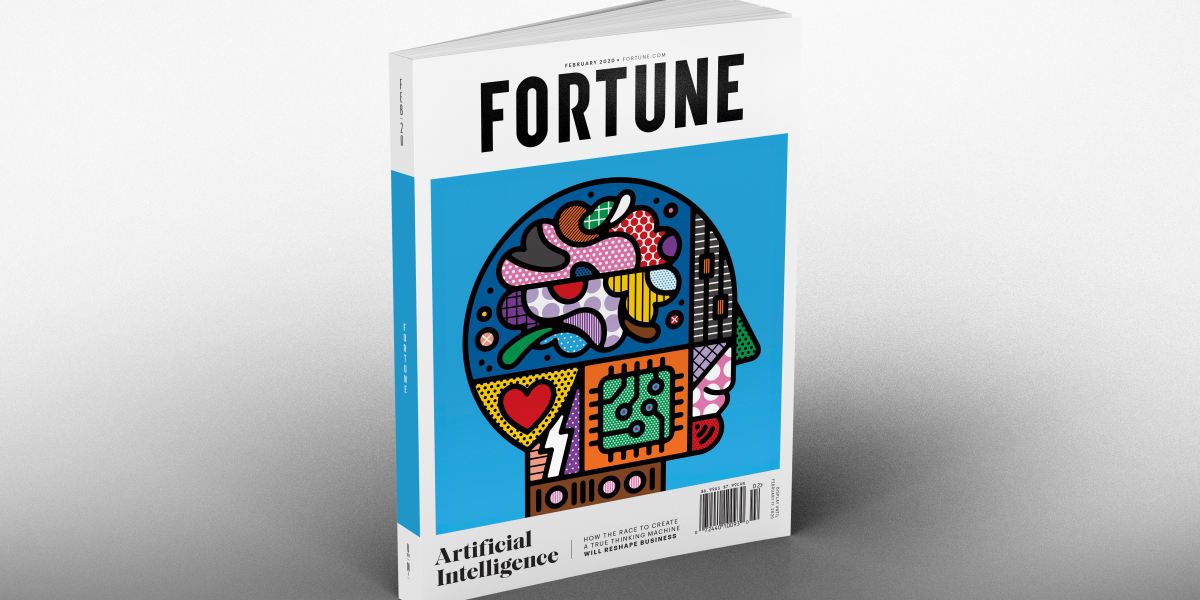
Fortune’s beautifully redesigned magazine hits newsstands this week. I urge you all to check it out, not least because the coverage package is devoted entirely to artificial intelligence. The issue serves as a concise field guide to the state of A.I. technology today.
Here’s a preview of what you’ll find inside.
- Why are some of the world’s most valuable corporations putting big money into efforts to create artificial general intelligence (or AGI), the kind of human-like, super-capable A.I. that exists only in Hollywood flicks and sci fi paperbacks? I explore that question through the prism of Microsoft’s $1 billion investment into San Francisco-based OpenAI. The answer, it turns out, has as much to do with the quest’s ancillary benefits—improved algorithms, better cloud computing capabilities and, just as importantly, branding— as it does with a desire to actually achieve the moonshot’s ultimate aim, something most A.I. researchers think won’t happen for decades, if at all.
- In a companion story, I examine recent breakthroughs in natural language processing and their impact on business. After years of A.I.’s language capabilities lagging progress in computer vision, the past eighteen months have seen a series of advances. What’s more, those new language models are making a faster leap out of the lab and into products used by billions than ever before. Could better language understanding be the key to unlocking more human-like A.I.? Some experts think so.
- My colleague Maria Aspan delves into A.I.’s use in hiring and human resources management, one of the hottest areas for the technology. A desire to move beyond human biases and widen the talent pool is driving adoption of machine learning-driven technologies in hiring. But, as Maria reports, the opaque nature of many of the models used by HR algorithms is raising new concerns that companies have simply swapped one kind of bias for another, more insidious, kind.
- Freelance reporter Jennifer Alsever looks at the crop of startups hoping to upend the pharmaceutical industry by using A.I. in drug discovery. In particular, Toronto-based Deep Genomics used machine learning to find a therapeutic candidate for the rare genetic disorder Wilson’s disease. There’s plenty of hope that companies like this will help slash drug development costs. But Eric Topol, the cardiologist and geneticist who has become an important voice of moderation amid all the hype surrounding A.I. in medicine, tells Jennifer the whole field right now is “long on promise and short on proof.”
- Hong Kong-based Eamon Barrett examines China’s national ambitions to become a world leader in artificial intelligence. Beijing’s strategic aims and surging funding for the technology have set alarm bells ringing in Washington. China also has access to vast pools of data on its own citizens. However, Jeffrey Ding, a researcher at Oxford’s Future of Humanity Institute who studies China’s A.I. strategy, tells Barrett that “the U.S. is still far ahead,” continuing to hold the lead in both algorithms and the specialized computing hardware needed to run A.I. systems.
- Barrett’s story is well worth checking out for its discussion of ByteDance, the company behind the wildly popular TikTok. Machine learning-driven recommendations lie at the heart of TikTok’s success, Barrett writes, but Chinese officials haven’t exactly embraced ByteDance as a standard bearer for homegrown A.I. expertise. Why? Apparently, Chinese Communist Party officials might consider the video sharing service too frivolous. Given how important social networks such as Facebook and Twitter have become to political discourse globally, Beijing may be overlooking a potent strategic asset.
Read the full package here, and keep reading for a quick round-up of the week’s other A.I. news.
Jeremy Kahn
@jeremyakahn
[email protected]
A.I. in the news
Google wants A.I. regulation, but asks for U.S., E.U. coordination
Alphabet CEO Sundar Pichai called for government regulation of artificial intelligence in a speech before a think tank in Brussels on Monday and in an accompanying op-ed in The Financial Times. “There is no question in my mind that artificial intelligence needs to be regulated,” the CEO writes. “It is too important not to.” In particular, the CEO said he favors a moratorium on the use of facial recognition technology, at least until appropriate ethical standards and rules can be agreed. But Pichai wants European Union leaders, who are set to unveil plans for new A.I. regulations next month, and Washington to coordinate. He also wants regulators to take a “proportionate approach, balancing potential harms with social opportunities.” Pichai reiterated these points in a talk at the World Economic Forum in Davos, Switzerland, today.
Clearview’s massive facial dataset is helping police—and obliterating privacy
The A.I. startup Clearview has built perhaps the world’s largest database of faces, including images of more than 3 billion people, and is using it to help law enforcement identify people, The New York Times reports in an investigation into the company. Clearview created its database largely by scraping photos from social media sites such as Facebook, in violation of those sites’ terms and conditions. Clearview is accelerating concerns about facial recognition’s impact on privacy and civil rights. “I don’t see a future where we harness the benefits of facial recognition technology without the crippling abuse of the surveillance that comes with it,” Woodrow Hartzog, a law professor at Northeastern University in Boston, tells The Times.
Apple buys A.I. startup Xnor.ai for $200 million
The iPhone maker bought the Seattle-based company that specializes in making A.I. algorithms efficient enough to run on so-called “edge devices,” such as mobile phones or even lower-powered electronics, such as security cameras. The company was spun-out of the Allen Institute for Artificial Intelligence, the A.I. research lab set up by the late Microsoft co-founder Paul Allen. “Apple would presumably have a special appreciation for the fact that Xnor.ai’s tools can keep AI data secure on mobile devices rather than sending it to the cloud,” according to GeekWire, which first broke the news of the acquisition.
Huawei creates a cloud computing and A.I. division
The Chinese telecom equipment giant has announced the creation of a new business group focused on cloud computing and artificial intelligence, according to a report in Technode. The new division, which will be headed by Hou Jinlong, is Huawei’s fourth business unit, joining its carrier, consumer and enterprise divisions. The move represents an attempt by the company, which is facing a U.S. campaign to restrict the sale of its products globally on security grounds, to diversify away from telecom equipment sales, according to the story.
FDA approves stroke-spotting A.I.
The U.S. Food and Drug Administration has approved A.I. software from Aidoc, a startup based in Tel Aviv, Israel, that can spot evidence of strokes during brain scans in near real-time, the Jerusalem Post reported. Computer vision pioneers—including Turing Award winner Geoff Hinton—have predicted such A.I. software would soon eliminate the need for radiologists. But Aidoc’s system is evidence that such forecasts were, at best, premature. Aidoc’s system is designed to help human doctors, not replace them. If the software detects the possibility of a blocked blood vessel in a CTA scan, it doesn’t make a definitive diagnosis—instead it reorders the doctors’ workflow so that the worrisome scans are brought to their attention for review first.
Aidoc’s system joins a growing list of A.I. software gaining FDA approval—in fact, this is the fourth FDA approval that Aidoc alone has secured (it had previous approvals for systems for brain bleeds, spinal fractures, and pulmonary embolisms). But critics, such as Dr. Eric Topol, have raised concerns that the FDA is employing too lax a standard for approving this kind of software, especially when the manufacturers claim it is to be used only as a triage tool, not as a diagnostic aid. In the majority of cases, the FDA has approved the use of these algorithms without publicly available, peer-reviewed research into their effectiveness. Some fear there’s little evidence on whether using these devices actually improves patient outcomes.
Eye on A.I. talent
- Intel has appointed Archana Deskus as its senior vice president and chief information officer. Deskus is joining Intel from Hewlett-Packard Enterprise, where she held a similar role.
- Former Goldman Sachs Chief Technology Officer Marty Chavez has joined the board of A.I. healthcare startup Paige, which was started by two doctors from the Memorial Sloan Kettering Cancer Center and applies machine learning to a large database of cancer pathology reports in the hopes of finding ways to detect and treat the disease earlier.
- A.I. researcher Jeff Clune has joined OpenAI, the San Francisco-based A.I. research company, to lead a project on building A.I. that can generate other A.I. algorithms. Clune, who will also be an associate professor of computer scientist at the University of British Columbia in Vancouver, had been a researcher at Uber’s A.I. lab.
Eye on A.I. research
Neural networks that do math. Facebook says it has developed a deep learning system capable of solving advanced mathematical equations faster and more accurately than traditional mathematics software. Previously, many computer scientists thought neural networks could not learn to solve these problems, which require symbolic reasoning and precision. Facebook succeeded by treating the equations as if they were a language and applying techniques from recent progress in machine translation. The result is further evidence of the power of new techniques in natural language processing. But these systems are still massively data hungry—to achieve this result, Facebook trained its network on 100 million pairs of problems and solutions.
Google says it’s going to rain. Researchers at the search giant have built a machine learning model that can forecast rain up to six hours in advance in a specific location (down to one square kilometer) from radar imagery with better accuracy than any previous method. The “now-casting” technique may have uses in agriculture, insurance and disaster and emergency management.
If you thought BERT was a big deal, get a load of Google’s “Reformer” Google A.I. research has unveiled a new sequence-learning architecture called “the Reformer,” which is a more efficient version of its seminal 2017 neural network design, the transformer. Transformers have had a massive impact on all kinds of A.I., but most notably in natural language processing, where they underpin the language model called BERT, now used to build numerous commercial applications at companies from Facebook to LinkedIn to Microsoft. But transformers have a problem—if you want them to understand contextual information over a lot of text, say many thousands of words, they use up a lot of computing power. With Reformer, Google has created a system that can look at a context window of up to 1 million words but still do all that processing on a single A.I. accelerator chip using only 16 gigabytes of memory.
Danish researchers say DeepMind’s AlphaZero can solve quantum problems. A team from Aarhus University in Denmark took the same algorithm that DeepMind developed to play games like Go and chess and used it to create novel solutions to the optimization problems that researchers hope to crack using quantum computers, according to a report in The Next Web. Optimization problems turn up in business all the time. For instance, the traveling salesman problem is used to figure out the optimal way to route delivery trucks given certain constraints.
DeepMind shows off its protein-folding prowess. The London-based A.I. research company, which is part of Google-parent Alphabet, published a paper in Nature detailing that it had made significant progress in training a deep learning system to predict how certain proteins would fold. The system learned to predict the distance between different amino acid residues. The system could have a big impact in identifying possible future pharmaceutical therapies. Look for more work in this area from DeepMind going forward.
Fortune on A.I.
In addition to our A.I. special package highlighted above, check out these Fortune stories on A.I.:
Facebook wants better A.I. tools. But superintelligent systems? Not so much.—by Jeremy Kahn
This startup is creating a massive health care map and just raised $50 million—by Sy Mukherjee
Could Fitbit be a flu warning tool?—by Sy Mukherjee
Brain food
In a second Nature paper published on the same day as its protein folding research, DeepMind demonstrated that dopamine-sensitive neurons (in the brains of mice and probably in humans too) don’t all have the same reward expectations: Some are programmed to be more optimistic, some more pessimistic. Collectively, they allow the brain to form a more accurate estimate of the actual distribution of the world’s rewards than if all the neurons had equal expectations.
DeepMind suspected this was the case. In its work on reinforcement learning, in which an A.I. model learns from experience to maximize some reward, having this diversity of sensitivity in the artificial neurons of a neural network is the most efficient way to accurately map the actual reward distribution. DeepMind says its work could eventually lead to new ways to treat motivation disorders in people—such as depression or impulsivity. It also says the results prove its A.I. work “is on the right track, since this algorithm is already being used in the most intelligent entity we’re aware of: the brain.”
What does A.I. mean for your company? Find out at Brainstorm A.I.
If you’re interested to learn how some of the biggest, most influential companies are strategizing about artificial intelligence, come to Fortune’s Brainstorm A.I. conference in Boston on April 27-28, 2020. A.I. is a game-changing technology that promises to revolutionize business, but it can be confusing and mysterious to executives. The savviest leaders know how to cut through the deluge of A.I. buzzwords and reap the technology’s benefits.
Attendees of this invite-only confab can take part in cutting-edge conversations with top corporate execs, leading A.I. thinkers, and power players. Among them: United States Chief Technology Officer Michael Kratsios; Accenture CEO Julie Sweet; Land O’Lakes CEO Beth Ford; Siemens U.S. CEO Barbara Humpton; Royal Philips NV CEO Frans van Houten; Landing AI founder and CEO Andrew Ng; Robust.AI founder and CEO Gary Marcus; and top machine learning experts from Bank of America, Dow, Verizon, Slack, Zoom, Pinterest, Lyft, and MIT. You can request an invitation here.
The future of Fortune is here
In 1930, Fortune published its first-ever issue, featuring the goddess Fortuna and her wheel on the cover. This year, on our 90th anniversary, we’re celebrating with a new Fortune. Here’s what’s in store for you:
- We’ve launched a new site, where you’ll find the best of business all in one place: strategic insights, deep-dive stories, and exclusive access to what executives are thinking. To access all of our revamped stories, register for free.
- We’re launching new newsletters: The Bull Sheet, a daily brief on finance news, and The Broadside, a monthly bulletin for career-oriented women. Sign up to stay up to date on their launches.
- We’ve launched a new hub for our exclusive videos. It curates collections of executive insights—the latest and best from our interviews with business leaders, analysis series, and conference sessions. Access hundreds of hours of content.
- Starting with the February 2020 issue, we’re substantially upgrading our print magazine. There will be more stories per issue, and the reading experience will be more premium, with gorgeous, higher quality covers and stock. To see for yourself, subscribe to the magazine.
- Our new FORTUNE: Global Business News app features expert curation, essential daily analysis, and every story in every magazine issue. Download the new app for iOs and Android.