



When David Grinberg’s 22-year-old daughter, Ily, started her career in wealth management in Chicago this summer, he was thrilled. But as an M&A attorney at Sidley Austin who has spent years advising entrepreneurs — and as the father of three daughters — he noticed something else: Ily was usually the only woman in the room.
Then, just a couple months into the job, Ily was asked to present part of a proposed wealth plan to a real client. She nailed it and received terrific feedback from her team.
For David, it was a small but important moment. Because what he wants for his daughters isn’t complicated: the opportunity to do whatever they are capable of doing, without being held back because they are women.
But he also knows ability alone isn’t always enough.
David, who also serves on Girls With Impact’s Los Angeles board, represents founders and family-owned businesses, many in the beauty and wellness industry and many led by women. He has watched extraordinarily successful female entrepreneurs build companies worth hundreds of millions of dollars — and still encounter people who second-guess their judgment. He has seen how important it can be for women entering male-dominated fields to have other women around them: as mentors, sounding boards and examples of what is possible.
When I asked him what young women need most to navigate that world, he came back to one word: confidence.
“The younger someone can start learning skills, the sooner they will understand what they can accomplish and the better they will be,” he told me.
Confidence, he believes, comes from doing something successfully and realizing: I can do that. Then carrying that belief into the next challenge.
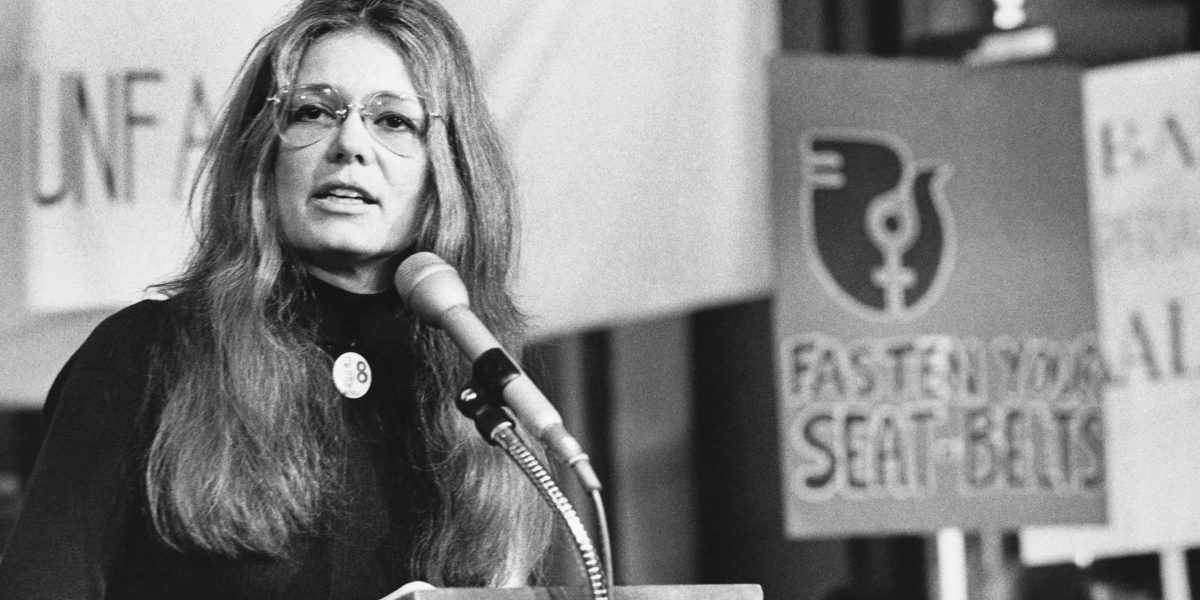
His comments stayed with me because they came just as America lost Gloria Steinem.
“We’re at the end of an era of unprecedented progress for women,” Lorraine Hariton, former CEO of Catalyst, told me as we discussed Steinem’s passing. But, she added, “these are fragile times and we still have an unfinished agenda. It’s time to pass the baton to a new generation.”
That is precisely where we are.
Steinem’s generation fought to open doors that had been closed to women for generations. Our challenge now isn’t simply keeping those doors open. It is preparing the next generation of women to walk through them with the confidence to speak up, take their seats at the table—and eventually lead the organizations behind them.
The baton is being passed.
But America still has a long way to go. The World Economic Forum estimates that global gender parity remains more than a century away. The U.S. ranks 42nd globally, with significant gaps remaining in economic and political leadership.
I’ve spent much of my career on the other side of the doors Gloria Steinem’s generation helped open. Today, I spend my time preparing young women to walk through them.
And what I see makes me both optimistic and impatient.
Women hold nearly half (47%) of entry-level jobs in America. They earn nearly 60% of bachelor’s degrees, build companies, support families and enter professions once largely closed to them. And don’t mistake the popularity of the “trad wife” on social media for the aspirations of an entire generation. The young women I meet want choices. They want careers, financial independence and the opportunity to reach their full economic potential.
Yet economic participation is not the same as economic power.
Women are nearly half of America’s workforce, yet hold just 31% of senior leadership positions.
The disparity is even more striking for entrepreneurs. Of roughly $265 billion in U.S. venture capital invested in 2025, just 1.2% went to companies with all-female founding teams. Half the talent cannot remain a fraction of the leadership and capital if America expects to compete at its best.
David sees this from both ends of the pipeline.
His daughter is just beginning her career. Many of the female founders he represents have already built enormously successful businesses. Yet even at that level, he has seen women encounter senior executives or investors who assume they know better than the woman who actually built the company.
He has also seen the opposite: women supporting other women because they understand that every woman who succeeds makes it easier for the next generation to envision herself doing the same.
“So often, you’re influenced by what you see,” he told me.
That’s why having more women at the table matters. Not simply for representation, but because who young women see leading helps shape what they believe is possible for themselves.
And these disparities don’t suddenly appear in the C-suite.
Girls begin questioning their abilities at age 6. By 14, their confidence has dropped 30%. Recruiters tell me they see talented young women enter job interviews less likely to speak up and advocate for themselves—behaviors that can affect everything from their first job to their lifetime earnings.
The irony? Research shows women outperform men on 17 of 19 leadership capabilities. Yet too many young women still resist calling themselves leaders.
That is why the next chapter of women’s advancement must start earlier.
We need to equip girls with confidence, business skills, networks, financial knowledge and technological fluency before they enter the workplace. We need to give them opportunities to try, fail, succeed and discover that they can do hard things. We need classrooms where girls’ ideas are taken seriously and workplaces where young women can see a path to leadership.
AI makes this work even more urgent. The workplace is being reconstructed before our eyes. Entry-level jobs and traditional career ladders are changing. Employers increasingly expect AI proficiency from new hires. If young women aren’t deliberately prepared for this new economy, yesterday’s victories will not guarantee tomorrow’s opportunities.
And this isn’t simply a women’s issue. It’s an American competitiveness issue.
When women gain greater economic power, the benefits ripple outward. Research shows they invest disproportionately in their families — strengthening financial resilience, communities, and the pipeline of future leaders and entrepreneurs.
Imagine what America could achieve if we fully developed the economic potential of half our population. At a time when global competitiveness increasingly depends on talent, innovation and leadership, we cannot afford to leave that potential on the sidelines.
Gloria Steinem’s generation fought so women could have choices their mothers and grandmothers never had. Our responsibility isn’t simply to admire what they accomplished.
It is to build on it.
If there is one message to take from Steinem’s passing, perhaps it is this: We cannot wait for the next generation of leaders to emerge. We have to create the conditions for them to become leaders.
The baton has been passed. What we do with it now is up to us.
The opinions expressed in Fortune.com commentary pieces are solely the views of their authors and do not necessarily reflect the opinions and beliefs of Fortune.