

Close Menu
Alpha Leaders
  • Home
  • News
  • Leadership
  • Entrepreneurs
  • Business
  • Living
  • Innovation
  • More
    • Money & Finance
    • Web Stories
    • Global
    • Press Release
What's On
Why Every Organization Needs An AI Operating Model

Why Every Organization Needs An AI Operating Model

3 August 2026
Jeff Bezos’s leadership lesson: Build around what never changes

Jeff Bezos’s leadership lesson: Build around what never changes

3 August 2026
AI Isn’t The Biggest Cybersecurity Risk. Yesterday’s Security Model Is

AI Isn’t The Biggest Cybersecurity Risk. Yesterday’s Security Model Is

3 August 2026
Facebook X (Twitter) Instagram
Alpha Leaders
newsletter
  • Home
  • News
  • Leadership
  • Entrepreneurs
  • Business
  • Living
  • Innovation
  • More
    • Money & Finance
    • Web Stories
    • Global
    • Press Release
Alpha Leaders
Home » Harvard researcher unearths data airlines don’t want you to notice: Three-hour flight delays are 4x more common now than 30 years ago
News

Harvard researcher unearths data airlines don’t want you to notice: Three-hour flight delays are 4x more common now than 30 years ago

Press RoomBy Press Room14 August 20255 Mins Read
Facebook Twitter Copy Link Pinterest LinkedIn Tumblr Email WhatsApp
Harvard researcher unearths data airlines don’t want you to notice: Three-hour flight delays are 4x more common now than 30 years ago

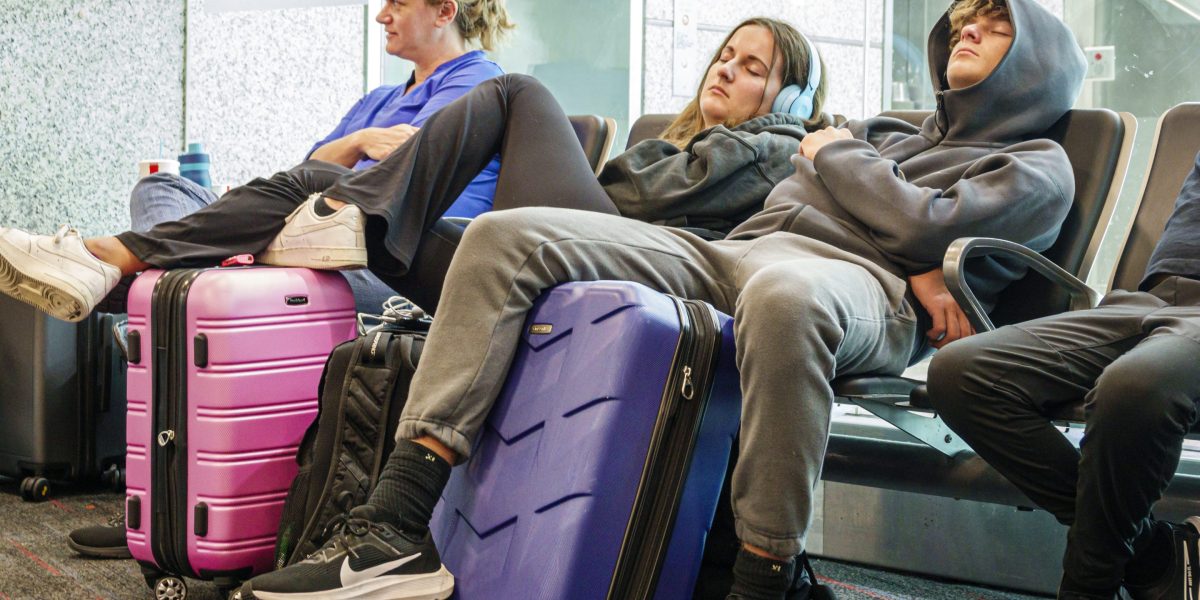
On one sweltering summer afternoon in June, thunderstorms rolled over Boston Logan International Airport. It was the kind of brief, predictable summer squall that East Coasters have learned to ignore, but within hours, the airport completely shut down. Every departure was grounded, and flyers waited hours before they could get on their scheduled flights.

Among those stranded were Maxwell Tabarrok’s parents, in town to help move him into Harvard Business School, where he is completing an economics PhD. Tabarrok told Fortune he was fascinated by how an entire airport could grind to a halt, not because of some catastrophic event, but due to a predictable hiccup rippling through an overstretched system. 

So, he did what any good statistician would: dive into the data. After analyzing over 30 years—and 100 gigabytes—of Bureau of Transportation Statistics data, he found out his parents’ situation wasn’t bad luck: Long delays of three hours or more are now four times more common than they were 30 years ago. 

Not only that, but Tabarrok found airlines are trying to hide the delays by “padding” the flight times—adding, on average, 20 extra minutes to schedules so a flight that hasn’t gotten any faster still counts as “on time.” Thus, on paper, the on-time performance metrics have improved since 1987, even as actual travel times have gotten longer. 

“For 15 years, from 1987 to 2000, the actual and scheduled times stayed very close together,” Tabarrok said. “Then, starting right around 2000, they started diverging—a pretty clear sign airlines made a decision to start padding their schedules to avoid shorter delays.”

The padding carries a hidden economic cost. Using average U.S. wage data, the extra minutes built into flights add up to roughly $6 billion in lost passenger time annually, the researcher calculated. 

There are far more users in the National Airspace system today than there were decades ago, industry sources say. U.S. Department of Transportation data shows weather is the most common cause of non-airline delays.  An ongoing shortage of air traffic controllers, combined with recent FAA equipment outages, has also disrupted operations worldwide. 

A structurally unsound system

For Tabarrok, the root of the problem isn’t just bad weather, outdated infrastructure, or even airline strategy: It’s incentives. He argues the FAA has little reason to respond quickly to rising delays because the agency doesn’t bear the cost of stranded passengers, nor are they rewarded when airports run smoothly.

“I think the costs of delays can double, triple, quadruple over the next 10 years. But is anyone’s career negatively affected at the FAA? Probably not,” Tabarrok said.

He pointed to the shortage of air traffic controllers as an example. Hiring and training more staff would ease congestion and reduce cascading delays—a very simple solution that many people have called for. However, doing so requires sustained effort and leadership that is actually willing to push through bureaucratic inertia.

“You need somebody at the FAA who really cares about improving service. That’s not so easy to do because there’s really no incentive for somebody at the FAA to care a lot about this… they don’t get paid more,” Tabarrok said. “They don’t really get rewarded at all.” 

A FAA spokesperson told Fortune the organization prioritizes safety, which sometimes necessitates delays. They pointed to a chart showing the top five causes of delays—with weather being “by far” the largest cause. They declined to answer questions about airlines padding schedules and incentives to improve airport quality.  

Expanding airport capacity, for Tabarrok, is the most obvious long-term solution to reduce the cascading delays. But the U.S. hasn’t opened a major commercial airport since Denver International in 1995, and runway construction at existing hubs has been minimal, he said. Passenger traffic, meanwhile, has grown by about 50% since 2000, meaning more travelers are concentrated in the same physical space.

While we have built larger aircrafts to help carriers move more people, that’s also created new bottlenecks, he added. Bigger planes take longer to fly at every turn. They take longer to board, unload, and turn around at the gate, so the disruption continues to ripple into the schedule.

“The infrastructure at airports is fixed, especially season to season,” Tabarrok said. “So when you have more demand with fixed infrastructure, there’s going to be more delays.”

‘Pessimistic story’

Further, Tabarrok argued big-ticket fixes like building a new airport or runways face environmental reviews and legal challenges that can drag on for a decade. 

That leaves staffing as the most realistic solution, but even that will require changing how the FAA recruits, licenses, and trains controllers.

“It’s kind of a pessimistic story,” Tabarrok said. “We have these two constraints that aren’t that responsive to the market pressures of people’s demand for more reliable travel, and they’ve been around for a long time.” 

Without those changes, Tabarrok predicts the U.S. will be locked into a cycle where every summer thunderstorm or mechanical hiccup crashes airports and wastes millions of hours of Americans’ lives.

“If you just do some rough estimation of the value of people’s time, multiplied by how much time they’re spending waiting around in airports or waiting around for delays, you can easily get billions of dollars lost every year.” Tabarrok said. “And that cost will keep growing.”

Air Travel Airports American Airlines Group Business Travel Delta Air Lines Flight Delays JFK Airport United Airlines Holdings weather and forecasting
Share. Facebook Twitter Pinterest LinkedIn Tumblr Email Copy Link

Related Articles

Jeff Bezos’s leadership lesson: Build around what never changes

Jeff Bezos’s leadership lesson: Build around what never changes

3 August 2026
Current price of oil as of August 3, 2026

Current price of oil as of August 3, 2026

3 August 2026
Electric air taxis are finally ready for takeoff

Electric air taxis are finally ready for takeoff

3 August 2026
Khosla leads 0 million raise for unicorn mining startup Mariana Minerals

Khosla leads $310 million raise for unicorn mining startup Mariana Minerals

3 August 2026
How Barnes & Noble CEO James Daunt tapped his indie bookstore cred to revive the big-box chain

How Barnes & Noble CEO James Daunt tapped his indie bookstore cred to revive the big-box chain

3 August 2026
He was homeless at 16. Now, his business is about to hit  billion in revenue

He was homeless at 16. Now, his business is about to hit $1 billion in revenue

3 August 2026
Don't Miss
Trump’s Tariffs Will Make AI Data Centers More Expensive

Trump’s Tariffs Will Make AI Data Centers More Expensive

By Press Room4 April 2025

Donald Trump’s administration has gone all-in on AI: A day after his inauguration, the newly-elected…

Unwrap Christmas Sustainably: How To Handle Gifts You Don’t Want

Unwrap Christmas Sustainably: How To Handle Gifts You Don’t Want

27 December 2024
Sam Altman’s World Wants To Scan Your Eyes To Prove You’re Human

Sam Altman’s World Wants To Scan Your Eyes To Prove You’re Human

22 October 2024
Stay In Touch
  • Facebook
  • Twitter
  • Pinterest
  • Instagram
  • YouTube
  • Vimeo
Latest Articles
How To Spot AI Writing By Eye

How To Spot AI Writing By Eye

3 August 20261 Views
Electric air taxis are finally ready for takeoff

Electric air taxis are finally ready for takeoff

3 August 20261 Views
Chinese AI Firm Siphoned American AI Knowledge From Anthropic Claude By Using Millions Of Prompts

Chinese AI Firm Siphoned American AI Knowledge From Anthropic Claude By Using Millions Of Prompts

3 August 20261 Views
Khosla leads 0 million raise for unicorn mining startup Mariana Minerals

Khosla leads $310 million raise for unicorn mining startup Mariana Minerals

3 August 20261 Views

Recent Posts

  • Why Every Organization Needs An AI Operating Model
  • Jeff Bezos’s leadership lesson: Build around what never changes
  • AI Isn’t The Biggest Cybersecurity Risk. Yesterday’s Security Model Is
  • Current price of oil as of August 3, 2026
  • How To Spot AI Writing By Eye

Recent Comments

No comments to show.
About Us
About Us

Alpha Leaders is your one-stop website for the latest Entrepreneurs and Leaders news and updates, follow us now to get the news that matters to you.

Facebook X (Twitter) Pinterest YouTube WhatsApp
Our Picks
Why Every Organization Needs An AI Operating Model

Why Every Organization Needs An AI Operating Model

3 August 2026
Jeff Bezos’s leadership lesson: Build around what never changes

Jeff Bezos’s leadership lesson: Build around what never changes

3 August 2026
AI Isn’t The Biggest Cybersecurity Risk. Yesterday’s Security Model Is

AI Isn’t The Biggest Cybersecurity Risk. Yesterday’s Security Model Is

3 August 2026
Most Popular
Current price of oil as of August 3, 2026

Current price of oil as of August 3, 2026

3 August 20262 Views
How To Spot AI Writing By Eye

How To Spot AI Writing By Eye

3 August 20261 Views
Electric air taxis are finally ready for takeoff

Electric air taxis are finally ready for takeoff

3 August 20261 Views

Archives

  • August 2026
  • July 2026
  • June 2026
  • May 2026
  • April 2026
  • March 2026
  • February 2026
  • January 2026
  • December 2025
  • November 2025
  • October 2025
  • September 2025
  • August 2025
  • July 2025
  • June 2025
  • May 2025
  • April 2025
  • March 2025
  • February 2025
  • January 2025
  • December 2024
  • November 2024
  • October 2024
  • September 2024
  • August 2024
  • July 2024
  • June 2024
  • May 2024
  • April 2024
  • March 2024
  • February 2024
  • January 2024
  • December 2023
  • March 2022
  • January 2021
  • March 2020
  • January 2020

Categories

  • Blog
  • Business
  • Entrepreneurs
  • Global
  • Innovation
  • Leadership
  • Living
  • Money & Finance
  • News
  • Press Release
© 2026 Alpha Leaders. All Rights Reserved.
  • Privacy Policy
  • Terms of use
  • Advertise
  • Contact

Type above and press Enter to search. Press Esc to cancel.