




Close Menu
Alpha Leaders
  • Home
  • News
  • Leadership
  • Entrepreneurs
  • Business
  • Living
  • Innovation
  • More
    • Money & Finance
    • Web Stories
    • Global
    • Press Release
What's On
The Democrats suddenly have a 39-year-old Senate warrior tearing into Trump and ‘Prince Don and Prince Eric’: Jon Ossoff

The Democrats suddenly have a 39-year-old Senate warrior tearing into Trump and ‘Prince Don and Prince Eric’: Jon Ossoff

19 July 2026
NYT Connections Answers Explained: Monday, July 20

NYT Connections Answers Explained: Monday, July 20

19 July 2026
The world is looking ahead toward a post-Iran oil market that offsets most Hormuz volumes

The world is looking ahead toward a post-Iran oil market that offsets most Hormuz volumes

19 July 2026
Facebook X (Twitter) Instagram
Alpha Leaders
newsletter
  • Home
  • News
  • Leadership
  • Entrepreneurs
  • Business
  • Living
  • Innovation
  • More
    • Money & Finance
    • Web Stories
    • Global
    • Press Release
Alpha Leaders
Home » How the U.S. Constitution was designed with respect for ‘a degree of depravity in mankind’
News

How the U.S. Constitution was designed with respect for ‘a degree of depravity in mankind’

Press RoomBy Press Room19 July 20267 Mins Read
Facebook Twitter Copy Link Pinterest LinkedIn Tumblr Email WhatsApp
How the U.S. Constitution was designed with respect for ‘a degree of depravity in mankind’

Many of the founders argued that the country needed a remodeled government. They asked whether it was possible to design a government for the new country that ensured liberty in the face of the inherent flaws of human nature.

In the aftermath of the American Revolutionary War, the national government remained a loose confederation of state governments. While effective in winning the war, the new government faced social and political fissures in the postwar period.

The Second Continental Congress in 1777 produced the first constitution of the United States, the Articles of Confederation. However, differing interests between state governments, including the management of western territory and public finance, slowed ratification. Only in 1781, as the Revolutionary War was entering its final stage, did all of the states finally agree to ratify the articles.

Both the terms of ratification and the text of the Articles of Confederation reflected a suspicion between the state governments, each of which wanted to protect their own local interests rather than cede authority to the national government.

A 1935 painting depicting – and titled – ‘The Adoption of the U.S. Constitution in Congress at Independence Hall, Philadelphia, Sept. 17, 1787.’ John H. Froehlich, painter; photo by Universal History Archive/Universal Images Group via Getty Images

Lumbering system

The limited powers that the articles granted to the national government reflected the lack of consensus between states. The government designed in the articles lacked any strong executive authority and did not have a national judiciary.

Additionally, the national legislature, which the articles referred to as a “league of friendship,” functioned less like a representative organ of the people at large than a council of state governments.

The articles created a single-chamber Congress in which each state cast one vote. Major legislation required a supermajority, and amendments required unanimity.

To many, such a slow-moving, restrictive system was preferable, particularly with the memory of the abuses of the British government still in recent memory.

However, the 1780s saw a series of contentious events – a barely thwarted uprising of frustrated soldiers called the Newburgh Conspiracy, interstate trade disputes, an economic depression and a rural tax rebellion that prompted many American leaders to reconceptualize the role and structure of American government around a more unified, national and interventionist model.

Competing visions

The nationalists were members of the Constitutional Convention that met in Philadelphia in the Summer of 1787 to draft the successor to the articles, the United States Constitution. This group included Alexander Hamilton, James Madison and John Jay. These three men sought to convey that the proper role of government is to protect people from themselves.

The nationalists believed in a more centralized national union that balanced competing interests in the new republic. They sought to eliminate friction between the states by eliminating interstate trade barriers, consolidating state debts and creating a stronger central administrative body under a strong executive.

Furthermore, they sought to create a balance of power by creating a three-part federal government consisting of a two-chamber legislature, an executive branch and a national judiciary. Each would have expanded powers.

In contrast to the articles, the proposed Constitution included uniform national commercial regulation, monetary controls such as the exclusive right of the national government to issue legal tender, augmented executive powers to determine foreign policy and an overarching federal court structure. It also included an explicit national power to suppress uprisings.

The representatives to the convention, which also included prominent figures such as George Washington and Benjamin Franklin, considered the federal government’s ability to deal with uprisings and fiscal policy to be particularly important. It was also topical: A tax imposed on cash-poor farmers to pay down the public war debt had just prompted a rebellion in western Massachusetts led by Revolutionary veteran Daniel Shays.

Many rebels believed the burden of repaying the public debt fell disproportionately on common people while benefiting elites. Nationalist political theorists such as Hamilton, Madison and Jay saw such revolts against national authority as the product of demagogues instigating unrestrained urges into social movements they referred to as “factions.”

Initially, the terms of the new Constitution received substantial opposition from prominent political writers later known as the Anti-Federalists. These often anonymous authors began publishing criticisms of the yet unratified Constitution as an unwarranted accumulation of federal power that would endanger the hard-won liberties secured by the Revolutionary War.

This is where the document that has become known as the Federalist Papers comes in.

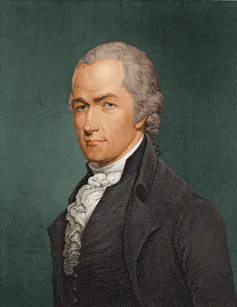
A gray-haired man dressed in a Colonial manner, with a ruffled white shirt and gray waistcoat and jacket.

Alexander Hamilton, who along with James Madison and John Jay wrote the collection of essays called the Federalist Papers. Stock Montage/Getty Images

‘If men were angels …’

Hamilton, Madison and Jay responded to these criticisms as a group. Adopting the pen name Publius, they published 85 essays in New York newspapers supporting ratification. In defense of the Constitution’s proposal to increase the powers of the proposed national government, these authors turned to some of the most basic philosophical questions about humanity.

Each argued that the inherent flaws of human nature necessitated a strong government to check political abuse, self-interest and even violence that they saw as inherent in the fabric of human society. They rallied around the position reflected in Madison’s famous statement in the essay known as Federalist 51 that “if men were angels, no government would be necessary.”

The Federalist Papers include proposals for institutional solutions that sought to redirect the destructive drives of individuals toward positive social ends. To the authors, a new constitutional government that controlled both the impulses of the masses and the abuses of their leaders would serve as the means through which the new United States government could accomplish this task.

Each saw human nature as susceptible to corruption by base impulses and self-interest.

In Federalist 10, Madison argued that faction is “sown in the nature of man.”

Similarly, in Federalist 6, Hamilton rejected the commonly held idea that republics were automatically peaceful. Instead, he argued, political leaders and states were driven by ambitions and jealousies, which he saw as a characteristic shortcoming of the government under the Articles of Confederation as well as a law of nature governing relations between nations.

Hamilton wrote that if the states remained disunited, then “the subdivisions into which they might be thrown would have frequent and violent contests with each other.” To argue otherwise, he wrote, would be “to forget that men are ambitious, vindictive, and rapacious.”

Consequently, as Hamilton asserted in Federalist 15, governments must have effective coercive authority to enforce laws because they cannot rely solely on the goodwill and civic virtue of their citizens: “If there be no penalty annexed to disobedience, the resolutions or commands which pretend to be laws will, in fact, amount to nothing more than advice or recommendation.”

Ultimately, the defense of the Constitution provided by the Federalist Papers sought to frame the new government in terms of a skeptical view of humanity that recognized what Madison called “a degree of depravity in mankind.”

They also asserted that constitutional design and balanced government could control these dangerous impulses. As Madison added, “There are other qualities in human nature which justify a certain portion of esteem and confidence.”

Donovan Fifield, Instructor, Department of History, University of South Carolina

This article is republished from The Conversation under a Creative Commons license. Read the original article.
The Conversation

Constitution history
Share. Facebook Twitter Pinterest LinkedIn Tumblr Email Copy Link

Related Articles

The Democrats suddenly have a 39-year-old Senate warrior tearing into Trump and ‘Prince Don and Prince Eric’: Jon Ossoff

The Democrats suddenly have a 39-year-old Senate warrior tearing into Trump and ‘Prince Don and Prince Eric’: Jon Ossoff

19 July 2026
The world is looking ahead toward a post-Iran oil market that offsets most Hormuz volumes

The world is looking ahead toward a post-Iran oil market that offsets most Hormuz volumes

19 July 2026
Trump hails World Cup as huge win for America: ‘It turned out we were a soccer country, and I think it’s going to remain’

Trump hails World Cup as huge win for America: ‘It turned out we were a soccer country, and I think it’s going to remain’

19 July 2026
The people sewing your clothes can’t see the stitches clearly — a  pair of glasses could unlock  billion in gains

The people sewing your clothes can’t see the stitches clearly — a $10 pair of glasses could unlock $27 billion in gains

19 July 2026
Trump officials were trying to use a Biden rule to gut billions in grants — a judge just said no

Trump officials were trying to use a Biden rule to gut billions in grants — a judge just said no

19 July 2026
Infantino’s 60,000-mile World Cup odyssey — the FIFA chief’s whopping private jet trips don’t even include the funeral in Qatar

Infantino’s 60,000-mile World Cup odyssey — the FIFA chief’s whopping private jet trips don’t even include the funeral in Qatar

19 July 2026
Don't Miss
Unwrap Christmas Sustainably: How To Handle Gifts You Don’t Want

Unwrap Christmas Sustainably: How To Handle Gifts You Don’t Want

By Press Room27 December 2024

Every year, millions of people unwrap Christmas gifts that they do not love, need, or…

Exclusive: DeFi platform Azura launches after raising .9 million from Initialized

Exclusive: DeFi platform Azura launches after raising $6.9 million from Initialized

22 October 2024
Sam Altman’s World Wants To Scan Your Eyes To Prove You’re Human

Sam Altman’s World Wants To Scan Your Eyes To Prove You’re Human

22 October 2024
Stay In Touch
  • Facebook
  • Twitter
  • Pinterest
  • Instagram
  • YouTube
  • Vimeo
Latest Articles
Trump hails World Cup as huge win for America: ‘It turned out we were a soccer country, and I think it’s going to remain’

Trump hails World Cup as huge win for America: ‘It turned out we were a soccer country, and I think it’s going to remain’

19 July 20262 Views
Can AI Dependence Develop Into AI Addiction?

Can AI Dependence Develop Into AI Addiction?

19 July 20261 Views
The people sewing your clothes can’t see the stitches clearly — a  pair of glasses could unlock  billion in gains

The people sewing your clothes can’t see the stitches clearly — a $10 pair of glasses could unlock $27 billion in gains

19 July 20262 Views
Today’s NYT Strands Hint, Spangram And Answers For Monday, July 20 (Small Talk)

Today’s NYT Strands Hint, Spangram And Answers For Monday, July 20 (Small Talk)

19 July 20261 Views

Recent Posts

  • The Democrats suddenly have a 39-year-old Senate warrior tearing into Trump and ‘Prince Don and Prince Eric’: Jon Ossoff
  • NYT Connections Answers Explained: Monday, July 20
  • The world is looking ahead toward a post-Iran oil market that offsets most Hormuz volumes
  • Samsung’s Galaxy Z Fold8 Future Is Caught Between Honor And Apple
  • Trump hails World Cup as huge win for America: ‘It turned out we were a soccer country, and I think it’s going to remain’

Recent Comments

No comments to show.
About Us
About Us

Alpha Leaders is your one-stop website for the latest Entrepreneurs and Leaders news and updates, follow us now to get the news that matters to you.

Facebook X (Twitter) Pinterest YouTube WhatsApp
Our Picks
The Democrats suddenly have a 39-year-old Senate warrior tearing into Trump and ‘Prince Don and Prince Eric’: Jon Ossoff

The Democrats suddenly have a 39-year-old Senate warrior tearing into Trump and ‘Prince Don and Prince Eric’: Jon Ossoff

19 July 2026
NYT Connections Answers Explained: Monday, July 20

NYT Connections Answers Explained: Monday, July 20

19 July 2026
The world is looking ahead toward a post-Iran oil market that offsets most Hormuz volumes

The world is looking ahead toward a post-Iran oil market that offsets most Hormuz volumes

19 July 2026
Most Popular
Samsung’s Galaxy Z Fold8 Future Is Caught Between Honor And Apple

Samsung’s Galaxy Z Fold8 Future Is Caught Between Honor And Apple

19 July 20261 Views
Trump hails World Cup as huge win for America: ‘It turned out we were a soccer country, and I think it’s going to remain’

Trump hails World Cup as huge win for America: ‘It turned out we were a soccer country, and I think it’s going to remain’

19 July 20262 Views
Can AI Dependence Develop Into AI Addiction?

Can AI Dependence Develop Into AI Addiction?

19 July 20261 Views

Archives

  • July 2026
  • June 2026
  • May 2026
  • April 2026
  • March 2026
  • February 2026
  • January 2026
  • December 2025
  • November 2025
  • October 2025
  • September 2025
  • August 2025
  • July 2025
  • June 2025
  • May 2025
  • April 2025
  • March 2025
  • February 2025
  • January 2025
  • December 2024
  • November 2024
  • October 2024
  • September 2024
  • August 2024
  • July 2024
  • June 2024
  • May 2024
  • April 2024
  • March 2024
  • February 2024
  • January 2024
  • December 2023
  • March 2022
  • January 2021
  • March 2020
  • January 2020

Categories

  • Blog
  • Business
  • Entrepreneurs
  • Global
  • Innovation
  • Leadership
  • Living
  • Money & Finance
  • News
  • Press Release
© 2026 Alpha Leaders. All Rights Reserved.
  • Privacy Policy
  • Terms of use
  • Advertise
  • Contact

Type above and press Enter to search. Press Esc to cancel.