


The world economy was already grappling with a perplexing assortment of variables, from geopolitical conflicts and a slowdown in China to the evolving complexities of climate change. Then, President Trump unleashed a plan to uproot decades of trade policy.
In starting a process to impose so-called reciprocal tariffs on American trading partners, Mr. Trump increased volatility for international businesses. He broadened the scope of his unfolding trade war.
In basic concept, the argument for reciprocal tariffs is straightforward: Whatever levies American companies face in exporting their wares to another country should apply to imports from that same country. Mr. Trump has long championed this principle, presenting it as a simple matter of fairness — redress to the fact that many American trading partners maintain higher tariffs.
Yet in practice, calculating individual tariff rates on thousands of products drawn from more than 150 countries poses a monumental problem of execution for a vast range of companies, from American manufacturers dependent on imported parts to retailers that buy their goods from overseas.
“It’s potentially a herculean task,” said Ted Murphy, an international trade expert at Sidley Austin, a law firm in Washington. “For every widget, every tariff classification, you can have 150 different duty rates. You’ve got Albania to Zimbabwe.”
The order that Mr. Trump signed on Thursday directed his agencies to study how to proceed with reciprocal tariffs. That raised the risk of increasing costs for American consumers at a time of deepening concern over inflation, challenging the president’s own vows to bring down prices on groceries and other everyday items. And that heightened the possibility of greater delay from the Federal Reserve in lowering borrowing costs.
It also hastens the diminishing of the world trading system, which has long been centered on multilateral blocs and adjudicated by the World Trade Organization. Mr. Trump is aiming to advance a new era in which treaties give way to country-to-country negotiations amid a spirit of nationalist brio.
The transition threatens to add to strains on global supply chains after years of upheaval. International businesses have contended with an unfolding trade war between the world’s two largest economies, the United States and China. They have confronted impediments to passage through the Suez and Panama Canals, sending shipping prices soaring.
Now, Mr. Trump has presented them with another formidable puzzle.
Under the system that has held sway for three decades, member countries of the World Trade Organization set tariffs for every type of good, extending the same basic rate to all members. They have also negotiated treaties — with other countries, and via regional trading blocs — that have further eased tariffs.
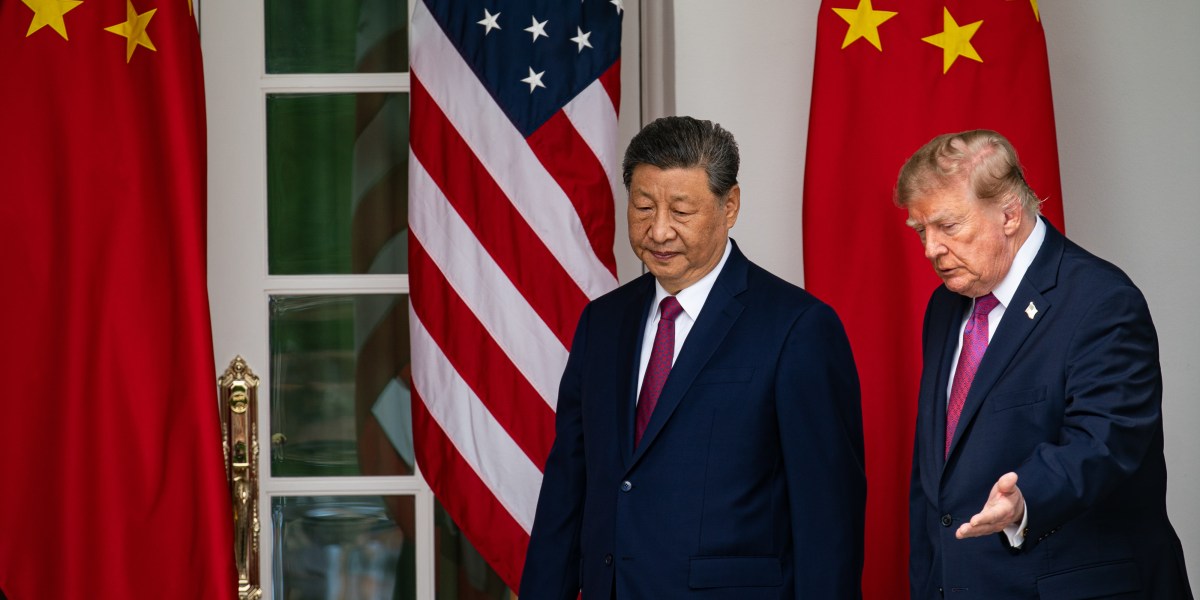
Mr. Trump has long described the United States as a victim of this structure, citing trade deficits with China, Mexico and Germany. In announcing the advent of reciprocal tariffs on Thursday, he served notice that he claims authority to renegotiate the terms to his liking, absent respect for existing trade agreements.
It seemed no coincidence that Mr. Trump made his announcement on the day that India’s prime minister, Narendra Modi, visited the White House. The United States runs a substantial trade deficit with India, with the value of its imported goods outweighing its exports last year by $45 billion.
Those imports include plastics and chemical products that incur tariffs of less than 6 percent when shipped to the United States, according to data compiled by the World Bank. When similar categories of American goods are exported to India, they confront tariffs ranging from 10 to 30 percent.
If the Trump administration were to lift American levies to equal levels, that would force American factories to pay more for chemicals and plastics.
The same pattern holds across a broad sweep of consumer and industrial products — footwear from Vietnam, machinery and agriculture from Brazil, textiles and rubber from Indonesia.
A leading electronics industry trade association, IPC, on Thursday warned that increased trade protectionism would damage the American economy.
“New tariffs will raise manufacturing costs, disrupt supply chains, and drive production offshore, further weakening America’s electronics industrial base,” the association’s president, John W. Mitchell, said in a statement.
Some experts see in Mr. Trump’s approach a potential negotiating tactic aimed at forcing trading partners to lower their own tariffs, rather than a prelude to the United States lifting its own. If that proves true, the process of calculating new tariff rates might actually lower prices.
“There are a lot of ways this can go very badly for us,” said Christine McDaniel, a former Treasury official under President George W. Bush and now a senior research fellow at the Mercatus Center at George Mason University in Virginia. “But if he can get other countries to open up their markets, there is a narrow path where this could end up promoting trade,” she said.
Still others warn that any process of negotiation could be guided less by national objectives than the interests of Mr. Trump’s allies. Tesla, the electric vehicle company run by the administration loyalist Elon Musk, could benefit from exemptions to increased tariffs on key components.
The tumult is leaving companies that operate in the United States having to guess how events will transpire as they weigh the costs of importing parts or finished goods. Business, as the cliché goes, craves nothing more than certainty. That commodity is getting more scarce.
Ever since Mr. Trump’s first term, when he put tariffs on Chinese imports — a policy that President Joseph R. Biden Jr. extended — companies that sell into the American market have shifted some production out of China.
Surging prices to move cargo by container ship have prompted companies to close the distance between their factories and their American customers, a trend known as nearshoring.
Walmart, a retail empire ruled by the pursuit of low prices, has moved orders from Chinese plants to India and Mexico. Columbia Sportswear has scouted factory sites in Central America. MedSource Labs, a medical device manufacturer, has moved orders from factories in China to a new plant in Colombia.
Mr. Trump has challenged the merits of such strategies by threatening 25 percent tariffs on imports from Mexico, Canada and Colombia, before quickly delaying or setting aside such plans. He has imposed across-the-board levies on steel and aluminum. He has delivered 10 percent tariffs on Chinese imports. Where he may turn next is the subject of a potentially expensive parlor game playing out in corporate board rooms.
Some surmise that the uncertainty stemming from these moves is precisely the point. Mr. Trump has long asserted that his ultimate goal is to force businesses to set up factories in the United States — the only reliable way to avoid U.S. tariffs. The more countries he menaces, the greater the risks for any company that invests in a plant somewhere else.
The trouble is that even businesses with factories in the United States depend on parts and raw materials from around the world. More than one-fourth of American imports represent parts, components and raw materials. Making these goods more expensive damages the competitiveness of domestic companies, imperiling American jobs.
Last week, Ford Motor warned that tariffs on Mexico and Canada would wreak havoc with its supply chains.
“A 25 percent tariff across the Mexico and Canadian border will blow a hole in the U.S. industry that we have never seen,” the company’s chief executive, Jim Farley, said.
For now, the business world is again struggling to divine which of Mr. Trump’s pronouncements are merely a gambit, and which portend real changes.
On spreadsheets maintained by multinational companies, the applicable tariff rates for every country on earth suddenly seem subject to reworking.
Or not.
“We take Trump seriously, but not necessarily literally,” said Mr. Murphy, the trade lawyer. “He talks in broad strokes, but we have to watch what actually emerges.”