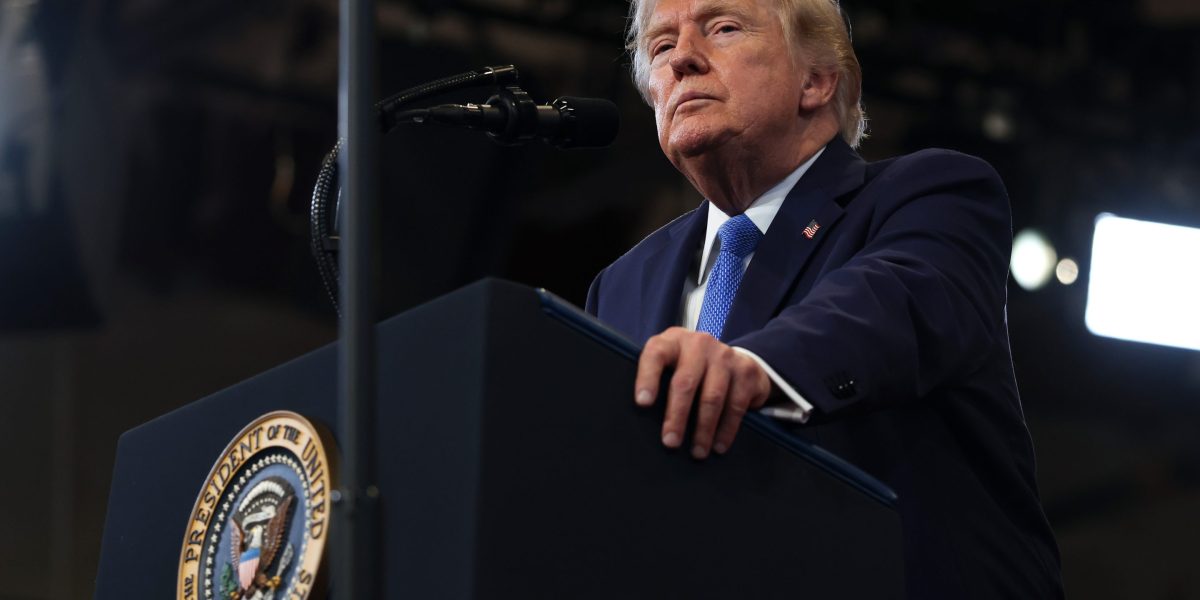




Decades of trade integration across North America are on the precipice of major disruption by tariffs that President Trump says he wants to impose on Canada and Mexico, the United States’ top trading partners.
And while tariffs are predicted to inflict pain on all three nations, they would cause more damage to Canada and Mexico, smaller economies that are deeply dependent on the United States.
Officials in both countries breathed a brief sigh of relief on Monday, when Mr. Trump stopped short of making tariffs part of his blizzard of executive orders on his first day in office. But the relief was short-lived: later in the evening, Mr. Trump told reporters he was still planning to pursue tariffs.
“We’re thinking in terms of 25 percent on Mexico and Canada,” Mr. Trump said in the Oval Office. “I think we’ll do it February 1.”
Trade experts are gauging whether tariffs will materialize or whether the threat alone is a negotiating tactic aimed at winning concessions from Mexico and Canada. Both countries avoided steep tariffs during the first Trump administration, and both are wagering that the United States needs Mexico and Canada to take on China, a much larger rival.
Economists and policymakers say tariffs would cause a loss of income and jobs and force consumers to pay more for many products.
Mr. Trump on Monday signed an executive order directing federal agencies to conduct a sweeping review of U.S. trade policies, which could result in further actions against Mexico and Canada.
The tariffs Mr. Trump is promising would most likely be met with retaliatory tariffs from Canada and Mexico and would unravel closely integrated production lines and supply chains across North America.
More than $1.5 trillion worth of items would be on the line — the total value of all goods traded between the United States and Canada, and the United States and Mexico. (This is the 2023 total value of these trading relationships, the most recent available, according to U.S. government data.)
Economists predict that the initial effect would be negative for all three nations, which are bound by a free-trade agreement known as USMCA (United States-Mexico-Canada).
The negative effect is tricky to translate into hard numbers: not only is it unclear exactly what items Mr. Trump would target and how Mexico and Canada would respond, but the consequences can shift over time, including a rise in inflation as goods become more expensive, loss of jobs and a chill on spending as consumers worry about diminished incomes.
And governments often intervene to lessen some of these negative effects. Canadian government officials have already said that they would consider bailing out businesses and supporting workers who are most affected.
But some industries would be swiftly disrupted: Agriculture, automobiles and energy suppliers, pillars of all three economies, would be upended by blanket tariffs.
United States
A few pockets of industry in the United States might welcome a 25 percent tariff on goods from Canada and Mexico — for example, American growers of tomatoes and other seasonal fruits and vegetables that have trouble competing with their Mexican counterparts.
But most industries would be hit hard by the economic disruption of such high tariffs.
Even groups that might prefer more protections against Mexican exports, like U.S. autoworkers, could be harmed if tariffs suddenly caused auto-supply chains to grind to a halt. Both the United Auto Workers and the United Steelworkers International Union also stretch across the U.S.-Canada border and include members in Canada, meaning they typically oppose any restrictions on Canadian exports.
Since the United States is North America’s largest economy and the least dependent on trade, the proportional effect on the U.S. economy would be less than on the Mexican or Canadian economies.
But tariffs would raise prices for consumers and add inflation. American households and businesses could expect to pay higher prices for a variety of goods subject to tariffs, including avocados, beer, steel, cars and petroleum.
Those higher prices would discourage purchases and most likely end up slowing the economy. Researchers at the Peterson Institute for International Economics in Washington estimate that a 25 percent tariff on all exports from Mexico and Canada would lower U.S. gross domestic product by about $200 billion for the duration of the second Trump administration.
U.S. industries that export to Canada and Mexico would also presumably be hurt if those countries turned around and imposed duties on U.S. goods. The Canadian government has made plans to target orange juice from Florida, whiskey from Tennessee and peanut butter from Kentucky, while the Mexican government has been drawing up its own retaliation plans.
Canada
The U.S.-Canada trade relationship is characterized by some eye-popping facts highlighting the countries’ close economic, industrial and trading ties.
Some $2.5 billion worth of goods is traded over the border every day, making it an $800 billion-a-year trade relationship.
For the auto industry, the U.S.-Canada border can often seem irrelevant, with a single vehicle crossing back and forth up to eight times before it is fully assembled.
Canada exports 80 percent of its oil to the United States, which gets half of its imported oil from Canada. And Canadian energy powers homes and businesses across the United States, especially in New England, where Quebec exports hydroelectric power.
And Canada sends other crucial commodities to the United States, like potash, which is used in fertilizer, and uranium, which is needed for nuclear energy production.
Should Mr. Trump pursue tariffs, the repercussion would depend on how extensive they are or if certain Canadian goods, like oil, might be exempt. But the fallout for Canada could be devastating.
Economists predict a 2 percent to 2.6 percent loss of economic output annually. More than a million Canadian jobs would be in jeopardy, including about half a million in the auto industry in Ontario, according to the province’s premier, Doug Ford.
If tariffs were placed on Canadian energy and Canada retaliated by limiting exports of oil, the effect would be felt across the country, particularly in Alberta, Canada’s oil-exporting hub.
Alberta’s provincial leader has rejected a federal government plan that would use oil as a lever to pressure the Trump administration into backpedaling from imposing tariffs.
Mexico
Mexico stands out among major economies for its dependence on trade with the United States, sending about 80 percent of its exports to its neighbor, with many coming from factories operating within 30 miles of the border.
Since those plants are overwhelmingly focused on serving the U.S. market, that makes Mexico far more vulnerable to tariffs than a large industrial economy like Germany that can more easily reorient its exports to an array of different markets.
Tariffs of 25 percent would be ruinous for Mexico, said Marcus Noland, executive vice president and director of studies at the Peterson Institute for International Economics.
“In effect, it would initiate a process of deindustrialization of Mexico,” he said.
Mr. Noland estimated that such tariffs could reduce Mexico’s economic output growth by about 2 percentage points, potentially resulting in large-scale factory closures and job losses. The automobile industry, which employs more than one million people in Mexico and relies heavily on complex supply chains moving parts across the border, could be especially vulnerable.
Other sectors of Mexico’s economy could come under severe pressure in the face of steep tariffs. Automobiles, computers, cables, phones and medical instruments are among Mexico’s largest exports.
Agriculture is another weak spot for Mexico, which supplies 63 percent of U.S. vegetable imports and 47 percent of its fruit and nut imports. The tariffs could hit emblematic products like avocados, which have experienced skyrocketing demand among American consumers since the United States began importing them from Mexico.
Mexico’s ability to soften the blow from tariffs is also limited because of budgetary challenges, said Kimberley Sperrfechter, an emerging markets economist at Capital Economics in London, citing a budget shortfall in 2024 that reached its highest level in decades.
One sector of Mexico’s economy that could benefit from tariffs is the tourism industry. If tariffs are imposed, the country’s currency, the peso, could weaken, Ms. Sperrfechter said, and make Mexico even more appealing to U.S. tourists, who represent the country’s largest international visitor group.
“But,” she added, “that’s unlikely to offset the hit to other sectors.”