



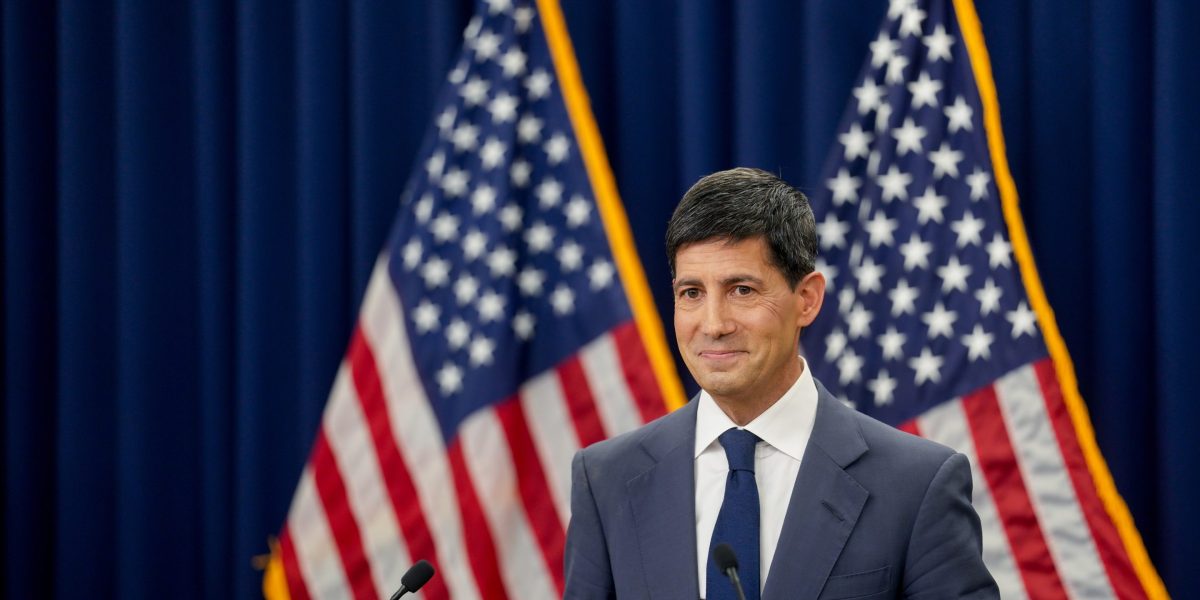
The first time former Secretary of State Condoleezza Rice encountered Kevin Warsh was in the 1980s when she was an associate professor of political science at Stanford University and he was an undergraduate. She knew he would go on to do something special. Admittedly, this isn’t an unusual phenomenon—it’s Stanford, after all.
However, by the fourth or fifth time Warsh knocked on her door in hopes of securing an audience during office hours, Rice realized Warsh wasn’t just bright; he was unusually determined—even by elite academia standards.
“He was persistent,” Rice told Fortune in an exclusive interview. “Kevin’s one of those people who demands more of himself than others could ever.”
Any insight into the enigma that is Warsh, the new chairman of the Federal Reserve, is of use to Wall Street and economists around the world. Warsh’s voice sets the tone CEOs listen to before making their biggest borrowing bets, that foreign investors study for details on the trajectory of the U.S. economy, and that consumers rely on to strengthen the value of their wallets.
Warsh’s tentative first steps in the role are being scrutinized perhaps more than any Fed chair in history. His appointment comes after unprecedented political attacks on the Fed from the White House during the second Trump administration, leading many to fear he is either the Oval Office’s “sock puppet” or lacks the backbone to stand up for vital Fed independence. Wall Street analysts also lament his stance on forward guidance (or lack thereof), saying its reduction undoes transparency at the central bank.
Everyone wants to know what Warsh is thinking, though Trump’s nominee has made it clear he’s not yet ready to show his cards. But a handful of people know how Warsh thinks. Those who have orbited his inner circle say Warsh’s depthless curiosity, strong interpersonal skills, and his ability to build accord have primed him to step into the central bank at what is, by his own definition, a moment “among the most consequential in our nation’s history.”
“I think he’s very well equipped in terms of his native abilities and the way he relates to people,” Donald Kohn, former Governor and later Vice Chairman of Governors at the Federal Reserve, tells Fortune. “He’s acquired a lot of economics over the years in the Fed and at Hoover, hanging out with some very good economists.”
The native New Yorker has won over cynics before, his peers tell Fortune. And while his CV now boasts the gongs expected of a central bank chairman, it’s his social fluency that could see the Fed emerge from a battering political storm stronger than it entered.
Warsh’s character
Few people have worked with Warsh as consistently as his mentor and close friend Rice—indeed, he told the Senate Banking Committee hearing during his confirmation trial that it is unlikely he would be sitting before them without the guidance of Rice, who now serves as Hoover Institution director.
The duo met as student and teacher, and became peers in D.C. Rice was the national security advisor to President George W. Bush from 2001 until she became his Secretary of State in 2005, while Warsh served as special assistant to the president for economic policy and executive secretary of the National Economic Council from 2002 until 2006, when he joined the Fed as a governor. Later, they reunited at Stanford as colleagues.
“I always said with Kevin, it wasn’t the first answer. He wanted the second and third-order answers,” Rice tells Fortune. “I loved having students like that, who were not just interested in getting what they needed for the test. They were curious beyond that and wanted to understand something more deeply.”
At Stanford, Warsh brushed shoulders with the likes of Nobel Prize-winning economist Milton Friedman and four-time federal cabinet member George Shultz. Warsh “fit right in” with this academic cohort, Rice added, courtesy of “deep curiosity” that has been a permanent feature throughout their interactions.
Warsh will need that curiosity in the current economic environment, particularly when so much hinges on the promise of AI. Prominent voices fear that the end result of the transformative technology is a job bloodbath and national security catastrophes, while others believe a new era of productivity is ready to be unlocked, with society living longer and healthier lives.
Every central banker is weighing the balance of these risks, though with Big Tech on his doorstep, Warsh will need to be all the more discerning in both his interpretation of the outlook and the delivery of his analysis.
But there are critics who say Warsh doesn’t always dig deep enough, particularly when sharing his worldview publicly. The definiteness of his statement: “I don’t believe in forward guidance,” for example, was so surprising to notable Fed alum Claudia Sahm that she told Fortune: “I almost fell out of my chair.” Another source shared similar concern, saying Warsh has shown aversion to getting into the macroeconomic weeds when he’s on the record.
This criticism may belie a bid to make complex topics more easily accessible to audiences ranging from Wall Street to the man on the street. “Kevin can go at two different speeds,” says Rice. “He can go into a class at the business school, and when you’re teaching, you have to do it in pretty straightforward ways, and he’s very good at that, and with public audiences, he’s very good at that.”
“But nobody should think that Kevin’s understanding or views of the economy are simplistic. He’s got very deep knowledge and can more than hold his own with these economists who spent their lives studying it.”
Warsh under pressure
Years after joining the Fed, Warsh found himself in a level of hot water few central bankers have experienced: he shouldered responsibility for navigating the 2008 financial crisis as one of three top decision-makers at the Fed, alongside then-chairman Ben Bernanke and the contemporary Vice Chair of the Board of Governors, Donald Kohn.
Kohn had worked in the Federal Reserve system for the better part of three decades when a fresh-faced Warsh, the youngest Board Governor in history, arrived on Capitol Hill. In fact, Kohn’s work for the Kansas City Fed began the year his future colleague was born.
Nevertheless, Kohn was surprised by how accurately Warsh could read a group. Warsh was a man of good humor, a well-timed pop culture reference, and calm demeanor, Kohn tells Fortune.
“When I was in charge of the committee on the reserve banks, one of the things we did was go around to six of the reserve banks every year and talk to the boards of directors, meet with the staff and evaluate where things were,” Kohn recalls. “Kevin and I started playing a game, where [we would] come out of these meetings and I would ask him: ‘So, what do you make of the people you just met?’ and he nailed so many people.
“This guy had spent two hours with a group of people and he had the insight into them that I had acquired over a number of years. I was very impressed with his ability to read people, to figure out which people had something to contribute and which maybe didn’t have so much to contribute, his basic intelligence but also his emotional intelligence, and his ability to relate to people.”
Kohn and Warsh’s partnership endured the era’s enormous pressure. In neighboring offices during the height of the financial crisis, Warsh and Kohn would make daily pilgrimages to Bernanke’s office—weekends or otherwise—to go over the day’s developments and plan for the next. Friday afternoons were spent with the Comptroller of the Currency, John Dugan, Treasury Under Secretary Robert Steele, and Under Secretary for International Affairs, Dave McCormick, who’s now a U.S. senator.
Warsh shone in these teams, says Kohn: He was a hard worker, pleasant, helpful, and a man who “didn’t mince words.” But perhaps his most useful—and rare—trait was the combination of his people skills and his financial background, courtesy of his early career at Morgan Stanley. Having earned a law degree from Harvard, Warsh joined the investment bank’s mergers and acquisitions department in 1995, the nucleus where negotiation meets financial expertise.
Bringing that insight to the Fed was timely, Kohn explained: “Kevin was especially important as a liaison with the financial sector. We would get information from people who would call and say, ‘This horrible thing is happening, that horrible thing is happening, we need help,’ … and he could help us because he knew these people and read them so well.
“He helped us understand what we were hearing and who we should listen to very carefully because they were smart and honest and were conveying information, and who maybe would be arguing their book.”
Warsh has continued to build private sector insight after leaving the central bank: He became a partner at Duquesne Family Office, led by legendary investor Stan Druckenmiller, and served on the boards of UPS and global commerce giant Coupang.
Warsh’s people skills mean he “thinks more like a CEO than a Fed chair,” Jerry Yang, the co-founder of Yahoo! Inc. and a longtime friend of the central bank chairman, tells Fortune. The pair met in a computer lab at Stanford and became close friends when Warsh would later visit Silicon Valley in his capacity as an investor. Policy “is obviously important, but the way he comes at [it] is very human, and it’s about the people that work there doing their best to be excellent, rather than some output that people want to put a box on,” Yang says. “So that’s what’s refreshing and different … Kevin just really thinks about a kind of inside out [approach]: ‘What do we have? What is our job? What would be excellent?’”
Warsh and consensus
The Fed Chairman’s job may be the pinnacle of economic power, but day-to-day, it’s a lot of herding cats. The Fed chair needs to corral staff in a new direction and muster a consensus from Federal Open Market Committee members.
The goal of the job is not being proved right—rather, it is landing on the correct outcome for the central bank and, by proxy, for the economy. The basics of the role (maximising monetary policy conditions for low inflation and full employment) should ideally be agreed upon by the FOMC as broadly as possible, giving markets confidence in its policy stance. But to deliver the “new chapter” and “fresh perspective” Warsh has promised, he’ll need unequivocal buy-in from those within the walls of the central bank. Warsh has been positive in the early days, lauding his colleagues’ “new ideas, new thinking, and genuine interest in moving the Fed forward.”
Warsh’s recent time at Hoover has been good practice, said Dr. Rice: “He’s led policy teams at Hoover … it’s not so easy to get a group of academics to steer in the same direction. He’s been very good at that.
“When I say somebody’s patient, it can come across as: ‘Well, if you’re chairman of the Fed or Secretary of State, do you really want to be patient?’ But [in Warsh] there’s a willingness to engage and to not shortcut people when they’re trying to get to a common position.”
Mark Zandi, chief economist at Moody’s, says Warsh always let him make his case. The two men served together on the economic advisory board to the nonpartisan Congressional Budget Office in 2025, and Zandi told Fortune that while “my views on policy have often differed from his, I always felt he gave mine a fair hearing.”
And while one might expect a flattering perspective from Warsh’s allies, even a former colleague who said Warsh wouldn’t be their first choice to lead the Fed told Fortune they believe he has the institution’s best interests at heart, that he would work tirelessly, and that he would compromise if it meant the central bank was stronger for it.
“He’s very mission-driven; he understands what the Federal Reserve is supposed to do and not to do, and I think he wants to really set those principles in the early days,” Yang says. “He wants to build a Fed that really stands the test of time.”