



The U.S.-Iran ceasefire was already not much of a ceasefire as missiles, drones, and bombs continue exploding around the Persian Gulf.
But this week’s latest exchange of fire over who controls the Strait of Hormuz threatens to snuff out the deal just weeks after it was signed.
On Sunday, Iran launched new attacks on Kuwait and Bahrain, while threatening a “complete halt” to peace talks. It continuined a tit-for-tat cycle of retaliation after U.S. airstrikes punished the regime for targeting commercial ships with drones.
The renewed skirmishes come as Iran seeks to shut down an alternate route through the strait that’s protected by the U.S. and bypasses a Tehran-backed channel meant to normalize its control over the vital energy chokepoint.
Over the weekend, the alternate route, which hugs the Omani coast, was expanded to accommodate both inbound and outbound traffic. That further dilutes Iran’s hold over the strait—its top source of leverage.
President Donald Trump has called Iran’s actions a violation of the ceasefire and threatened devastating consequences. But he has also signaled reluctance to go back to war and hasn’t followed through on similar threats.
“Iran is choking Hormuz, forcing a brutal choice: escalate or surrender control,” University of Chicago political science professor Robert Pape posted on X. “Trump wants out, but Iran is forcing the ‘escalation trap.’ The collision course is set, and worse is yet to come.”
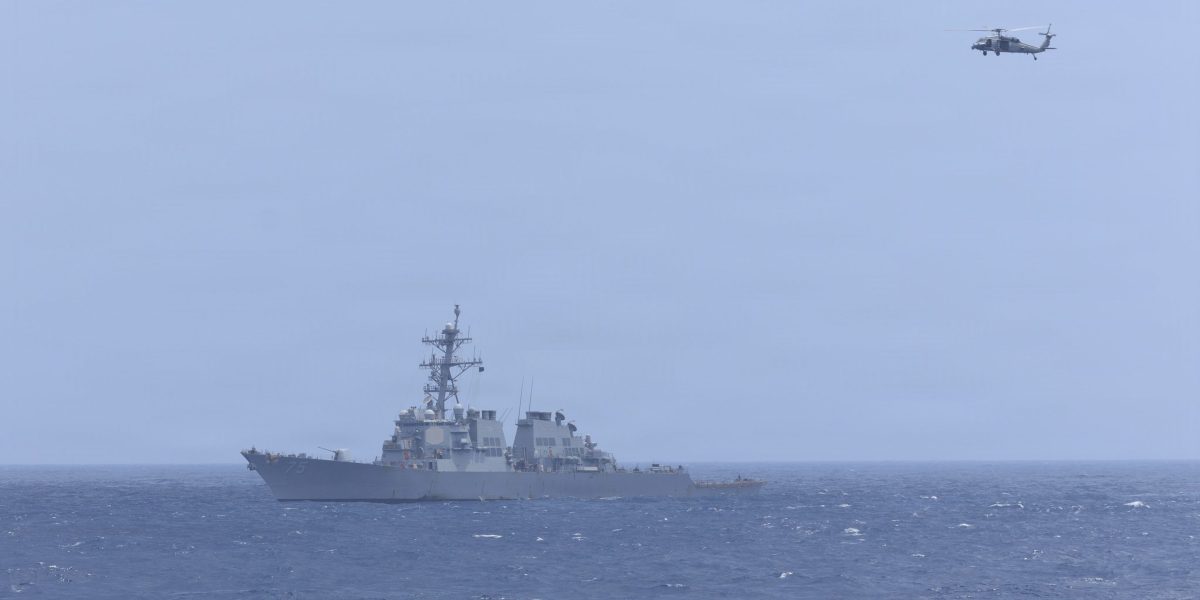
For now, the U.S. Navy appears to be making of a point of showing that the alternate route is still safe, as Gulf traffic data Sunday revealed a convoy of tankers heading through the strait under escort with their transponders turned on.
Other ships have likely switched off their transponders to quietly slip through the waterway undetected. But the mere threat of Iranian attacks could scare away enough ships to effectively shut down the strait.
Pape explained that Iran’s strategic logic is to force the strait to stay mostly closed and cut off oil flows again, requiring the U.S. to draw down its inventories. That would provide Iran more leverage as it tries to drive the U.S. military out of the region.
Commercial shipping companies are also caught in a trap. They could use the alternate route and risk Iranian attacks, or use the regime’s route and face Western sanctions against transacting with the Islamic Revolutionary Guard Corps.
Since many ships have no choice but to use the alternate channel and are transiting under the radar, Iran will have to keep escalating in order to completely halt flows, according to HFI Research.
“For the US, the fact that the Oman route might be blocked presents it with a big ultimatum: either the US escalates or gives IRGC control of the Strait of Hormuz. Logic says there’s no way that would happen, so escalation will continue,” it posted on X.
“Given that Trump has made it obvious that he does not want to escalate, I fear that the IRGC would just keep escalating until they gain control. This issue is far from over.”
University of Oslo professor Francesco Sassi pointed out that Iran’s latest attack on shipping specifically targeted a vital workaround that Gulf oil producers have employed: ship-to-ship transfers of oil at sea that bypass Hormuz.
That sets up an existential test for U.S. deterrence capability to protect regional allies like Bahrain and Kuwait, he wrote on X on Sunday, adding that a return to the pre-conflict status quo is officially dead.
“The war for the Strait of Hormuz has entered a highly dangerous new phase,” Sassi warned. “Following consecutive nights of US retaliatory strikes against IRGC targets, a shadow war is rapidly expanding to the outer rim of the Gulf.”
In fact, Iran has no intention of going back to business as usual in the strait, Noam Raydan, senior fellow at the Washington Institute think tank, wrote in a blog post on Friday.
That’s because returning to prewar conditions would deprive Iran of its strongest remaining source of leverage, she added.
“The question now is not how Iran will facilitate a return to a status quo that does not serve its objectives,” Raydan explained. “Rather, policymakers must prepare for the justifications Tehran will put forward to ensure that it plays a central role in the new maritime system, and the barriers it will put in place to impede any alternative systems.”