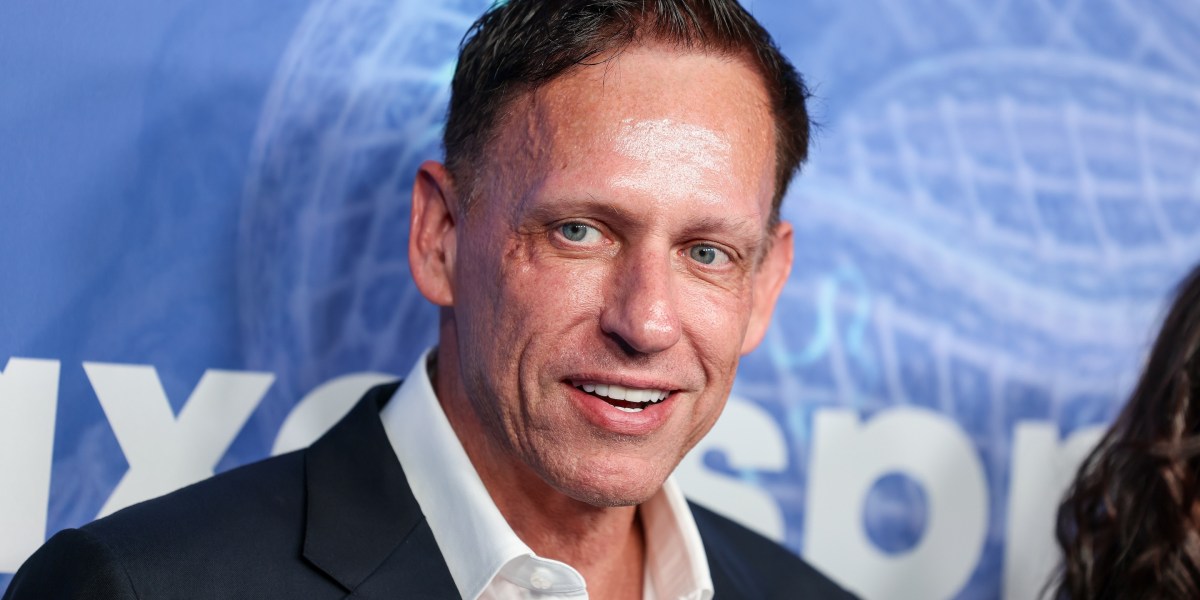




Silicon Valley billionaire Peter Thiel is escalating his campaign against artificial intelligence regulation, targeting two of the technology’s most prominent critics: former President Barack Obama and Pope Leo XIV.
Thiel accused both men of capitalizing on public anxiety about AI during closed-door lectures in Nashville on Sept. 28 and Oct. 5, according to recordings obtained by Decoded by Politico. The talks are the latest installment of Thiel’s lecture series on the Antichrist, a figure from Christian theology whom he sees as halting technological progress and advocating a “one world government” of regulation.
In Thiel’s telling, that threat includes efforts to rein in AI development, which he frames as a path toward centralized control that would restrict technology and individual freedom. Thiel’s representatives did not respond to Politico’s request for comment.
Thiel says Obama and Pope Leo are cashing in on AI anxiety
During the lectures, Thiel questioned why so many public figures are weighing in on AI, and singled out Obama and the pope.
“Many people know that AI is politically unpopular and want to leverage that to boost their own popularity,” Thiel said. “Both Obama and the pope fall into this category. Obama knows the Democrats have no ideas, but they can at least oppose AI.”
Obama recently urged Democrats to develop a clear AI plan. At a September fundraiser, he told House Minority Leader Hakeem Jeffries that Democrats should build a framework for a public conversation on AI policy if they retake the House. He also said 2028 presidential hopefuls should make the technology one of their “central agendas”.
Thiel was even more pointed about the pope, suggesting Leo’s focus on AI is a distraction from the Catholic Church’s legacy of abuse.
“He needed something politically popular to distract from the church’s child sex abuse scandals, and he found it in AI,” Thiel said, according to Politico, in a passage aimed at the pope’s first encyclical, Magnifica Humanitas. The book-length teaching, released in May, focuses on safeguarding the human person in the age of AI.
Pope Leo has urged AI companies to build strong ethical guardrails into their models. He has also warned that society’s growing reliance on the technology could reshape what it means to be human.
Thiel also took aim at the effective altruism movement, telling attendees that its ideology “has brainwashed a significant portion of the people working on AI,” according to Politico.
From San Francisco to Nashville
The Nashville talks are the latest stop on a tour that has drawn growing scrutiny. Thiel first delivered his Antichrist lectures in a sold-out series in San Francisco last fall. He then took them to Paris in January and to Rome in March, where Catholic commentators and Italian politicians pushed back on his ideas. Across all of them, he has argued that regulating technology, and AI in particular, plays into the Antichrist’s hands. Critics have noted that his Antichrist looks a lot like the people who want to regulate Thiel’s own businesses.
A co-founder of PayPal and Palantir Technologies, Thiel has become a major voice in tech and conservative politics, with close ties to President Donald Trump and Vice President JD Vance.
Thiel’s view puts him at odds with AI’s biggest CEOs
Thiel’s hard line against regulation increasingly sets him apart from the people building the technology.
Last month, Anthropic CEO Dario Amodei published an essay calling on the industry to deliberately slow the pace at which AI models gain new capabilities, so that safety work can catch up. OpenAI CEO Sam Altman and Tesla and SpaceX CEO Elon Musk, who has long warned that AI poses greater risks than other technologies, both publicly backed the call. Altman wrote that he agreed the industry needs to “pace the frontier,” and Musk posted that Amodei was right. Altman later spelled out why OpenAI would welcome safety requirements for frontier AI labs.
That rare show of unity among rivals stands in sharp contrast with Thiel’s view that the push to slow AI down is not caution but something closer to evil.