



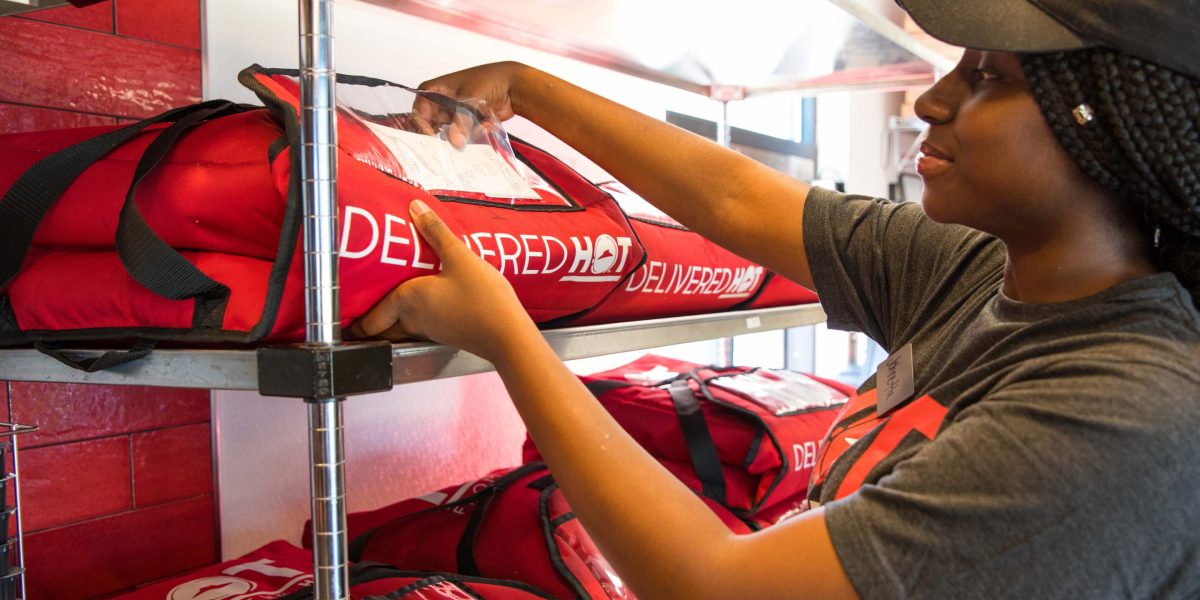
A major Pizza Hut franchisee is suing the pizza chain, claiming gig workers leveraged its AI system for their own benefit, causing “cascading operational breakdowns” that pummeled sales at more than 100 locations.
Pizza Hut franchisee Chaac Pizza Northeast—which operates more than 110 Pizza Huts across New York, New Jersey, Maryland, Washington, D.C., and Pennsylvania—filed a lawsuit in Texas Business Court earlier this month claiming that its franchiser’s Dragontail Artificial Intelligence system gave outsized visibility of operations to third-party delivery drivers, enabling them to prioritize certain orders, slowing delivery times and throttling customer satisfaction. The litigation was first reported by Restaurant Dive.
Chaac is seeking $100 million in damages for lost business and enterprise value.
Yum! Brands, Pizza Hut’s parent company, did not respond to Fortune’s request for comment but told Restaurant Dive it did not comment on ongoing litigation.
“We are in the process of reviewing the claim and will respond through the appropriate legal channels,” a spokesperson said in a statement.
The allegations are the latest manifestation of the simmering tension between workers and employers, and even franchisees and licensees, over automation and productivity across jobs. This is particularly felt in restaurants, where staff shortages and frequent turnover have pushed fast-food businesses to turn to AI systems and robots in an effort to reduce labor costs, ballooning global restaurant automation into a $28 billion market this year. Ironically, the unintended consequences of this particular example seem to have empowered gig workers to take back some autonomy, allegedly using AI to coordinate deliveries for their schedule, and racking up losses for the franchisee at the other end.
Labor economists are skeptical of widespread automation in restaurants, warning productivity benefits are often modest compared to the cost of the new technology, and that truly unlocking benefits of AI in the industry requires a complete overhaul of operations.
“To really get the benefit of robots or artificial intelligence, you need to redesign the whole system, rather than just including one robot to do a particular thing,” Ajay Agrawal, professor of entrepreneurship at the University of Toronto’s Rotman School of Management, previously told Fortune.
Chaac’s alleged AI headaches
According to Chaac, Yum! Brands may have fallen prey to a similar unintended consequence of automation. The conglomerate finalized its acquisition of Dragontails in September 2021, touting the platform’s ability to optimize kitchen flow and driver dispatching by assisting workers with the timing and sequencing of orders, as well as planning optimal delivery routes.
But combined with the fallout of Dragontail, Pizza Hut also minted a national contract with DoorDash, giving Dashers greater access to Chaac’s kitchen operations and order timing. As a result, Dashers allegedly began waiting to accept orders in order to batch them together, which led to longer wait times and slower deliveries.
Chaac alleged drivers waited 15 minutes to pick up orders, resulting in a longer period of pizza sitting out of the oven waiting to be delivered. The lawsuit also claimed other drivers could see tip amounts for orders, disincentivizing them from claiming certain orders. Pizza Hut allegedly did not properly train operators to use the system or fulfill requests for support.
“With the intention to improve efficiency and service to the customer, Dragontail did the exact opposite; it caused significant delays and pummeled consumer satisfaction,” the complaint said.
Chaac alleged that prior to Dragontail’s 2024 deployment in New York, the franchisee was among Pizza Hut’s best-performing operators in delivery times, customer satisfaction, and sales growth. According to the lawsuit, Chaac managers previously manually input orders into DoorDash tablet software that processed delivery orders, as well as allow an operator to prevent Dashers with lower ratings from accepting orders. The franchisee claimed “more than 90% of pizza orders at Chaac’s were delivered within thirty (30) minutes.”
Chaac’s stores at one time accounted for 15% of DoorDash’s Pizza Hut volumes from its Drive Program, despite the franchisee’s locations accounting for fewer than 2% of Pizza Hut’s U.S. stores, the complaint stated.
AI’s mixed results in fast food
While Yum! Brands has continued to thrive by leaning on its chains like Taco Bell, Pizza Hut has struggled to grow. The pizza chain reported a 4% drop in same-store sales last quarter, offset by stronger international same-store sales that ultimately resulted in flat sales globally.
Beyond Dragontail, the conglomerate has leaned into AI to increase operational efficiency. Last year, the conglomerate announced a partnership with Nvidia to deploy AI to take drive-thru and call orders in 500 locations.
But fast food giants have seen mixed success integrating AI into their operations. Wendy’s drew criticism after an announcement of an AI-powered digital menu over concerns it would lead to surge pricing, which the company denied. McDonald’s has invested in AI firms since at least 2019 to speed up orders, but ended a two-year partnership with IBM in 2024. The change came after customers took to social media about incorrect orders they received from the fast-food joint, including nine sweet teas and 260 McNuggets.