



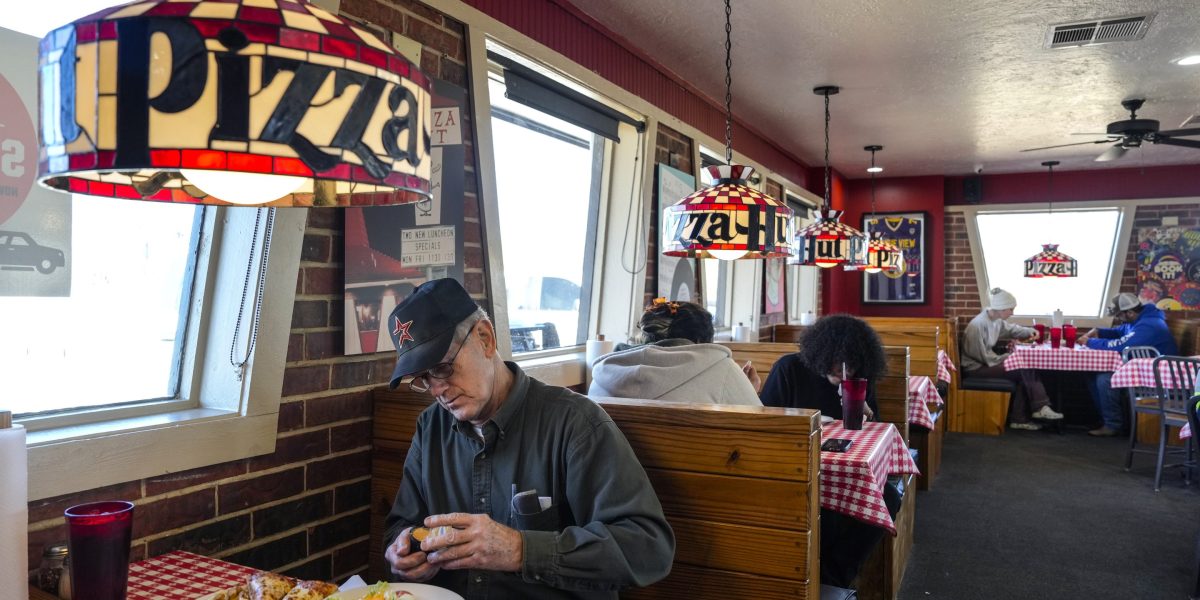
After years of being a struggling business and losing ground to competing chains, Pizza Hut’s fate will now rest with private equity.
Yum Brands announced on Tuesday it sold Pizza Hut to private equity firm LongRange Capital for about $1.5 billion. Yum China Holdings Inc. will acquire the chain’s mainland China locations in a separate deal worth about $1.2 billion.
For years, Pizza Hut has struggled to keep up with other casual pizza chains, particularly Domino’s, which dethroned it as the world’s largest pizza chain in 2017. A year later, Pizza Hut announced it would close 500 of its nearly 7,500 locations by the middle of 2021. In 2020, the chain said it would close up to 300 more locations following the bankruptcy of one of its largest franchises, NPC International. KFC and Taco Bell have continued to succeed under Yum Brands, which began exploring options for Pizza Hut in Nov. 2025.
At the end of last year, Pizza Hut had 19,974 restaurants worldwide, but today, many locations in the U.S. have shuttered, and There are nearly 1,500 fewer Pizza Hut locations than there were at the chain’s peak in the U.S. in the early 1990s. It’s a long fall for a brand still recognized by its red roof. Pizza Hut was first opened in 1958 by two brothers, Wichita State University students Dan and Frank Carney, after their mother gave them a $600 loan, and the two brought it public in 1969. It became the largest global pizza chain two years later and a mainstay for American families who would sit under Tiffany-style lamps under red-checkerboard tablecloths to munch on doughy slices of pepperoni pizza.
With a private equity takeover, new ownership could either be a chance for the brand to recapture the hearts of nostalgic Americans, or a death knell.
“It’s anyone’s guess as to what private equity does,” Neil Saunders, managing director of GlobalData Retail, told Fortune. “Private equity can be a force for good. They can invest in the business—try and grow Pizza Hut, invest in the proposition, make restaurants more appealing—or they can go the other way, which is trying to monetize the brand and squeeze it.”
Private equity’s question marks
Private equity has gone on a tear to snap up fast casual concepts. From 2014 to 2024, private equity firms invested $94.5 billion in parts and restaurants, according to PitchBook data.
For some, private equity can be a saving grace: Firms can offer much-needed cash and guidance on how to scale or scale back operations. But they can also be a cash grab and a way to strip a business of assets with little concern for its future success.
Pizza Hut will join the ranks of casual dining concepts from the days of yore looking to private equity to refind their footing. In 2014, Golden Gate Capital bought Red Lobster from Darden Restaurants, financing the deal by selling the real estate for around 500 locations and leasing it back to the restaurant, driving up costs by $200 million annually in rent alone. The seafood chain filed for Chapter 11 bankruptcy in 2024 and emerged under new ownership with CEO Damola Adamolin helming the company’s turnaround.
Last year, Hooters cofounder and CEO Neil Kiefer bought back more than 100 locations of the chain from private equity, blaming previous ownership for turning what he first envisioned as a family-friendly beach restaurant to a more provocative concept.
“It’s a beach-theme restaurant, not a sexualized one,” Kiefer previously told Fortune. “So I think they went too far down the road of making it more like a little boys club hangout, and they therefore alienated the women and the families we have.”
Pizza Hut’s nostalgia factor
With Pizza Hut now in its portfolio, LongRange Capital will have to both address the restaurant’s persistent problems and find a path to future success. The concept thrived in its early days when casual sit-down restaurants were popular, but failed to adapt when takeout joints like Domino’s became the dominant model for quick service restaurants. Domino’s prime locations for pick-up, as well as its technology like the pizza tracker, cemented it as a carry-out giant.
Pizza Hut “just really faded in terms of relevance to the diner, and it wrapped them in a very, very difficult position,” Saunders said. “Whereas, of course, Domino’s was born as a takeout service, so it was on the right side of trends from the get-go.”
There’s a chance Pizza Hut’s retro reputation could help it regain business. More than 150 Pizza Hut franchises recently revived themselves as Pizza Hut Classics, recreating the vibe from the 1980s of red cups, arcade games, and vinyl seats, which have gained something of a cult following.
Leaning into the nostalgia is compelling, Saunders said, but it will take more than that to revive the company—otherwise Yum Brands would have already fixed the chain. Pizza Hut’s new ownership will instead have to look at its menu, locations, and investment in technology for answers.
“People kind of like that nostalgia in a curious way,” Saunders said. “I don’t think it’s powerful enough to override some of the inherent problems with Pizza Hut….nostalgia on its own, it just doesn’t cut the mustard.”