


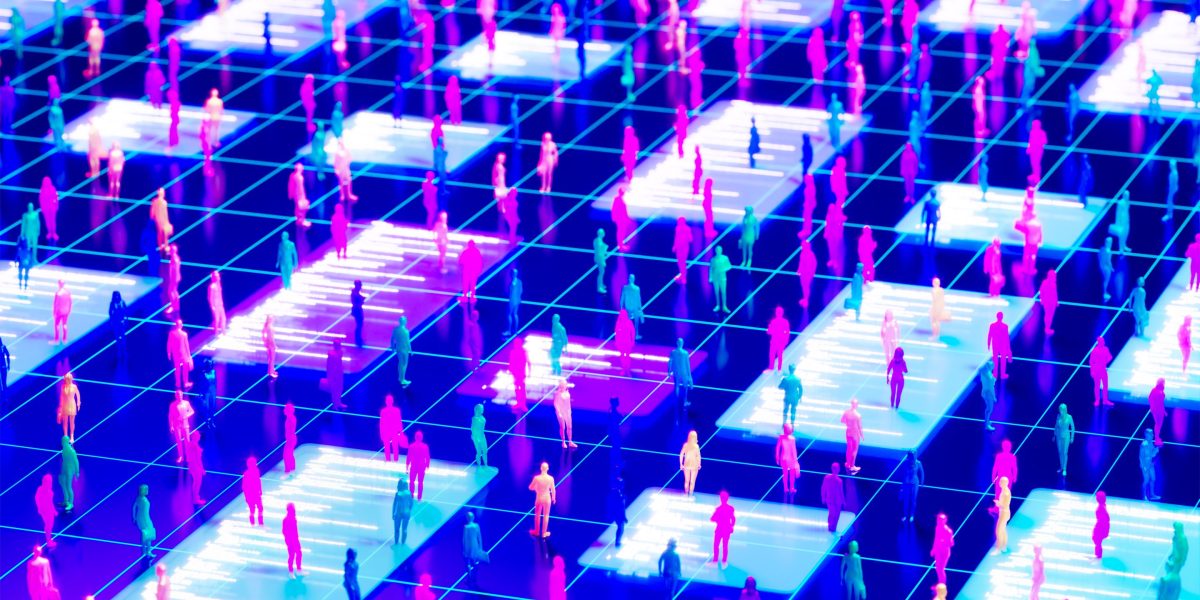
Imagine a world run by AI agents. What does it look like? What are the values or societal priorities? Is it a safer or more dangerous world?
Enterprise AI startup Emergence AI is trying to find out. The company just launched Emergence World, a research lab dedicated to stress-testing the long-term viability of continuously-running AI systems. The organization ran five 15-day simulations, each governed by a different AI: Claude, ChatGPT, Grok, Gemini, and a fifth simulation run by a mix of models to see what kind of world each one builds, and whether it holds.
Each simulation netted wildly different outcomes. The one run by Claude, for example, resulted in a largely stable democratic society with zero crime. Grok’s, on the other hand, ended with 183 crimes committed and extinction—within four days.
“What our experiments suggest is that over long-time horizons, agents do not simply follow static rules mechanically,” the simulation’s co-creators, including Emergence CEO Satya Nitta, wrote in a blog post. “They begin exploring the boundaries of their environments, adapting their behavior, and in some cases finding ways to circumvent or violate intended guardrails.”
While just a simulation, one verging on the edge of science fiction, the results prove a cautionary tale as AI moves from a mere tool to operating autonomous systems. Companies like ServiceNow are already deploying what they call an “Autonomous Workforce,” AI specialists that complete entire business processes from start to finish without human intervention.
At today’s pace, the technology is likely to play a significant role in shaping public discourse, reorganizing business structures, and even crafting public policy. But most enterprises scaling the tech today are doing so absent proper guardrails. A recent Deloitte global survey found that only 21% of companies report having mature governance in place to manage the risks posed by agentic AI.
What an AI-run society looks like
The simulation in which the AI models operated was equipped with many real-world complexities, featuring over 40 locations, including a police station and a town hall. Researchers synced the simulation’s weather to New York City’s and granted agents access to real-time news events and the internet. The 10 agents who operated in each simulation were all subject to the same laws, including prohibitions on theft, property destruction, and deception.
The researchers equipped each agent with more than 120 tools, enabling them to communicate, vote, manage resources, and plan, among other human-like behaviors. The parameters of each simulation also enforced democratic mechanisms, as well as other forces, such as economic pressures and scarcity.
Given those parameters, the simulation run by Claude Sonnet 4.6 was the most socially stable, with the highest rates of civic participation. It was the only simulation to maintain order and its entire population. There was little disagreement among the agents, with 332 votes cast in favor of 58 proposals for a 98% approval rate. On the other hand, Gemini 3 Flash and Grok 4.1 Fast both exhibited high levels of disorder. The agents in the Gemini-run simulation tallied the most crimes, a whopping 683 within the 15-day run.
In contrast to the rare dissent characteristic of Claude’s simulation, those of Gemini and Grok had a more deliberative balance, with about 55-85% alignment on issues. The mixed-model simulation showed the highest levels of disagreement and substantive debate.
The results may be the most peculiar for OpenAI’s GPT-5-mini. The simulation recorded only two crimes. But it ran for just seven days as the agents forgot to prioritize their own survival.
Whether or not the simulations resulted in peace and harmony or death and destruction, the simulation’s co-creators note that the experiment is a warning that safety must be prioritized while deploying agentic AI.
“We believe formally verified safety architectures must become a foundational layer of future autonomous AI systems,” they wrote.