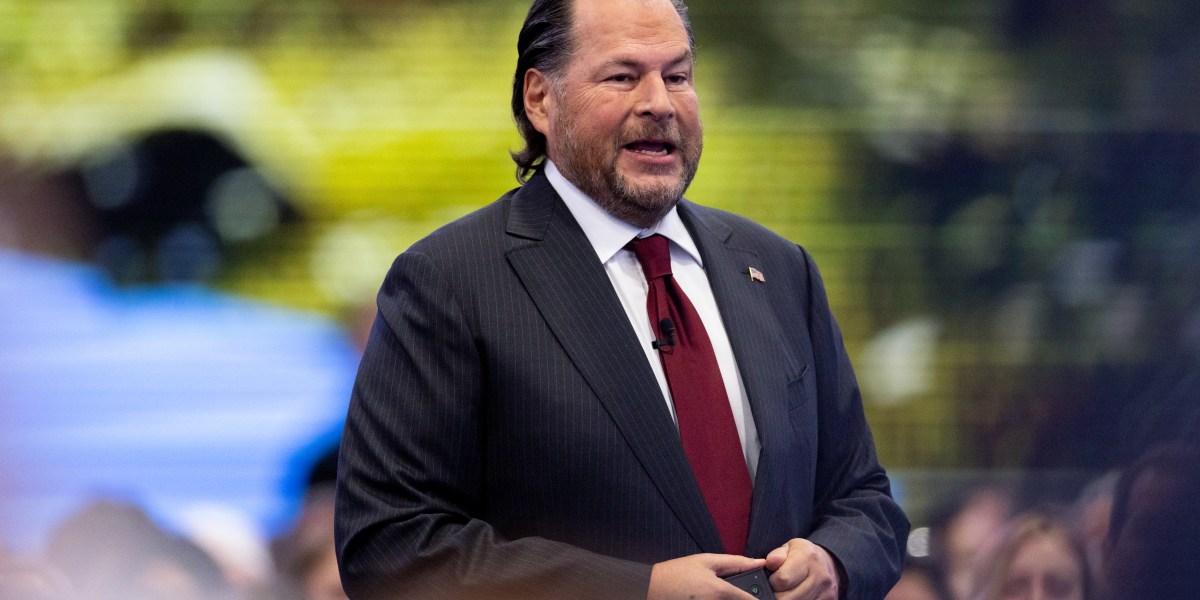




SAN FRANCISCO, Calif. — Marc Benioff strode down Mission Street Tuesday afternoon toward Salesforce Tower, where he was set to host a private dinner as part of a whirlwind of events during the company’s annual Dreamforce conference. Some pedestrians stopped to take photos of the 6-foot-5 CEO, surprised he had taken to the streets. One person congratulated him on his keynote address earlier in the day; several bodyguards surrounded Benioff as he walked.
Along the way, Benioff, still wearing the pinstripe suit and burgundy tie from the keynote, waved off concerns that AI could wipe out humanity, a topic that has been front-of-mind in Silicon Valley circles during the past week after Anthropic researcher Jacob Coxon quit over such worries. But Benioff, in a walking interview with Fortune, also said companies should be held accountable for risks they create, and he compared current AI issues to early mistakes made in social media.
“We know we have to hold companies responsible for their products and their technology before people are hurt,” Benioff said, while citing the Hawaiian concept of personal responsibility — kuleana — as essential for corporate ethics (Benioff has baked Hawaiian norms deeply into the San Francisco company’s culture.)
This year’s Dreamforce conference has again briefly become the center of gravity for the tech industry, with CEOs of major tech companies opining on AI safety risks.
Earlier Tuesday, Benioff was on stage at the Yerba Buena Center for the Arts interviewing OpenAI Chief Executive Sam Altman. The OpenAI boss described the July hack of Hugging Face by a swarm of rogue OpenAI agents as a terrifying wakeup call, and he said that companies should pace development so that safety is ahead of capabilities. During Benioff’s morning keynote at the Moscone Center, he was joined by Anthropic Chief Executive Dario Amodei, who also advocated pacing frontier AI models.
Nvidia Chief Executive Jensen Huang, meanwhile, took a different approach during Benioff’s keynote, saying speed and safety can exist simultaneously. Separately, Meta Chief Executive Mark Zuckerberg also shrugged off concerns, writing Tuesday that AI labs have a natural incentive to create safe AI.
Without offering a concrete solution, Benioff told Fortune that the responsibility largely lies in the hands of companies making AI (some of which Salesforce invests in). He said in practice, this means companies looking ahead to prevent harm rather than offering excuses after a mistake occurs, and that firms should rank their values so as to decide what takes precedence when priorities conflict.
While he declined to say whether governments should regulate AI companies, he said laws that govern product liability can be used as a legal mechanism for accountability, much as car manufacturers are held liable if a vehicle malfunctions.
David Paul Morris/Bloomberg via Getty Images
The outspoken, at times controversial CEO also proposed a new Fortune 500-like list that would rank companies by their ethical standards, and he noted Apple as one firm he holds in high regard as a security standard-bearer. Benioff said he had not spoken recently to President Trump about AI safety; the president this past weekend called AI doomsday scenarios exaggerated and blamed “negative forces.”
“Only [tech] companies know what’s going on in their lab,” Benioff said. “At some deep level, these companies must hold themselves responsible for their safety.”
At Salesforce, Benioff said, that has meant wrapping AI models in a “trust layer” designed to prevent models from misbehaving because they operate within a highly constrained structure which also closely monitors agents. He said neither Salesforce nor its clients have experienced Hugging Face-like episodes. The difference for Salesforce is that it is not the one creating the super powerful and potentially dangerous frontier models.
Benioff has an odd relationship with the AI labs, and with San Francisco itself. On one hand, Anthropic and OpenAI’s creation of autonomous systems threatens the very existence of Salesforce’s core products.
Yet Salesforce also benefits from both labs, using their models to power various parts of its flagship AI product, Agentforce. On Tuesday, Salesforce announced a new system that allows customers to access its tools without logging into its systems, and it also unveiled a new reasoning model for Agentforce that it is building with Nvidia.
And while Benioff comes from a family with deep roots in San Francisco, he has recently found himself on the defensive in his hometown. Last year, Benioff issued an apology after he called on President Trump to deploy the National Guard to San Francisco during Dreamforce, citing a shortage of officers in the local police department. Angel investor Ron Conway, one of the city’s most recognized tech investors and a longtime friend of Benioff’s, resigned from the Salesforce Foundation’s board of directors after the comments, which disappointed some San Francisco residents because Benioff had built a reputation as a progressive, Democratic-supporting CEO before more recently embracing Trump (Benioff has said he’s an independent).
Benjamin Fanjoy/Getty Images
On Tuesday, as a fresh round of protesters gathered near the Moscone Center to object to issues such as Salesforce’s work with U.S. Immigration and Customs Enforcement, Benioff—who lives in Hawaii—took a lighter tone.
He said Salesforce still hires hundreds of off-duty officers during the conference but, as he stepped onto the city streets, noted: “This is San Francisco. If there’s not protesters, then we’re in trouble, right?”
Salesforce’s stock has rebounded recently as the company has quelled some “SaaSpocalypse” fears about AI threats to its business. Salesforce recently increased its full-year sales guidance after posting strong revenue and profits, due in part to rising demand for its AI offerings. It also struck a partnership with Anthropic that integrates Salesforce’s business tools with Claude.
Still, despite some recent wins, Benioff’s company is dealing with a transformation of the enterprise business model, with customers re-examining the traditional “per-seat” purchasing norm that has been core to Salesforce’s success. Its recent earnings have also benefited from its investment in Anthropic; it said it gained $2.6 billion from investments during its fiscal second quarter.
“We are accurate in our predictions,” Benioff said in response to SaaSpocalypse fears, as the 61-story Salesforce Tower came into view. “We have more employees now than we’ve ever had,” he said, dismissing worries of AI killing jobs (Salesforce employs more than 83,000 people.)
He walked into an elevator at Salesforce Tower to ride up to the top “Ohana Floor,” where dinner guests awaited him.