


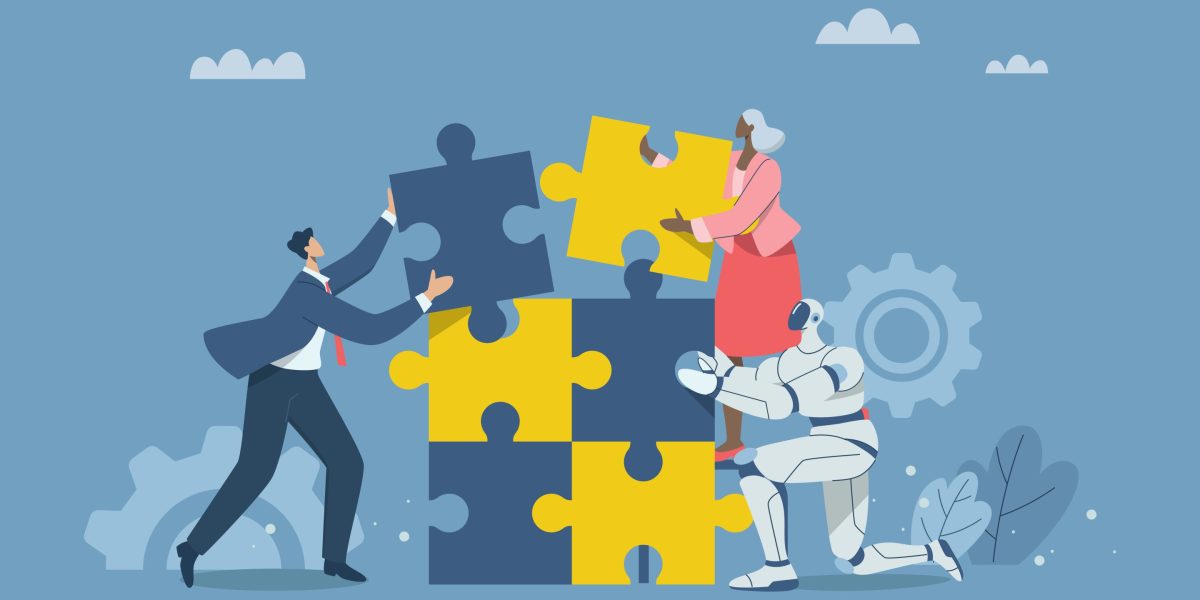
A novel experiment at Procter & Gamble reveals that artificial intelligence isn’t just a tool—it’s becoming a genuine teammate that can match human collaboration.
For decades, the holy grail of business performance has been effective teamwork. We’ve organized entire companies around the premise that collaboration beats individual effort—that two heads are better than one. But what happens when one of those “heads” is artificial intelligence?
A remarkable field experiment involving 776 professionals at Procter & Gamble—and led by Harvard’s D^3 Institute, where I’m an executive fellow—has fundamentally challenged our assumptions about teamwork, expertise, and the future of collaborative work. The results suggest we’re witnessing the emergence of what researchers call the “cybernetic teammate”: AI that doesn’t just assist but actively participates in the collaborative process.
When teaming with AI equals teaming with humans
The P&G experiment was elegantly simple yet profound. Cross-functional teams of commercial and R&D professionals were randomly assigned to work on real product innovation challenges in four different configurations: individuals working alone; traditional two-person teams; individuals with AI; and teams augmented with AI.
The headline finding is striking: Individuals working with AI delivered measurable performance improvements—nearly 40% gains —that elevated them to the same level as traditional human teams. In other words, AI appears capable of replicating the fundamental benefits we’ve long attributed to humans in terms of collaboration, including the innovative power of multiple human perspectives.
Think about what this means. For generations, we’ve structured organizations around teams because collaboration allows us to pool different expertise, catch blind spots, and generate better solutions than individuals working alone. The P&G study shows that AI can provide these same collaborative benefits to a single person.
The cross-functional AI advantage
But here’s where the story gets even more interesting. While AI-enabled individuals could match traditional teams, AI-augmented cross-functional teams delivered results that were in an entirely different league. When researchers examined the top 10% of solutions—the breakthrough ideas that could drive real competitive advantage—AI-enhanced cross-functional teams were three times more likely to produce them.
This wasn’t a marginal improvement. The combination of diverse human expertise working together with AI created a multiplicative effect that neither human-only teams nor AI-enabled individuals could achieve. It suggests that the future of high-stakes innovation lies not in replacing human collaboration with AI, but in supercharging cross-functional teams with artificial intelligence. The P&G experiment effectively shows that just as AI enhances the performance of individual workers, it can to the same with entire teams with unmatched quality results.
Giving access to missing expertise and breaking down silos
One of the significant advantages of working in teams is the access to complementary expertise provided by diverse team members. The experiment discovered that AI could fulfill this role quite well.
Individuals, either technical or commercial, when working without AI predictably created solutions that favored their own expertise domain. However, those individuals working with AI produced solutions that were as balanced as cross-functional teams working with or without AI. R&D specialists began proposing more commercially viable solutions while commercial professionals developed technically sounder approaches. AI acted as a bridge, helping team members access and integrate perspectives outside their domain expertise.
Few business commonplaces are as oft repeated as the need to “break down silos.” Yet doing so remains difficult in practice for most organizations. Now, with the help of AI, businesses will be better able to fundamentally change how cross-functional teams operate. Instead of gathering experts who advocate for their functional perspective and then compromise, AI enables teams where each member can think holistically across functions.
In the case of the P&G experiment, the result was more technically feasible and commercially attractive solutions from the ground up, rather than negotiated settlements between competing viewpoints—just the tangible “breaking down of silos” that leaders so often seek and can only poorly approximate through reshuffling of reporting lines.
For organizations struggling with the classic challenges of cross-functional collaboration—territorial disputes, communication gaps, and suboptimal compromises—AI offers a pathway to genuine integration.
The emotional dimension: AI as a motivational partner
This experiment also challenges everything we thought we knew about technology’s impact on workplace satisfaction. Far from creating a cold, mechanical work experience, AI collaboration enhanced positive emotions in ways that rival human teamwork itself.
The data is striking. Individuals working with AI showed a 46% increase in positive emotions—excitement, energy, and enthusiasm—compared to those working alone. But AI-augmented teams experienced an even more dramatic 64% boost in positive emotions. Simultaneously, AI reduced negative emotions like anxiety and frustration by approximately 23% across both individual and team settings.
What makes this finding interesting is that it reveals AI filling a role we never expected: that of the emotionally supportive and motivational partner. Traditionally, one of the key justifications for teamwork has been its psychological benefits—the energy that comes from collaboration, the reduced stress of shared responsibility, the excitement of building on each other’s ideas. The P&G experiment shows that AI can replicate many of these emotional benefits.
Perhaps most tellingly, participants who experienced these positive emotional responses also reported significantly higher expectations for future AI use. This creates a virtuous cycle: Positive AI experiences drive greater adoption, which leads to more sophisticated AI interaction skills, which in turn generates even better outcomes and more positive experiences.
This emotional dimension helps explain why AI adoption often exceeds initial expectations once people actually use it. It’s not just about efficiency gains—it’s about AI making work more enjoyable and engaging.
Strategic implications for leaders
These findings reveal specific organizational design principles that forward-thinking companies should implement immediately:
Reimagine your innovation architecture. The traditional model of assembling large, diverse teams for every innovation challenge is now obsolete. Instead, deploy AI-augmented cross-functional teams as your primary innovation unit. These teams combine the boundary-busting power of AI with diverse human expertise to consistently produce breakthrough solutions. This approach can reduce the overhead coordination of traditional innovation processes while maximizing the probability of generating top-tier ideas from the start.
Transform cross-functional team dynamics. Stop tolerating the dysfunction that plagues most cross-functional teams—the territorial battles, the compromised solutions, the endless coordination meetings. AI can eliminate these friction points by enabling each team member to think and contribute across functional boundaries. This isn’t just about adding AI to existing teams; it’s about redesigning how cross-functional teams operate from the ground up. AI as a cybernetic teammate can bridge silos and bring in missing expertise, enabling teams to work faster and better.
Train ‘T-shaped’ AI collaborators. The P&G findings reveal that effective AI collaboration requires a new type of professional—one who combines deep domain expertise with sophisticated AI interaction skills. Employees can no longer rely on broad, shallow knowledge; they need to deepen their functional expertise while developing the ability to “dance” with AI across domains. The vertical stroke of the “T” becomes even more critical as it provides the substantive knowledge needed to guide, challenge, and refine AI outputs. Meanwhile, the horizontal stroke expands dramatically as AI enables professionals to contribute meaningfully beyond their core expertise. This dual development—deeper specialization paired with AI-enabled boundary spanning—creates professionals who can extract maximum value from human-AI collaboration.
Companies that build these competencies first will have sustainable advantages in innovation speed and quality.
Restructure project economics and timelines. If one AI-enabled person can match a traditional team’s output while working 16% faster, your resource allocation needs to be adjusted accordingly. Projects that previously required months of coordination between functions can now be completed by smaller, AI-augmented teams in weeks. This isn’t about cost-cutting—it’s about dramatically accelerating time-to-market while maintaining or improving output quality.
Design for the emotional multiplier effect. The emotional benefits of AI collaboration create a compounding advantage. Employees who have positive AI experiences become AI advocates, driving organic adoption throughout the organization. Conversely, poor initial AI experiences create resistance that’s difficult to overcome. Invest heavily in the first 90 days of AI implementation—training, support, and carefully curated use cases that ensure positive emotional responses from the start. In the training, have employees directly experience how AI enables them to perform better and develop new skills instead of the fears of deskilling and replacement.
The future of collaborative work
We’re witnessing the early stages of a fundamental shift in how knowledge work gets done. AI isn’t just automating tasks completed by individual workers; it’s also now capable of participating in the collaborative processes that drive innovation.
This doesn’t mean human collaboration becomes obsolete. Rather, it suggests we’re entering an era where the most powerful problem-solving units will be human-AI ensembles that combine the best of both worlds: human intuition, creativity, and domain expertise with AI’s vast knowledge base, pattern recognition, and ability to rapidly explore solution spaces.
The companies that figure out how to orchestrate these cybernetic teams—where AI truly functions as a teammate rather than just a tool—will have a significant competitive advantage in the innovation economy. The future belongs to those who can master the art of human-machine collaboration.
François Candelon is a partner at private equity firm Seven2 and executive fellow at D^3 Institute at Harvard.
Read other Fortune columns by François Candelon.