




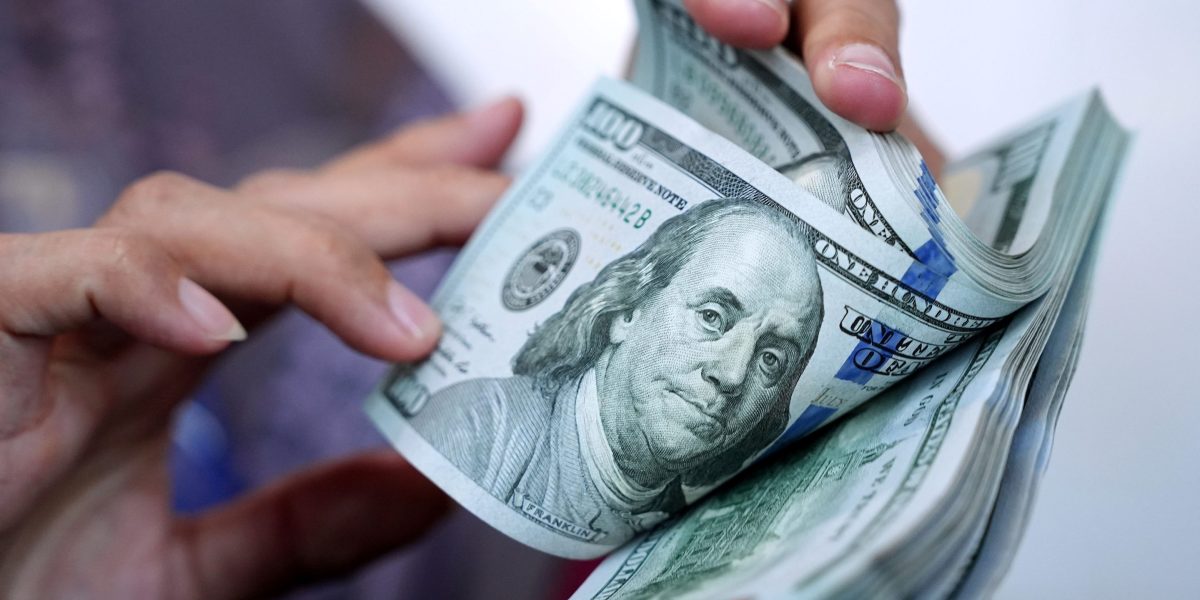
Over the past year or so, obituary writers have taken aim at the U.S. dollar. They’ve spilled ink over the greenback’s sliding valuation, griped about the lack of “safe haven” correlations after “Liberation Day” (the dollar failed to rally as rates rose and stocks fell), and called China’s currency a clear usurper, as more and more trade is settled in its currency.
Dollar obituaries are a regular feature of public discourse since at least 1971 when Nixon finished off the gold standard. But over the subsequent half century, the greenback has comfortably outlived a variety of terminal diagnoses.
Today is no different. A weaker (or stronger) dollar says little about America’s ability to remain the world’s reserve currency, and neither do the greenback’s other blemishes. Instead of analyzing the dollar’s shortcomings, we need to see reserve currency primacy as a demanding competition that imposes burdens few are willing to carry. As it turns out, you don’t have to be pretty to win a beauty contest—just prettier.
The dollar’s valuation says little about dollar hegemony
Executives and investors around the world have good reason to care about the greenback’s value as their revenues, assets, liabilities, and competitiveness often depend on it. But viewing the dollar’s—and America’s—strategic role through the lens of dollar valuation is as misguided as it is common.
Take three snapshots over the past 40 years: In 1990, the end of the Cold War ushered in America’s unipolar moment, but the dollar was 24% lower than today. In 2000, before the dot.com bubble popped and before the 9/11 attacks, the dollar was 14% lower. And in 2015, before the rise of American populism and isolationism, the dollar was 11% lower.
In fact, it’s precisely over the past decade—when debates about US “declinism” reached fever pitch—that the dollar’s value hit a 37-year high (October 2022) and largely sustained those high valuations.
Price is not a good mirror of a currency’s or nation’s strategic standing. Its value is driven by a tactical competition that rests largely on relative growth, relative inflation, and relative interest rates.
An exorbitant privilege—and a massive burden
If it’s not a currency’s valuation, then what drives reserve primacy?
A popular but lackadaisical belief is that currency hegemony is a matter of historical luck and unearned endowment. The phrase “exorbitant privilege”, coined by French Finance Minister Valéry Giscard d’Estaing about the dollar in the 1960s, has stuck to this day. It rings true: few economies have the privilege of borrowing and trading in their own currency, and even fewer see their currencies rally in times of crisis—a powerful privilege of issuing the world’s reserve currency.
But reserve currency status is the outcome of an open competition. The privilege must be earned, and significant burdens must be accepted. Few nations have what it takes to win this competition, while those who could compete are unwilling to carry the burdens.
Earning the privilege requires a large economy, but that is only the beginning. The issuer of a primary reserve currency must also provide deep, open markets in safe assets that the rest of the world wants to hold in reserve. It must support total capital mobility so that these assets can be withdrawn and moved without restriction. And to be credible, it needs a track record of legal stability and policy consistency, without which the assets’ future usefulness would be doubted. Geopolitical clout rounds out the profile.
Meanwhile, the burdens are significant. For other countries to build reserves, they need to run a trade surplus over time, which means a deficit for the reserve issuer (i.e., it buys more than it sells). As the rest of the world buys its assets, the reserve currency is structurally overvalued and weakens competitiveness. It also brings looser credit which encourages spending and even bubbles. Not to mention that an open capital account comes with the volatility of capital moving in and out at will.
You don’t have to be pretty to win a beauty pageant—just prettier
Like any competition, reserve currency status is a relative game. To be sure, the dollar has many blemishes: America flippantly adds large deficits to its large debts, policy has lurched towards protectionism, and an isolationist turn undercuts former willingness to underpin global security.
But to see why the dollar wins out we don’t need to analyze its blemishes, we need to understand that other contestants have many more.
Start with the euro, which has enough economic heft as it represents economies only somewhat smaller than the US. It also offers capital openness as well as high institutional and legal credibility. Not for nothing, today about 20% of allocated official reserve assets are in euros.
But it falls short in its willingness to supply a deep pool of reserve assets—an equivalent to US Treasuries—and it scores low on geopolitical clout. Baby steps have been taken towards joint European liabilities (e.g., during Covid), but the continent offers nothing comparable in size and depth. That can change, but this is probably measured in decades, not years—and seems more distant today than in the recent past.
China’s trilemma
Many see China’s currency making inroads, pointing to facts that more and more of China’s trade is settled in renminbi, not dollars. But it’s easy to forget the rules of reserve currency competition: today, China does not support full capital mobility which is strictly necessary to compete.
Open economies face a trilemma by which they can only ever have two of the following three conditions: a fixed exchange rate, flexible monetary policy, and free capital movement. A conscious choice, China prizes exchange rate control and monetary policy flexibility more than capital mobility. For example, if China opted for capital mobility, in order to retain the fixed (managed) exchange rate it would have to accept that external factors, not domestic needs, determine interest rate decisions.
To progress in the competition for reserve currency status, China could open its capital account. But giving up exchange rate control is an unattractive choice for an economy built around exporting excess domestic capacity. And giving up monetary policy flexibility is unattractive for an economy that has often relied on investment to stimulate growth.
What about that rapidly growing share of Chinese trade settled in its currency? It does not fundamentally change this picture. While the share has grown from effectively zero to around 50% over the past 15 years, what matters far more is how trade is invoiced, not how the bill is settled. Do buyers of Chinese exports need and want to continuously hold renminbi to facilitate their purchases? Today, they continue to be invoiced mostly in other currencies (dollars) and buy renminbi when it comes to settling the bill. Tellingly, the renminbi’s share of invoicing is far smaller than China’s share of trade, whereas for the US dollar it’s the reverse, according to a 2025 IMF research paper.
To be sure, the renminbi is internationalizing. Policy makers have nudged it into reserve baskets, offered central bank swap lines, nurtured its own payment system and more. But without an open capital account, China is ruling itself out of the competition for reserve primacy.
Life after death
What if the dollar’s reign does come to an end? Public discourse habitually links dollar death to sudden economic disaster—a cratering currency, sovereign debt default, or hyperinflation.
That’s unlikely, too. The transition from the British pound to the US dollar provides an instructive if imperfect case study. The pound’s loss of reserve currency status wasn’t a cataclysmic event but a slow decline over decades. Britain continued to grow, wealth expanded, and the pound remained an international currency—even if the policy flexibility that comes with being the reserve currency disappeared.
The dollar’s value will continue to swing. Policy gyrations will continue to shine a light on its imperfections. Obituaries will continue to be written. Amidst this noise, what will decide the dollar’s supremacy is not its perfection but its ability to outshine others.
The opinions expressed in Fortune.com commentary pieces are solely the views of their authors and do not necessarily reflect the opinions and beliefs of Fortune.