


The Federal Reserve has tolerated inflation above its 2% target for five years as it navigated a series of shocks, but analysts at Bank of America said that patience is coming to an end.
In a note on Monday, BofA changed its forecast and predicted the Fed will raise rates by a quarter point three times this year, lifting the benchmark rate to 4.25%-4.5% from the current 3.5%-3.75% range.
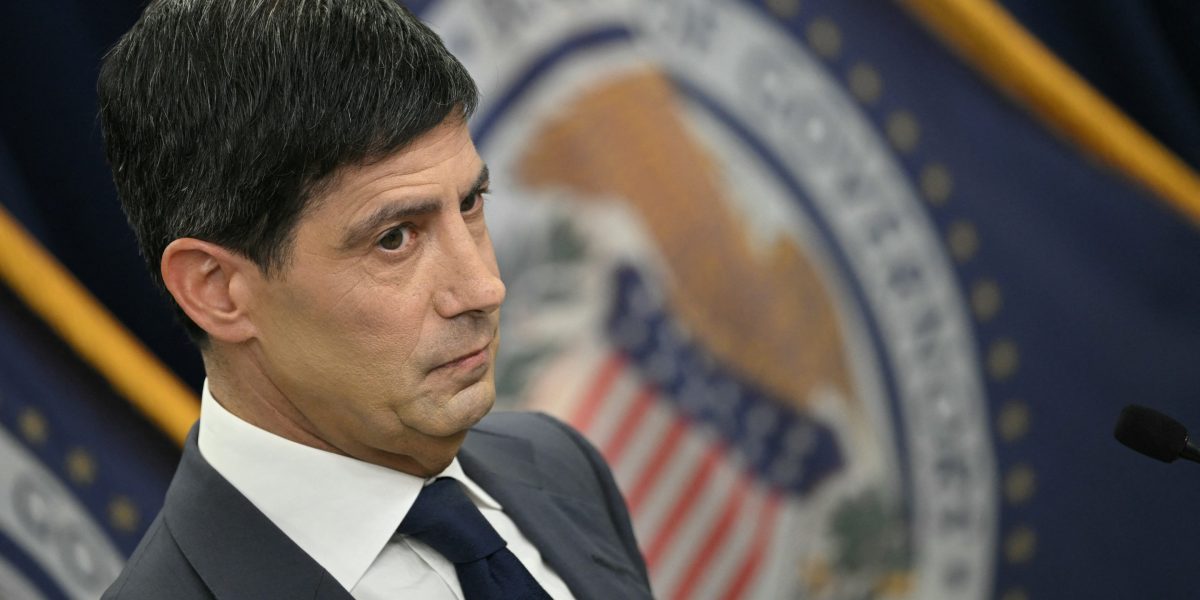
The bank’s previous base case was for rates to remain steady through the year. But last week’s Federal Open Market Committee meeting, where half of policymakers predicted rate hikes, as well as new Fed Chairman Kevin Warsh’s surprisingly hawkish remarks prompted analysts to change their view.
The Fed kept rates on hold last week, and BofA sees it doing the same next month. Then the first increase should come in September, the bank predicted, followed by another in October and December, reversing the last cut made last year, when the central bank lowered the federal fund by 0.25 percentage points on Dec. 10, 2025.
Since then, the economic landscape changed dramatically. In the fall, the Fed cut rates as job data weakened while anticipating President Donald Trump’s tariffs would only have short-term impact on inflation. But the labor market strengthened this year, and Trump’s Iran war sent oil prices soaring.
“Meanwhile, the Fed’s inflation problem has gotten unambiguously worse,” BofA said. “Core PCE could reach 3.5% in May, nearly 70bp higher than it was a year ago. The pickup has been partly due to tariffs and other one-offs. The Fed was willing to look through the tariffs, but it is losing patience after the latest round of supply shocks. Also, housing-driven disinflation has now mostly run its course, while other core services remain very sticky.”
The note highlighted Fed policymakers’ forecasts that showed several expecting rate hikes even though the unemployment rate isn’t seen falling. That upended BofA’s assumption that a tighter labor market would be a pre-requisite for hikes.
The projections also put inflation at 2.5% by the end of next year—still above the Fed’s target—indicating prices will remain sticky even after one-off effects this year roll off.
Wall Street has started pricing in the risk of a hawkish Fed. On Monday, the 10-year Treasury yield jumped 4.6 basis points to 4.497%, despite Brent crude prices falling 4% to $77.29 a barrel.
It’s possible the Fed could hold off on tightening if job growth slows down sharply, inflation cools, or stocks tumble, according to BofA, adding that Warsh could also be “strategically hawkish” to gain credibility while biding his time to cut later.
But analysts also pointed out that Warsh didn’t push back on the notion of rate hikes and suggested monetary policy isn’t totally restrictive.
That’s as a gusher of money is coming out of Wall Street as companies are on pace to raise trillions of dollars in stock and debt offerings this year. In his press briefing on Wednesday, Warsh nodded to this flood of capital, even as he said that monetary policy overall is “somewhat restrictive.”
“I would have a hard time managing to say those words if I were to see what’s happening in financial markets,” he admitted. “So I’d say it’s uneven. That’s perhaps a function of different transmission mechanisms of monetary policy, whether monetary policy is coming from our interest rate tool or our balance sheet tool.”
But Chen Zhao, chief global strategist at Alpine Macro, said in a note Monday that rate hikes are unlikely. The end of the Iran war could send oil prices to $50-$60 a barrel, helping inflation get back down. Meanwhile, small businesses are struggling, AI is already improving productivity, and wage growth is weakening.
“The bottom line is that while half of the Fed’s voting members may be signaling their intention to raise rates, the odds of actual tightening remain very low,” Zhao wrote. “We maintain our view that inflation will begin to decline later this year as these transitory shocks pass through the system.”