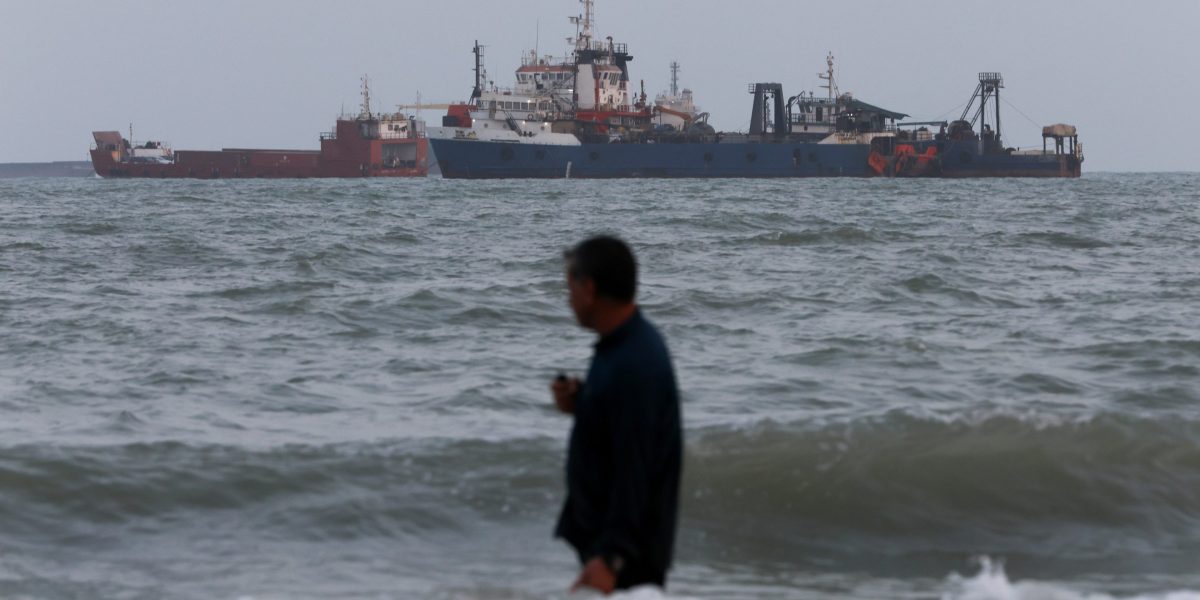




Concerns are growing that the de-facto tolling of the Strait of Hormuz could trigger a domino effect for key shipping bottlenecks worldwide, creating more global inflation and effectively killing key components of international maritime law.
As Iran insists on some form of fee structure for traversing the now-infamous strait—and the U.S. increasingly seems unable to prevent it—the rising expectation is that other nations may insist on new fees elsewhere, such as Asia’s Strait of Malacca, Europe’s and Africa’s Strait of Gibraltar, as well as key waterways impacted by Russia’s war in Ukraine.
“I think that the ‘freedom of the seas’ is dead,” said Michelle Brouhard, head of policy and geopolitical risk for the Kpler energy intelligence firm.
“The way that we’ve known maritime security is moving into a new era, and the rules are still getting rewritten,” Brouhard told Fortune. “It’s going to look different than what we’ve seen before. It’s going to be expensive; it’s going to be inflationary; and it’s also going to create a lot of benefits for people who start onshoring industrialization.”
The so-called freedom of the seas is the centuries-old recognition that maritime transit and commerce should be free and open to all. The “absolute freedom of navigation” was insisted in Woodrow Wilson’s famed “Fourteen Points” statement of peace to end World War I. That legality is carried today through the U.N. Convention on the Law of the Seas.
In that vein, “The post-World War II order is burning to the ground,” Brouhard said. This trend was already in the works with President Trump’s return to office and the so-called ‘Donroe Doctrine’ emphasizing regionalism and control over the Western Hemisphere. “It’s just accelerating now with the [Iran] war,” she added.
Shipping companies, insurance firms, and more would certainly oppose tolling structures—they’re already threatening to cancel coverage on vessels that pay tolls or involuntary fees—but that doesn’t mean they can prevent them, she said.
Iran is demanding a 5% or 7% service fee per barrel of oil that would generate close to $20 billion annually, and that’s not even counting fees on other cargoes, such as natural gas, petrochemicals, helium, fertilizer, and container cargoes. While analysts are skeptical that such high charges would come to fruition, many see a fee system of some kind as inevitable.
And Brouhard believes it’s increasingly an inevitably that more fees will be charged for cargoes to move through other straits as other nations seek to capitalize, such as Malaysia and Indonesia in the Strait of Malacca and Morocco with the Strait of Gibraltar.
“Once Iran said they were going to charge a fee—if they charge a toll—then everyone is going to charge a toll,” Brouhard said. “This is one of the last known natural resources that someone can make money off of. Imagine if you’re Malaysia, you’re a relatively poor country. Now, all of a sudden, you can charge a toll. You’re going to be a relatively rich country. Morocco could become a richer country,” she said.
“It’s an entirely new commoditized asset that didn’t exist before.”
New world order
There is an ongoing debate in energy and geopolitical circles as to whether some kind of fee structure—even a so-called voluntary one—is an inescapability or a leveraging tactic to win Iran the economic freedoms from sanctions it desires.
Bob McNally, former White House energy advisor under George W. Bush and founder of the Rapidan Energy Group, believes Iran would likely settle for tiny, voluntary service fees, similar to what already exists at the Strait of Malacca.
“We look at the whole question of Hormuz tolls as mainly an Iranian bargaining chip that they’re willing and able to give up for big sanctions relief and other things,” McNally said. “We just don’t think heavy-handed Iranian tolls are going to be the future. That could be wrong.”
Another argument is that Iran’s oil-producing neighbors, the Gulf Cooperation Council (GCC), may opt for regular payments to Iran—instead of a per-vessel fee system—to keep Hormuz open, said Gregory Brew, senior analyst for Iran and energy with the Eurasia Group.
“My expectation has been that money will be delivered to the Iranians in some way, shape, or form,” Brew said. “It will likely come from the GCC states, and it will likely come in the form of voluntary fees that are meant to cover the costs of managing the strait.”
And that is very different that the miniscule, voluntary fees in Malacca, he said.
“I think the [Malacca] comparison will be made to frame the agreement in Hormuz as legal and acceptable,” Brew added. “The difference will come in the quantity of funds delivered. The Iranians won’t accept a nominal, minor amount. They’ll want something more substantial, and the GCC will likely have to deliver them what they want.”
Indonesia and Malaysia already have publicly flirted with tolling the Strait of Malacca this year but have also insisted they’ll avoid doing so for now.
Even though it would have violated the freedom of navigation, Brouhard said there’s an argument that the U.S. should have worked with Turkey and others to make Russia pay tolls through the Bosporus Strait as punishment for invading Ukraine—instead of capping the prices of Russia’s oil and gas sales.
Making Russia’s oil the most expensive in the world would have punished Russia more than making its oil the cheapest and benefitting the oil buyers, especially China, she said.
In such a way, Brouhard said, there’s an argument that the “freedom of the seas” is no longer ideal for the modern world.
“Freedom of the seas makes sense in a world where everybody’s friends with each other. But, in a world like now, where there are a lot of hostilities, and you have the rising power of China, maybe freedom of navigation doesn’t make sense,” Brouhard said.
As such, this would hasten onshoring and the building up of domestic supply chains. But it would also prove inflationary for essentially everything. In the case of oil though, tolls charged on cheaper oil on open straits would prove less costly than the oil spikes of today, she said. And worldwide tolls would also apply to container ships—essentially all exported goods—and not just oil and gas tankers.
“Everything that we’ve seen that has been inflationary has been on commodity prices,” Brouhard said. In a world of tolls on straits, “You’re going to have higher prices on the transit of container goods. And 90% of global trade happens on the water. It’s not just commodities, it’s everything. All global trade is happening on the water.”