



President Trump’s global trade war has significantly raised the bar for the Federal Reserve to lower interest rates, as tariffs risk worsening an already knotty inflation problem while also damaging growth.
Jerome H. Powell, the Fed chair, drove home that message in a hotly anticipated speech that came at the end of a turbulent week as financial markets melted down after Mr. Trump’s tariff plans were revealed.
The measures would lead to higher inflation and slower growth than initially expected, Mr. Powell warned during an event in Arlington, Va., on Friday. He showed concern about the souring economic outlook, but his emphasis on the potential inflationary effect of the new tariffs made clear that it was a significant source of angst.
“Our obligation is to keep longer-term inflation expectations well anchored and to make certain that a one-time increase in the price level does not become an ongoing inflation problem,” Mr. Powell said. The Fed’s mandate includes two goals, fostering a healthy labor market and maintaining low, stable inflation.
Before Mr. Trump’s return to the White House, inflation was already proving to be stubbornly sticky, staying well above the Fed’s 2 percent target. Yet the economy had stayed remarkably resilient, leading the central bank to adopt a more gradual approach to interest rate cuts that culminated in it pausing reductions in January. At that policy meeting, Mr. Powell established that the Fed would need to see “real progress on inflation or, alternatively, some weakness in the labor market” to restart cuts.
But with inflation set to soar because of tariffs, it will take tangible evidence that the economy is weakening significantly to get the central bank going again. That could mean that rate cuts are pushed off until much later this year or even delayed until next year if that deterioration takes time to materialize.
“They will not be inclined to be pre-emptive to cut rates to avoid what may be a downturn,” said Richard Clarida, a former vice chair at the Fed who is now a global economic adviser at Pimco, an investment firm. “They’re actually going to have to see an actual crack in the labor market.”
Mr. Clarida said he would look for a “material” rise in the unemployment rate or a “very sharp slowdown, if not a contraction” in monthly jobs growth to account for what he expected would be a significant lurch higher in inflation.
The latest jobs report, which was released Friday, showed that on the eve of Mr. Trump’s latest tariff blitz, the labor market was far from cracking. Employers added 228,000 jobs in March, and the unemployment rate ticked up to 4.2 percent as participation in the labor market rose.
Any enthusiasm about the latest data was quickly overtaken by a torrent of worries about the economic outlook — concerns Mr. Trump’s top economic advisers sought to address on Sunday.
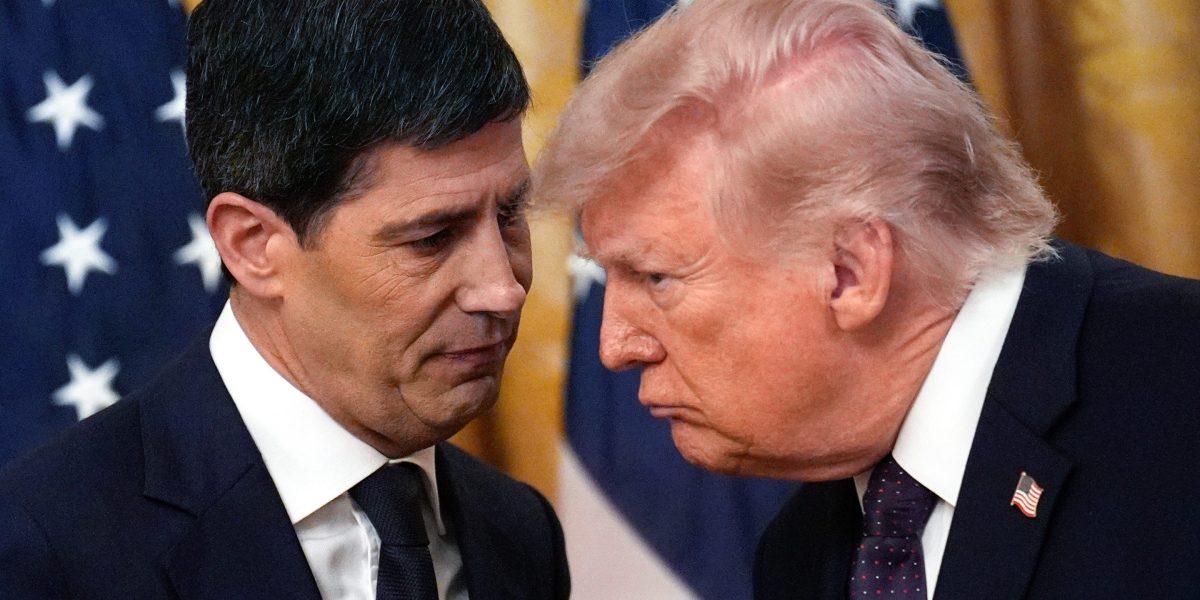
Kevin Hassett, director of the White House National Economic Council, acknowledged that the president’s approach could exacerbate inflation. “There might be some increase in prices,” he said on ABC’s “This Week.” But he insisted that Mr. Trump’s plan would ultimately reverse a long-running trend of importing lower-cost products in exchange for job losses.
“We got the cheap goods at the grocery store, but then we had fewer jobs,” he said.
Scott Bessent, the Treasury secretary, also sought to downplay the prospects of a recession, telling NBC’s “Meet the Press” on Sunday that there would be an “adjustment process.”
Economists across Wall Street are much more gloomy about the outlook. Many have sharply raised their recession odds alongside their forecasts for inflation. Those economists fear that Mr. Trump’s tariffs, which are a tax on imports, will eventually decimate consumer spending, squeeze businesses’ profit margins and potentially lead to layoffs that push the unemployment rate above 5 percent.
Many in this cohort expect the Fed to lower interest rates swiftly as a result, beginning as early as June. Federal funds futures markets reflect a similar approach.
Michael Feroli, chief U.S. economist at J.P. Morgan, is calling for a recession in the second half of this year, with growth declining 1 percent in the third quarter and another 0.5 percent in the fourth quarter. Over the course of the year, he expects growth to fall 0.3 percent and the unemployment rate to rise to 5.3 percent. Even as the Fed’s preferred inflation gauge — once volatile food and energy prices are stripped out — surges to 4.4 percent, Mr. Feroli forecasts that the Fed will restart cuts in June and then lower borrowing costs at every meeting through January until the policy rate reaches 3 percent.
Jonathan Pingle, chief U.S. economist at UBS, has penciled in a percentage point worth of cuts this year even as core inflation reaches 4.6 percent. He expects the unemployment rate to shoot higher this year before peaking at 5.3 percent in 2026. Economists at Goldman Sachs projected that the Fed would deliver three consecutive quarter-point cuts beginning in July.
But there are credible risks to this outlook. The prevailing one is that the inflation shock will be just too enormous for the Fed to look past it by the summer, especially if the economy has not yet deteriorated in a meaningful way.
“The burden of proof now is higher because of the inflation situation that we’re in,” said Seth Carpenter, a former Fed economist who is now at Morgan Stanley. “They have to get enough information that convinces them that the negative effects of slowing — and possibly negative — growth outweighs the cost to them of inflation.”
Mr. Carpenter said he expected no cuts from the Fed this year but multiple next year, bringing interest rates down to between 2.5 percent to 2.75 percent. Economists at LHMeyer, a research firm, have also shelved cuts this year, assuming there is no “full-blown” recession.
Perhaps the most important determinant of when the central bank will restart rate cuts is what happens with inflation expectations. Beyond a year ahead, expectations have stayed somewhat stable, aside from some survey-based measures that are seen as less reliable than others.
If those expectations begin to wobble in a more notable way, the Fed would become even more hesitant to cut and would need to see even more economic weakness than usual, said William English, a Yale professor and a former director of the Fed’s division of monetary affairs.
Eric Winograd, an economist at the investment firm AllianceBernstein, said Mr. Powell’s inflation-focused posture on Friday would help to avoid that outcome. “The name of the game is: You talk tough,” he said. “You keep inflation expectations where they are, and, by doing that, you preserve your ability to ease later if it’s necessary.”
A higher bar for interest rate cuts could put the Fed in a tougher spot with the Trump administration, Mr. English said. Up until last week, the president had been more subdued in his criticism of the central bank, compared with his first term. He had called for lower interest rates but sought to justify them by pointing to his plans to lower energy prices, among other reasons.
But as the rout in financial markets intensified last week, Mr. Trump turned his ire back toward Mr. Powell and the Fed, in what could be a prelude of more intense pressure to come. At one point, the president appeared to suggest that the market rout was part of his strategy. He circulated a video from a user on Mr. Trump’s social media network that suggested the president was “purposely CRASHING” the markets in part to force the Fed to lower interest rates.
Pressed on the matter on Sunday, Mr. Hassett of the National Economic Council responded by saying that the Fed was independent, before adding: “He’s not trying to tank the market.”
Mr. Trump has already sought to chip away at the central bank’s longstanding independence from the White House by targeting the Fed’s oversight of Wall Street. His decision last month to fire two Democratic commissioners from the Federal Trade Commission has also reverberated widely, raising important questions about what kind of authority the president has over independent agencies and the personnel who run them.
At the event on Friday, Mr. Powell said he fully intended to serve out all of his term, which ends in May 2026. He has also previously been explicit that early removal by the president is “not permitted under the law.”
“The risk to the Fed’s independence is bigger now,” Mr. English, the Yale professor, said. “It just puts them right in the firing line.”