



One hundred days of President Trump. Seventy days of whipsaw trading in financial markets. Thirty three days of losses. More than $6.5 trillion wiped from the value of public companies.
For financial markets, the 9 percent drop in the S&P 500 is on track for the worst start to a presidential term since Gerald R. Ford took over from Richard M. Nixon in August 1974 after the Watergate scandal. The slump is worse even than when the tech bubble burst at the turn of the century, and George W. Bush inherited a market already in free fall.
In contrast, Mr. Trump inherited an economy on solid footing and a stock market rising from one record high to another.
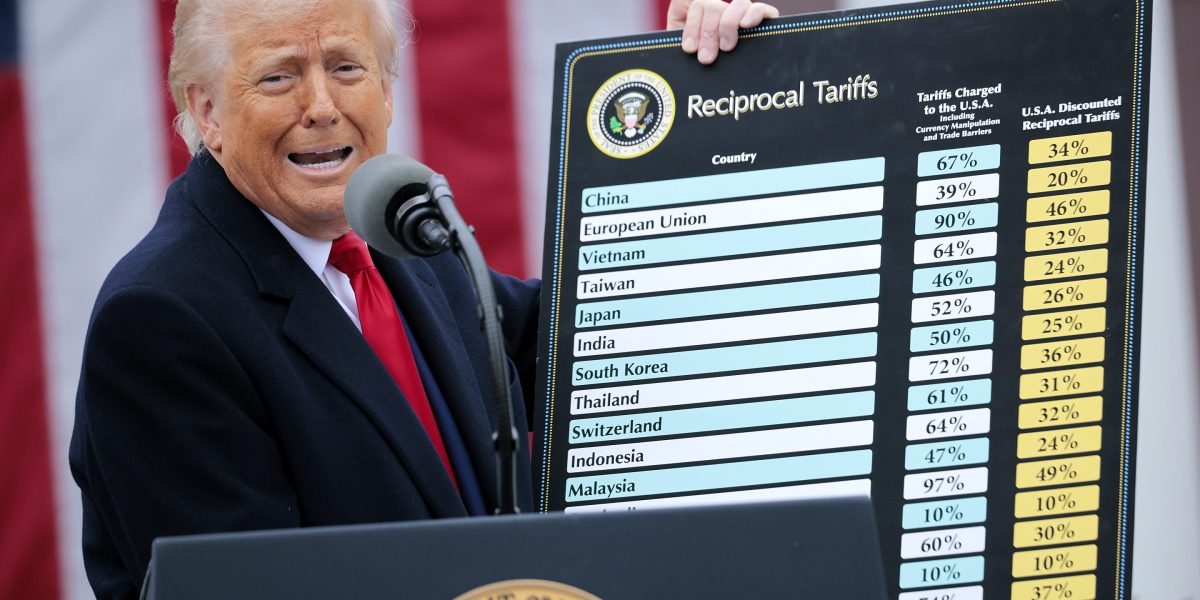
That swiftly changed when Mr. Trump unveiled his marquee suite of tariffs on April 2 — not the first new import taxes announced by his administration, but by far the most sweeping. Volatility erupted. Wall Street frantically began to grapple with the economic consequences of the new government’s policies.
The S&P 500 tumbled more than 10 percent in two days, a drop comparable to some of the worst days of the pandemic-induced sell-off in March 2020 and, before that, the financial crisis in 2008.
Stocks have since stabilized, but the shock waves from the chaotic tariff rollout continue to send tremors through the global financial system.
Some investors have questioned the United States’ role at the heart of that financial system and the safety of the nation’s assets during periods of market turmoil, threatening the long-held market order.
There remain some optimists who note that the market turmoil did seem to eventually prompt Mr. Trump to back down on his steepest tariffs. But for many investors, even hopes of trade deals, tax cuts and deregulation — a return to the more pro-business policies on the president’s agenda — remain marred by the sheer uncertainty over what else could happen next.
“It’s a very unstable situation,” said Michael Purves, chief investment officer at Tallbacken Capital.
Promises of Prosperity Ahead
It didn’t start out like this.
One month into Mr. Trump’s term, the S&P 500 notched a record high. Investors were encouraged by the seemingly unlimited potential of artificial intelligence and a new president who had campaigned on a pro-growth agenda.
Addressing the Future Investment Initiative Institute in Miami on Feb. 19, Mr. Trump assured investors of economic prosperity ahead.
“There’s no better place on earth than the current and future United States of America under a certain president named Donald J. Trump,” he said.
Investors were jubilant. “There was so much optimism in the air,” said Todd Ahlsten, chief investment officer at Parnassus Investments, adding “there were few warning signs on the horizon.”
Within a day of Mr. Trump’s speech, however, worries over inflation started to weigh on the market, intensifying at the beginning of March with the announcement of 25 percent tariffs on Mexico and Canada. Economists expect tariffs, which are a tax on imports paid by the importer, to lead to higher prices for consumers and businesses.
Investors, who once believed that Mr. Trump’s aggressive campaign talk about trade imbalances would not become policy, were suddenly confronting a new reality. The president was serious about imposing tariffs, and he was willing to risk a sell-off in the stock market to achieve his goals.
Investors were still not prepared for what came next.
‘A Huge Change in the Paradigm’
The announcement of double-digit tariffs on countries across the globe incited the worst two-day sell-off for the S&P 500 since March 2020. The difference this time was that the slide came in direct response to government policy.
“It was a rapid sell-off, especially when you consider that there was no external shock like the pandemic,” said Mohamed El-Erian, President of Queens’ College at Cambridge University and the former chief executive of Pimco, one of the largest asset managers in the world.
Economists began sounding the alarm that the economy, which had been experiencing steadily slowing job growth as inflation cooled, was now headed toward a much sharper downturn. The administration again shrugged off the stock slide. Investors rushed to protect their portfolios from further losses.
“The U.S. economy has gone from being celebrated for economic exceptionalism to concerns that it is slipping into stagflation or recession,” Dr. El-Erian said. “That is a huge change in the paradigm for the world’s most important economy.”
The week before the tariffs were expected to go into effect, both the tech-heavy Nasdaq Composite index and the Russell 2000 index of smaller companies — which tend to be more of a barometer of the outlook for the economy than much larger, multinational companies — had fallen into bear markets.
A bear market, in which an index falls 20 percent from its peak, is rare. When one occurs, it is a marker of extreme investor pessimism. In this case, analysts and economists say, it’s over the direction of the economy in response to tariffs. It’s a line in the sand for a sell-off turning into a sustained down market.
When markets closed on April 8 — the day before the tariffs were set to take effect — the S&P 500 had fallen 18.9 percent below its February peak. With the market continuing the fall further toward a bear market as the tariffs came into force the next morning, Mr. Trump announced a 90-day pause for the most punitive tariffs on all countries except China. Stocks rallied, with the S&P 500 recording its best day since 2008.
Alarm Bells Across the Financial System
But it wasn’t the stock market that Mr. Trump said had made him blink.
That same week, something strange occurred in both the bond and currency markets. Typically, in times of turmoil, investors all over the world seek out U.S. assets as a source of reliability and safety. They buy dollars and U.S. government debt, typically pushing up the value of each.
That is what happened as the stock market initially tumbled. But in the days leading up to the tariffs, both the dollar and U.S. government bonds started to fall as well, setting off alarm bells across Wall Street.
Traders described a sense of panic and fear as prices lurched lower, sending yields soaring.
The 30-year Treasury bond started the week with a yield of just over 4.3 percent. In overnight trading before the tariffs went into effect, the yield — which is indicative of the borrowing cost for the U.S. government — rose above 5 percent. That was a huge move in a market that typically moves by hundredths of a percentage point each day.
“The bond market is very tricky,” Mr. Trump remarked
Traders pointed to technical thresholds that were breached in the bond market, setting off a spate of selling from different computer-driven trading strategies that automatically buy and sell based on preset programming.
Then the sell-off gathered momentum, with some analysts saying the unusual moves were a sign that investors were souring on U.S. assets amid the chaos caused by tariffs.
U.S. exceptionalism is rooted in the notion that the United States plays a central role in global financial markets, where the dollar is the reserve currency and the nation’s debt underpins borrowing domestically and internationally. That very notion, analysts say, has become vulnerable.
Amid the chaos, Mr. Trump also ramped up attacks on the people and institutions underpinning U.S. exceptionalism, such as Jerome H. Powell, the chair of the Federal Reserve, whose independence helps underpin investor confidence in U.S. markets.
The president was displeased that Mr. Powell had not lowered interest rates, even though the latter has warned that doing so could fuel further inflation. While many investors also long for lower rates, it is more important to them that the Fed maintain its independence.
More ‘Yo-Yo’ Tariffs?
Since April 9, there had been a shift in the tone of the administration.
Officials have promoted what they say have been positive trade negotiations taking place behind the scenes.
Even when the administration’s claims of talks are rebuffed for being made up, as in the case of China, investors have taken the cue that the White House is trying to give the market something to cheer.
Still, few are willing to bet on what happens next.
One bond banker at a U.S. bank said his team was no longer making trading decisions with a time horizon of up to six months, as it was last year. Instead, uncertainty has forced it to make decisions week to week, with much dependent on the eventual level of tariffs that may not be known for weeks or even months.
Economic data will be watched closely for signs that tariffs are taking hold. Earnings reports will continue to be pored over for signs that tariffs are hitting Main Street.
Then it will be July and the end of the 90-day pause that put tariffs and the market’s meltdown on hold.
“If the administration moderates the tariff policy soon, and the tariff uncertainty abates, the lasting damage might be modest or negligible,” said James Egelhof, an economist at BNP Paribas. He said he was spending an increasing amount of time fielding questions from clients about what a potential economic downturn might look like if the tariff uncertainty persists.
“If we continue on a course where tariffs behave like a yo-yo, going up, then down, then up again, then this uncertainty won’t abate, and it will have a paralyzing effect on businesses in particular,” he said.
Highlighting that uncertainty again on Wednesday, Mr. Trump pushed off blame for the current market turmoil onto his predecessor.
“This is Biden’s Stock Market, not Trump’s,” Mr. Trump wrote on Truth Social. “I didn’t take over until January 20th. Tariffs will soon start kicking in, and companies are starting to move into the USA in record numbers.”
“BE PATIENT!!’ he added.