

Close Menu
Alpha Leaders
  • Home
  • News
  • Leadership
  • Entrepreneurs
  • Business
  • Living
  • Innovation
  • More
    • Money & Finance
    • Web Stories
    • Global
    • Press Release
What's On
NYT ‘Pips’ Hints, Answers And Walkthrough For Wednesday, July 8

NYT ‘Pips’ Hints, Answers And Walkthrough For Wednesday, July 8

8 July 2026
Wednesday, July 8 (Here Comes Trouble)

Wednesday, July 8 (Here Comes Trouble)

8 July 2026
Trip.com cofounder James Liang sees demographic decline as threat to innovation

Trip.com cofounder James Liang sees demographic decline as threat to innovation

8 July 2026
Facebook X (Twitter) Instagram
Alpha Leaders
newsletter
  • Home
  • News
  • Leadership
  • Entrepreneurs
  • Business
  • Living
  • Innovation
  • More
    • Money & Finance
    • Web Stories
    • Global
    • Press Release
Alpha Leaders
Home » Why America may not have won World War II without its secret weapon: Greenland
News

Why America may not have won World War II without its secret weapon: Greenland

Press RoomBy Press Room17 February 20265 Mins Read
Facebook Twitter Copy Link Pinterest LinkedIn Tumblr Email WhatsApp
Why America may not have won World War II without its secret weapon: Greenland

That very week in Washington, at a meeting of the Pan American Union, Roosevelt and his advisers spoke with hundreds of geologists and other representatives from Latin America — a resource-rich region that the U.S. saw as an answer to its strategic materials shortages.

Nervous about the history of U.S. imperial high-handedness in the region, some Latin Americans thought that their countries should seal off their resources to outside control, as Mexico had in nationalizing U.S. and European oil holdings in 1938.

Japan’s advances in Southeast Asia after Pearl Harbor cut off rubber from the Dutch East Indies and Malaysia, prompting a rush for rubber in the Amazon and the development of synthetics. World War II posters urged Americans to conserve rubber for the war effort. U.S. Government Printing Office, Courtesy of Northwestern University Libraries

With European empires crumbling, Roosevelt faced a delicate diplomatic dance with Greenland. He wanted to maintain the appearance of neutrality, keep skeptical isolationists in Congress from revolting and give no provocations to Latin American anti-imperialists to cut off resources. Crucially, he also needed to avoid giving the resource-starved Japanese a legal justification to seize the oil-rich Dutch East Indies, now Indonesia – another European colony orphaned by the Nazi invasion.

Roosevelt’s solution: enlist Coast Guard “volunteers” to guard Ivittuut. By the end of the summer, long before the U.S. officially entered the war, 15 sailors resigned from their ships and took up residence near the mine.

Seeing Greenland as crucial to US security

Roosevelt also got creative with geography.

In an April 12, 1940, press conference, just days after the Nazi invasion, he began to emphasize Greenland as part of the Western Hemisphere, more American than European, and thus falling under Monroe Doctrine protections. To calm fears in Latin America, U.S. officials recast the doctrine as development-oriented hemispheric solidarity.

Maj. William S. Culbertson, a former U.S. trade official speaking before the Army Industrial College in fall 1940, noted how the scramble for resources pulled the U.S. into a form of nonmilitary warfare: “We are engaged at the present time in economic warfare with the totalitarian powers. Publicly, our politicians don’t state it quite as bluntly as that, but it is a fact.” For the rest of the century, the front line was just as likely a far-off mine as an actual battlefield.

On April 9, 1941, exactly a year after the Nazis seized Denmark, Kauffmann met with U.S. Secretary of State Cordell Hull to sign an agreement “on behalf of the King of Denmark” placing Greenland and its mines under the U.S. security blanket. At Narsarsuaq, on the island’s southern tip, the U.S. began constructing an airbase named “Bluie West One.”

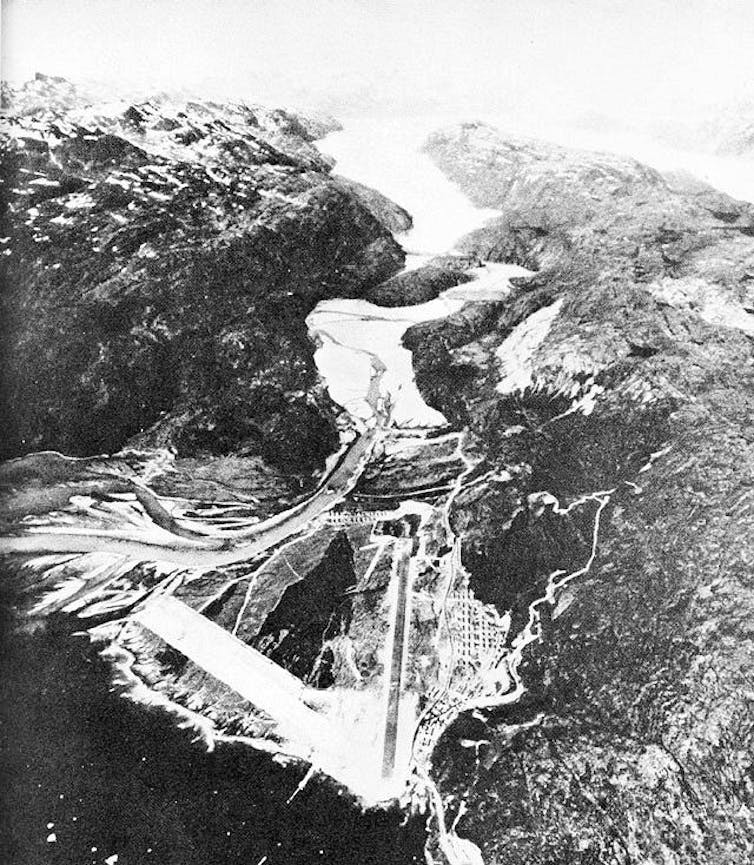
A photo from a plane of an airbase surrounded by mountains with glaciers above – in June.

An aerial view shows Bluie West One, a U.S. air base at Narsarsuaq, Greenland, in June 1942. Later, during the Cold War, the U.S. used Thule Air Base, now called Pituffik Space Base, in northwest Greenland as a key missile defense site because of its proximity to the USSR. USAF Historical Research Agency

During the rest of World War II and throughout the Cold War, Greenland would house several important U.S. military installations, including some that forced Inuit families to relocate.

Critical minerals today

What transpired in Greenland in the 18 months before Pearl Harbor fit into a larger emerging pattern.

As the U.S. ascended to global leadership and realized that it couldn’t maintain military dominance without wide access to foreign materials, it began to redesign the global system of resource flows and the rules for this new international order.

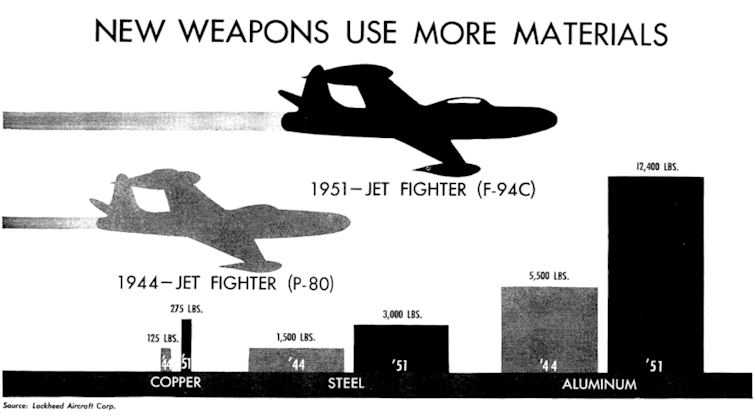
A chart showing costs significantly higher for steel, aluminum and copper in the 1950s compared with the early 1940s.

A 1952 chart from the President’s Materials Policy Commission, established by President Harry Truman to study the security of U.S. raw materials during the Cold War. The group was commonly known as the Paley Commission. Resources for Freedom: A Report to the President

It rejected the Axis’ “might makes right” territorial conquest for resources, but found other ways to guarantee American access to critical resources, including loosening trade restrictions in European colonies.

The U.S. provided a lifeline to the British with the destroyers-for-bases deal in September 1940 and the Lend-Lease Act in March 1941, but it also gained strategic military bases around the world. It used aid as leverage to also pry open the British Empire’s markets.

The result was a postwar world interconnected by trade and low tariffs, but also a global network of U.S. bases and alliances of sometimes questionable legitimacy designed in part to protect U.S. access to strategic resources.

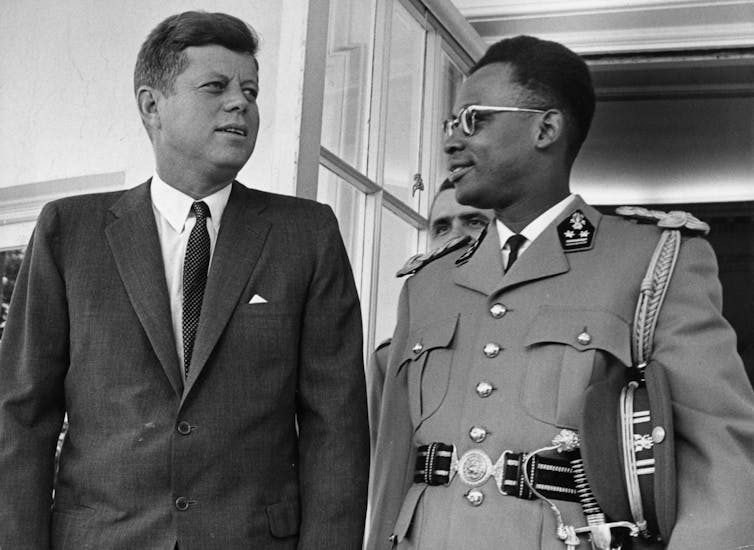
Two men, one in military uniform, stand in front of a White House door talking.

President John F Kennedy meets with Mobutu Sese Seko of the former Belgian Congo, now the Democratic Republic of Congo, at the White House in 1963. Starting in the 1940s, the African country provided the U.S. with cobalt and uranium, including for the Hiroshima bomb. CIA-supported coups in 1960 and 1965 helped put Mobutu, known for corruption, in power. Keystone/Getty Images

During the Cold War, these global resources helped defeat the Soviet Union. However, these security imperatives also gave the U.S. license for support of authoritarian regimes in places like Iran, Congo and Indonesia.

America’s voracious appetite for resources also often displaced local populations and Indigenous communities, justified by the old claim that they misused the resources around them. It left environmental damage from the Arctic to the Amazon.

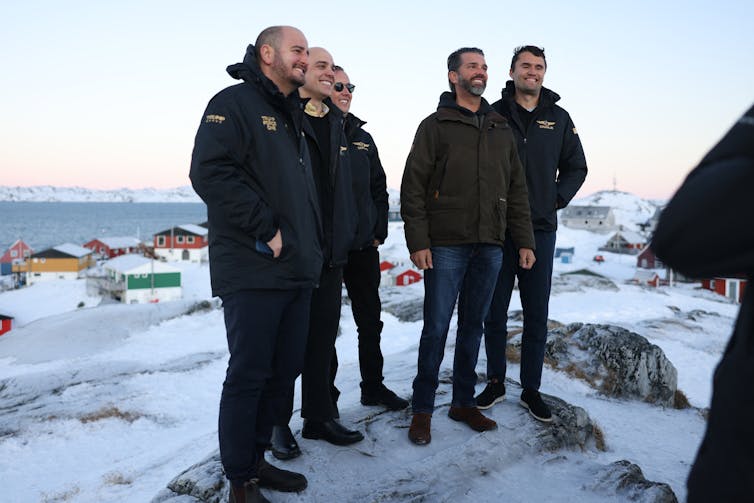
Five white men standing on snow smile for the cameras with a Greenland village behind them.

Donald Trump’s son visited Greenland in 2025, shortly after the U.S. president began talking about wanting to control the island and its resources. The people with Donald Trump Jr., second from right, are wearing jackets reading ‘Trump Force One.’ Emil Stach/Ritzau Scanpix/AFP via Getty Images

Strategic resources have been at the center of the American-led global system for decades. But U.S. actions today are different. The cryolite mine was a working mine, rarer than today’s proposed critical mineral mines in Greenland, and the Nazi threat was imminent. Most important, Roosevelt knew how to gain what the U.S. needed without a “damn-what-the world-thinks” military takeover.

Thomas Robertson, Visiting Associate Professor of Environmental Studies, Macalester College

This article is republished from The Conversation under a Creative Commons license. Read the original article.
The Conversation

Greenland history
Share. Facebook Twitter Pinterest LinkedIn Tumblr Email Copy Link

Related Articles

Trip.com cofounder James Liang sees demographic decline as threat to innovation

Trip.com cofounder James Liang sees demographic decline as threat to innovation

8 July 2026
AI start-ups are snubbing entry-level talent in favor of Silicon Valley men with top degrees

AI start-ups are snubbing entry-level talent in favor of Silicon Valley men with top degrees

8 July 2026
He went from working in a factory to being rich enough to retire at 32—but 3 decades later, this millionaire still works and takes public transport

He went from working in a factory to being rich enough to retire at 32—but 3 decades later, this millionaire still works and takes public transport

8 July 2026
European Parliament members call for a probe of FIFA president Gianni Infantino over his Trump call

European Parliament members call for a probe of FIFA president Gianni Infantino over his Trump call

8 July 2026
Palantir CEO Alex Karp is wrong about Anthropic and OpenAI. But he has reason to be worried.

Palantir CEO Alex Karp is wrong about Anthropic and OpenAI. But he has reason to be worried.

7 July 2026
Meet the former Goldman Sachs exec who became the America’s Cup Partnership’s first CEO

Meet the former Goldman Sachs exec who became the America’s Cup Partnership’s first CEO

7 July 2026
Don't Miss
Unwrap Christmas Sustainably: How To Handle Gifts You Don’t Want

Unwrap Christmas Sustainably: How To Handle Gifts You Don’t Want

By Press Room27 December 2024

Every year, millions of people unwrap Christmas gifts that they do not love, need, or…

Exclusive: DeFi platform Azura launches after raising .9 million from Initialized

Exclusive: DeFi platform Azura launches after raising $6.9 million from Initialized

22 October 2024
Sam Altman’s World Wants To Scan Your Eyes To Prove You’re Human

Sam Altman’s World Wants To Scan Your Eyes To Prove You’re Human

22 October 2024
Stay In Touch
  • Facebook
  • Twitter
  • Pinterest
  • Instagram
  • YouTube
  • Vimeo
Latest Articles
AI start-ups are snubbing entry-level talent in favor of Silicon Valley men with top degrees

AI start-ups are snubbing entry-level talent in favor of Silicon Valley men with top degrees

8 July 20261 Views
Samsung Confirms Radical ‘Galaxy Buds’ Apple Threat

Samsung Confirms Radical ‘Galaxy Buds’ Apple Threat

8 July 20262 Views
He went from working in a factory to being rich enough to retire at 32—but 3 decades later, this millionaire still works and takes public transport

He went from working in a factory to being rich enough to retire at 32—but 3 decades later, this millionaire still works and takes public transport

8 July 20261 Views
Claude Fable 5 Extends By Five More Days. 10 Moves To Make Now!

Claude Fable 5 Extends By Five More Days. 10 Moves To Make Now!

8 July 20262 Views

Recent Posts

  • NYT ‘Pips’ Hints, Answers And Walkthrough For Wednesday, July 8
  • Wednesday, July 8 (Here Comes Trouble)
  • Trip.com cofounder James Liang sees demographic decline as threat to innovation
  • Today’s Wordle #1845 Hints And Answer For Wednesday, July 8
  • AI start-ups are snubbing entry-level talent in favor of Silicon Valley men with top degrees

Recent Comments

No comments to show.
About Us
About Us

Alpha Leaders is your one-stop website for the latest Entrepreneurs and Leaders news and updates, follow us now to get the news that matters to you.

Facebook X (Twitter) Pinterest YouTube WhatsApp
Our Picks
NYT ‘Pips’ Hints, Answers And Walkthrough For Wednesday, July 8

NYT ‘Pips’ Hints, Answers And Walkthrough For Wednesday, July 8

8 July 2026
Wednesday, July 8 (Here Comes Trouble)

Wednesday, July 8 (Here Comes Trouble)

8 July 2026
Trip.com cofounder James Liang sees demographic decline as threat to innovation

Trip.com cofounder James Liang sees demographic decline as threat to innovation

8 July 2026
Most Popular
Today’s Wordle #1845 Hints And Answer For Wednesday, July 8

Today’s Wordle #1845 Hints And Answer For Wednesday, July 8

8 July 20262 Views
AI start-ups are snubbing entry-level talent in favor of Silicon Valley men with top degrees

AI start-ups are snubbing entry-level talent in favor of Silicon Valley men with top degrees

8 July 20261 Views
Samsung Confirms Radical ‘Galaxy Buds’ Apple Threat

Samsung Confirms Radical ‘Galaxy Buds’ Apple Threat

8 July 20262 Views

Archives

  • July 2026
  • June 2026
  • May 2026
  • April 2026
  • March 2026
  • February 2026
  • January 2026
  • December 2025
  • November 2025
  • October 2025
  • September 2025
  • August 2025
  • July 2025
  • June 2025
  • May 2025
  • April 2025
  • March 2025
  • February 2025
  • January 2025
  • December 2024
  • November 2024
  • October 2024
  • September 2024
  • August 2024
  • July 2024
  • June 2024
  • May 2024
  • April 2024
  • March 2024
  • February 2024
  • January 2024
  • December 2023
  • March 2022
  • January 2021
  • March 2020
  • January 2020

Categories

  • Blog
  • Business
  • Entrepreneurs
  • Global
  • Innovation
  • Leadership
  • Living
  • Money & Finance
  • News
  • Press Release
© 2026 Alpha Leaders. All Rights Reserved.
  • Privacy Policy
  • Terms of use
  • Advertise
  • Contact

Type above and press Enter to search. Press Esc to cancel.