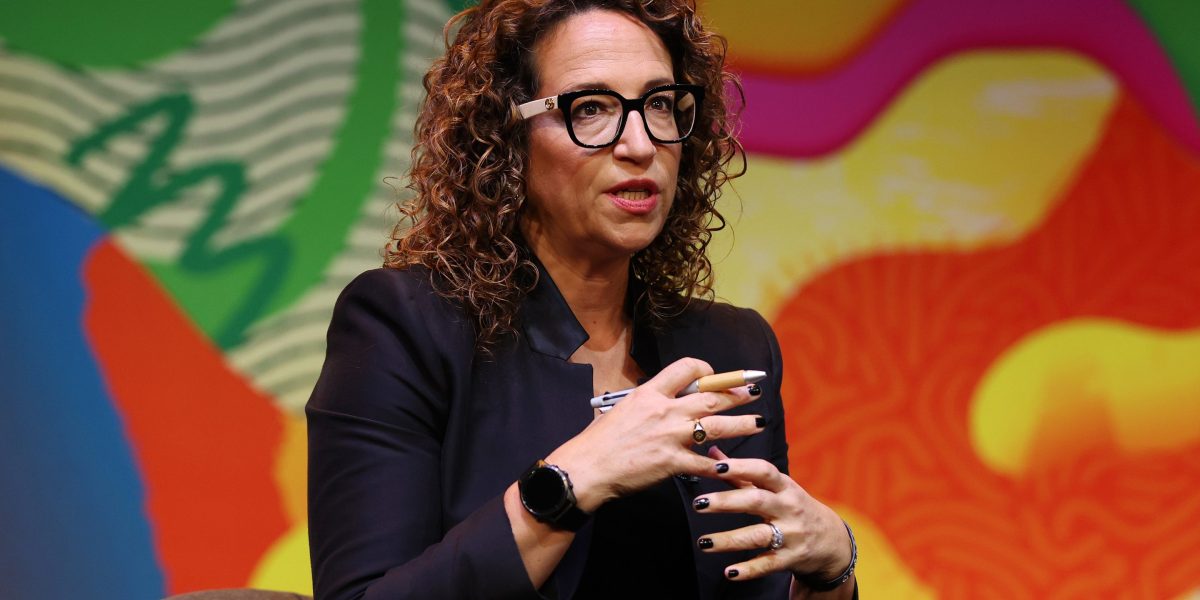




Amy Webb was on her long Sunday bike ride, the one she takes when she’s not training for a race, when the thought arrived fully formed. As she posted on LinkedIn recently: every CEO she talks to is buying abundance, and none are budgeting for the cost of abundance. And she talks to CEOs every day for a living.
Webb, 51, runs the Future Today Strategy Group, the foresight and consulting firm she founded in 2006 after a career in data journalism that led to her subsequent interest in machine learning. Webb, who also teaches at NYU’s Stern School of Business, published The Big Nine, which named nine American and Chinese tech giants as forces that would dominate in a world marked by artificial intelligence and a full-scale tech cold war, so she’s used to being ahead of her time, and she’s used to being frustrated by the world being behind the schedule she sees in her head.
So when Webb told Fortune that she sees something like a bust coming for corporate AI spending, it’s worth pausing on the precise dynamic she’s describing. “AI is making production cheap,” she said, “but it’s making everything else in companies much more expensive.” The corporate world, she added, is going through something like what millennials and Gen Zers experienced as dating-app fatigue.
“The best thing [for a dating app] is to never get married,” Webb said, adding that she sees the same thing playing out in the endless series of generative AI pilots. She said executives tell her they’re in “pilot purgatory”: dealing with unending pilots and “enormous productivity but [they’re] not sure what to do with that.”
Venture capitalist Marc Andreessen, meanwhile, said in March that large companies are overstaffed by as much as 75% and were using AI as a “silver bullet excuse” for cuts that reflect pandemic-era overhiring. A separate analysis by Oxford Economics found AI-cited layoffs accounted for a mere 4.5% of total U.S. job losses despite outsized headlines.
‘It feels like you’re buying abundance’
Webb, who speaks with between 100 and 150 CEOs a year, said she’s most focused on a bubble that sits apart from what’s happening on Wall Street: the strange way that AI is deforming work without actually changing it much at all.
“It feels like you’re getting a lot when you invest in AI,” Webb said, “it feels like you’re buying abundance. But that abundance ends up costing much more down the road.” It’s not a question of long-term investment versus short-term gains, an old business trade-off. “This is immediate satisfaction, followed by: can I productize this? Can I put it in a workflow?” AI is making companies feel like they’re winning, a sensation of “I’m getting away with it,” and that’s driving a lot of enthusiasm and adoption.
At the same time, she said she can count on one hand the number of companies that have figured out a sustainable way to pull off this kind of experimentation. One of her clients had run 14 or 15 generative AI/agent pilots since the start of the year and used Amazon’s famous two-pizza rule, in which no team was big enough that it would take more than two pizzas to feed them. None of them scaled. “They’ve gone through a lot of pizza.” Part of the issue is that pilots often run without integration into legal and IT, and so executives don’t embed the pilots into their infrastructure, but restart from zero each time. “That costs a lot of money,” she said.
The pattern shows up in the data: A Bain & Company survey of 951 global companies published in June found that nearly 40% of companies that measured their AI cost savings landed below 10%, despite having targeted returns of 11% to 20%. But to Webb’s point, the shortfall hadn’t slowed spending, as 90% of companies surveyed said they’re increasing their AI budget anyway.
Drowning in decks
Outside of pilot purgatory, there’s the drowning-in-decks issue. Webb recalled an executive who recently shared that their direct reports were experiencing something like decision paralysis, not because they had too little information, but because they were being buried in too much analysis to process. Another described the problem to Webb as “insta-decks”: presentations that used to take a week to build now take a day, but the same team is receiving five times as many of them. It doesn’t help, she added, that “Claude has a little bit of a verbosity problem,” producing 10 pages when you only need one.
“The more a company uses these tools,” Webb added, “the more generic ideas are spit out.” This isn’t the same thing as AI slop, she said — it’s something different. “It’s fine with me if something was not written necessarily by a person, if the rest of the information is useful.”
Webb said she asks nearly every CEO she meets: if AI freed up 10% of your total capacity tomorrow, where would you deploy it? “So far, I haven’t gotten an answer.” Of all the time being saved, she said, nobody seems to have the job of harvesting all these productivity gains. “I’d bet at most companies, people are prioritizing speed over creating new ways of thinking. And then you’re not learning anything.”
Psychologists have begun studying the phenomenon of “cognitive offloading”—delegating mental work to a tool rather than doing it yourself—and recent research finds that when AI takes over core reasoning tasks, people’s sense of ownership over the resulting work declines. It’s “automating something that people very much feel they have ownership over,” Webb said, adding that you can see this in debates in Hollywood and the media over where true creativity is headed. From a business perspective, she stressed, “AI is cheap to get started with,” but then the costs start to compound in ways that quickly get “shockingly uncomfortable.”
When will the reckoning happen?
Webb said she expects the reckoning as early as next year. “Right now, very few companies are in a position to show an actual measurable change in the next two quarters,” she said, calling it the “second chapter” of the story playing out now. “We might start to see cracks happen with missed targets” as Wall Street starts asking about all of the generative AI pilots in the enterprise, and wanting to see results.
At the same time, she resisted the tidy bubble framing. “This is not a normal dotcom bubble and burst,” she said. “All of this abundance and productivity comes at a new cost that people aren’t factoring in.”
Part of what’s colliding here, Webb added, is generational and emotional, not just financial. She was working in journalism when the commercial internet first really switched on and remembers how “a lot of people were demoted to digital” in that earlier transition, without much intentional planning behind that decision. She sees a similar dynamic playing out now—the people steering the AI revolution aren’t the ones equipped to really know what they’re dealing with.
A big part of the problem, Webb explained, is that the boards and executives under pressure to adopt AI — and do it yesterday — have spent the past several decades developing expertise in fields that have nothing to do with it. “No CEO was hired because they’re an expert in artificial intelligence,” she said. “These people are heads of organizations because they’re excellent executives,” and AI is nearly the worst possible technology for them to grapple with. “AI is not one technology, it’s an umbrella for many technologies,” she said, and “planning requires data — you can’t just go with your gut on this stuff.”
Every new technology wave feels disorienting in the moment, and the people who don’t feel fluent in it tend to resist it, she added. And the people most likely to feel that way are the older and more expensive workers who are also the most likely to be laid off.
If this mismatch between pressure, inexperience and misleadingly expensive technology persists, she added, the outcome could be far worse than just a market crash. “This isn’t like the economy takes a hit. It’s like the economy makes weird decisions.” When Fortune asked if she’s describing an AI hallucination on an economywide scale, she laughed and said, “I’m going to start using that in class.”
Her own business, by the way, has never been doing better. “When there’s horrific uncertainty out there,” she said, “uncertainty is what we do.”