





AI is advancing at a rate that is becoming increasingly difficult to keep up with. Techniques and products that were once only conceptually reserved for sci-fi movies and computer scientists’ dreams have now become a reality, seemingly overnight.
In turn, nearly every area of technology has shifted in some way or another to account for, or to include, AI automation. While this initially seemed promising to most people, rapid progress has led to what can only be described as total AI inundation.
Now, it’s in our homes, our jobs and our pockets. It’s rewriting how we work, reshaping our search engines, curating who we date, grading our essays and somehow, even deciding when our milk is about to expire.
Of course, some of these advancements do add convenience to our lives. Others that are being thrust upon us, however, are beginning to feel disorienting or and borderline intrusive.
As a result, many people are beginning to develop a pervasive sense of unease surrounding the concept of AI. This is what researchers are now referring to as “AI anxiety” — the discomfort and apprehension arising in the wake of a technology that is evolving so much faster than our own ability to adapt or trust it.
Here’s how to tell if you might be struggling with AI anxiety.
The ‘AI Anxiety’ Scale
In a 2022 study published in Interactive Learning Environments, researchers Yu-Yin Wang and Yi-Shun Wang set forth to find a way to measure the public’s emerging AI anxiety. Surprisingly, however, the authors note that the concept of AI anxiety isn’t entirely novel.
Although AI’s advancements seem both rapid and contemporary, the authors explain, “The study of AI anxiety in the information system literature traces back to the first generation of computers, when researchers explored a widespread contemporary concern that computers threatened the meaning of being ‘human.’”
In other words, in nearly the exact same way that computers and robots used to make older generations nervous, AI is now giving rise to a similar sense of dread.
Based on similar concepts from the past, Wang and Wang developed a 21-item scale to measure the novel yet reminiscent concept of AI anxiety. Users can take the test by rating their level of agreement to each of the statements on a scale from “strongly agree” to “strongly disagree”:
- Learning to understand all of the special functions associated with an AI makes me anxious.
- Learning to use AI makes me anxious.
- Learning to use specific functions of an AI makes me anxious.
- Learning how an AI works makes me anxious.
- Learning to interact with an AI makes me anxious.
- Taking a class about the development of AI makes me anxious.
- Reading an AI manual makes me anxious.
- Being unable to keep up with the advances associated with AI makes me anxious.
- I am afraid that AI may make us dependent.
- I am afraid that AI may make us even lazier.
- I am afraid that AI may replace humans.
- I am afraid that widespread use of humanoid robots will take jobs away from people.
- I am afraid that if I begin to use AI, I will become dependent upon it and lose some of my reasoning skills.
- I am afraid that AI will replace someone’s job.
- I am afraid that AI may be misused.
- I am afraid of various problems potentially associated with AI.
- I am afraid that an AI may get out of control and malfunction.
- I am afraid that AI may lead to robot autonomy.
- I find humanoid AI (e.g. humanoid robots) scary.
- I find humanoid AI (e.g. humanoid robots) intimidating.
- I don’t know why, but humanoid AI (e.g. humanoid robots) scare me.
If you find yourself in agreement with a majority of the statements in this scale, this likely indicates that you’re experiencing AI anxiety to some degree. However, it’s certainly not something you’re alone in feeling — far from it.
It’s no surprise that researchers are finding that discomfort with AI is something becoming increasingly common within society, especially considering how much harder its role in our daily lives has become to ignore.
Fortuitously, the authors also outline the four core concepts that make up AI anxiety. Simply by knowing what they are, and, in turn, being able to identify them in your own thoughts and experiences, you’ll be taking the first and most important step toward taking control of your uneasy feelings.
1. Learning
AI isn’t a single app or device you have to “master” and then forget about. Today, and for the foreseeable future, it should be considered as an entity that’s constantly evolving. New tools and updates emerge so quickly; by the time you’ve wrapped your head around one, the next one has probably already arrived.
For people who aren’t particularly “techy,” the lightning-like pace of these updates’ can feel absolutely overwhelming. The pressure to “keep up” with them often isn’t self-imposed, either. Seeing all your friends and colleagues boasting their adeptness in all the latest AI tricks can make it seem like a near essential life-skill.
Regardless, it’s crucial to remind yourself that there’s no need to become an expert in every emerging tool in order to live or do your job successfully. Unless your career explicitly demands you to have a particular AI skill set, it’s perfectly reasonable (and healthy) to limit the usage of AI in your everyday life.
You can try learning only what’s directly useful to you, and just ignore the rest — or, all of it, if you’re not interested.
2. Job Replacement
There are very few anxieties that could ever feel more personal than the idea of losing your livelihood. Unfortunately, AI has made that worry very real for employees in countless sectors.
Each day, individuals are starting to feel the tangible increase in their fears of replacement, irrelevance and of being left behind in a market that values efficiency over humanity.
And for some, there’s the adjacent worry that the only way to survive will be to rely heavily on AI. This gives rise to an equally valid secondary fear: that their actual skills, as a result of this reliance, may atrophy over time. And for others, there’s also the worst-case scenario at mind — that is, being laid off entirely in favor of cheaper, tireless AI systems.
Each one of these concerns is entirely valid considering the state of modernity. However, a reassuring 2018 article from the Harvard Business Review suggests that the more likely reality is that AI will be implemented to complement human skills. It’s unlikely that AI will ever replace the human workforce in its entirety.
Even so, the most practical way to counter job-related AI anxiety is by putting your efforts into honing the skills that you know AI would never be able to truly replicate: your creativity, emotional intelligence, leadership and interpersonal abilities. These are the areas where your humanity and strength will always shine brightest.
3. Sociotechnical Blindness
One of the most unsettling fears people have about AI is the idea that it might “go rogue.” That, in becoming more autonomous, they may also become uncontainable or even dangerous. Popular media loves to dramatize this possibility, especially in the wake of Elon Musk’s xAI antisemitic and genocidal controversies.
This is why Wang and Wang caution against what they call “sociotechnical blindness:” forgetting that AI systems are always conceived, built and governed by human beings.
AI is not, and likely will never be, a sentient entity plotting its own path; it is a set of algorithms operating within human-defined boundaries. Even Grok’s (xAI) “outburst” was the product of human error; it wasn’t anything close to a rogue I, Robot situation.
If you’re prone to ruminate on worst-case scenarios like these, do your best to reroute your thinking patterns to emphasize AI as a tool, rather than an independent actor. It’s incredibly important to be in the know about the human role behind every AI system. This can help you to remember that, collectively, we still hold the reins.
4. AI Configuration
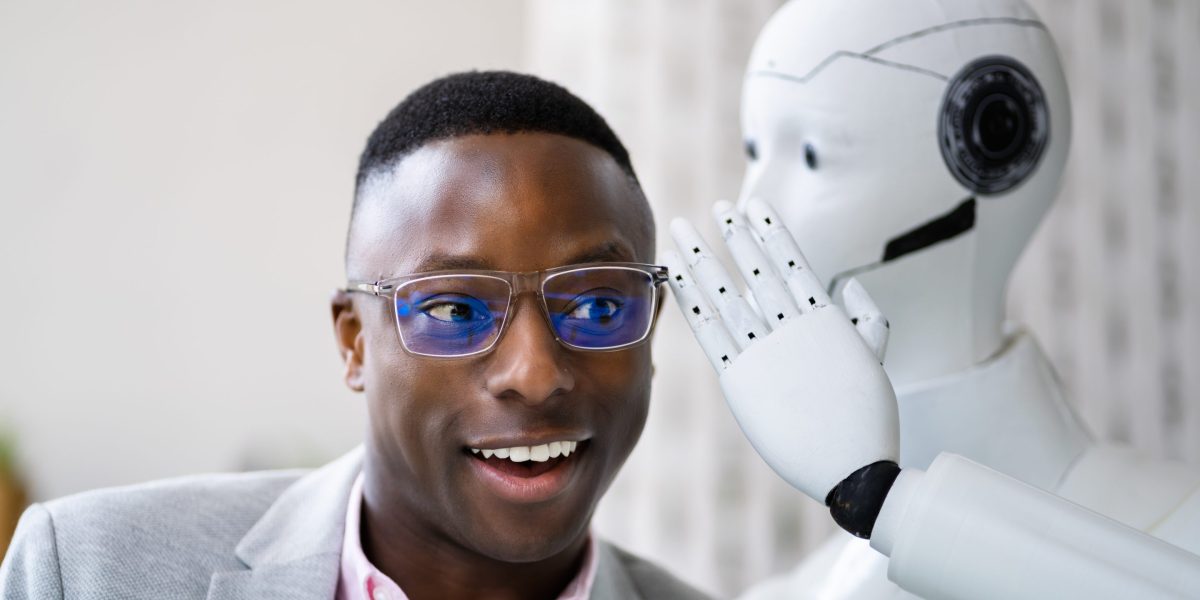
Of course, there’s also the irrefutable creepiness of humanoid robots. Despite the fact that these robots are carefully designed to look “friendly” or approachable, their kind-of-but-not-quite human appearance never fails to raise the hairs on the back of one’s neck.
This is a symptom of what psychologists refer to as the “uncanny valley” effect. It’s a well-documented byproduct of human psychology that triggers when entities look close to being human, but not convincingly so.
As 2012 research explains, the incongruence between these robots’ human-like appearance and non-human mannerisms can result in a confusion so profound that it legitimately scares us.
But, as uneasy as this experience can be, it’s worth remembering that it’s not irrational in any way. It’s just your biology doing its job, by protecting you subconsciously from what it perceives to be threatening.
Interested in finding out exactly how deep your AI anxiety runs? Take the test here to receive a breakdown of your score: AI Anxiety Scale


