




Close Menu
Alpha Leaders
  • Home
  • News
  • Leadership
  • Entrepreneurs
  • Business
  • Living
  • Innovation
  • More
    • Money & Finance
    • Web Stories
    • Global
    • Press Release
What's On
AI Killed The Startup Video Star

AI Killed The Startup Video Star

15 July 2026
‘Redollarization,’ not ‘dedollarization’: Standard Chartered thinks U.S. dollar fears are overstated

‘Redollarization,’ not ‘dedollarization’: Standard Chartered thinks U.S. dollar fears are overstated

15 July 2026
​Who’s Accountable When An AI Agent Approves A Discount?

​Who’s Accountable When An AI Agent Approves A Discount?

15 July 2026
Facebook X (Twitter) Instagram
Alpha Leaders
newsletter
  • Home
  • News
  • Leadership
  • Entrepreneurs
  • Business
  • Living
  • Innovation
  • More
    • Money & Finance
    • Web Stories
    • Global
    • Press Release
Alpha Leaders
Home » The real reason college costs 43% of family income isn’t tuition
News

The real reason college costs 43% of family income isn’t tuition

Press RoomBy Press Room14 July 20266 Mins Read
Facebook Twitter Copy Link Pinterest LinkedIn Tumblr Email WhatsApp
The real reason college costs 43% of family income isn’t tuition

Why has a college degree become akin to an unaffordable luxury for millions of Americans?

I am a scholar of the history of higher education. My data analysis of college tuition trends from 1840 to 2020 shows that college tuition has not significantly risen since 1990, at least compared to tuition changes over the previous decades.

In fact, after a period of extraordinarily high tuition growth from 1920 to 1990, tuition growth slowed in the 1990s, 2000s and 2010s.

But that’s likely little comfort to American families shocked at the sticker price of college costs. This is especially true because since 1980 the growth in real median family income has been relatively modest, while college tuition has continued to rise faster than inflation.

Yale University’s class of 1870 poses for a photograph on the school’s campus in New Haven, Conn. Bettmann/Contributor via Getty Images

Rising tuition, more loans

High tuition has contributed to more than half of all undergraduate students in 2025 taking on student loans. In 1995 and 1996, by comparison, about 25% of undergraduate students had student loan debt.

Cumulative student loan debt rose from about $500 billion in 2006 to nearly $1.8 trillion in 2024.

Student loan debt can prevent college graduates from purchasing their own homes or cars, as well as making other decisions in adulthood, such as whether to marry or have children. Total student loan debt accounted for 7.1% of borrowers’ annual income in 2024, compared to 4.6% in 2006.

There is no shortage of policy proposals for reducing college costs, ranging from freezing tuition to canceling student debt.

But all available statistics about the evolution of tuition capture only the growth of tuition since 1963.

Tuition over time

To fill this data void, I collected data about the origins and evolution of tuition charges at American colleges from 1840 to 2020. I’m working to create the very first national database of college tuition that charts its entire history.

This database, which I am working to publish in an academic journal, comprises tuition data in 10-year increments for 667 private and public colleges and universities – representing 64% of all colleges and universities established before 1920.

Using this data, I recently published an article on the origins and evolution of college tuition in the journal History of Universities.

Tuition rates were essentially flat in inflation-adjusted terms for seven decades, from 1840 to 1910. The annual average tuition rate fluctuated between $41 and $59, equivalent to between $1,586 and $2,194 today.

In many cases, college students did not pay their own tuition bills. Rather, their future employers or the community where they expected to serve as teachers or ministers footed the bill.

Some colleges did not even charge tuition. The number of colleges that offered tuition-free education climbed from one in 1840 to 119 in 1910. In 1910, about 20% of universities – or 100 public schools and 19 private schools – did not charge their students any tuition. These schools included Stanford University, Howard University and Oregon State University.

While many 19th-century colleges were generally populated by poor students who were trained as ministers or teachers, early 20th-century colleges prepared students from rich families for professional careers as lawyers, medical doctors and other high-earning professions.

Influential donors such as John D. Rockefeller Jr. argued that these students could and should pay for their education. And he convinced college administrators that students from wealthy families went to college because they wanted to have a good time and because they wanted to make money after graduation.

The 1920s and 1930s subsequently saw a race among college administrators about who could raise tuition fees faster. These tuition increases were primarily not a response to financial needs but a response to the fact that college students increasingly came from richer families.

A shift in tuition

In the 1920s and 30s a consensus emerged among donors, college administrators and state legislators that students should be asked to pay for their education.

Tuition grew steadily by about 150% to 190% every 10 years, from the 1920s to the 1950s, in numbers not adjusted for inflation. Then, the 1960s and 1970s experienced a growth of about 220% in each decade. The 1980s was the decade of the highest growth in my study, with a 241% increase over the 10-year time frame.

In the 1990s tuition growth began to slow and dropped to 180% over the decade. By the 2010s, tuition growth had fallen to 142%, which represented the lowest growth level since the 1910s.

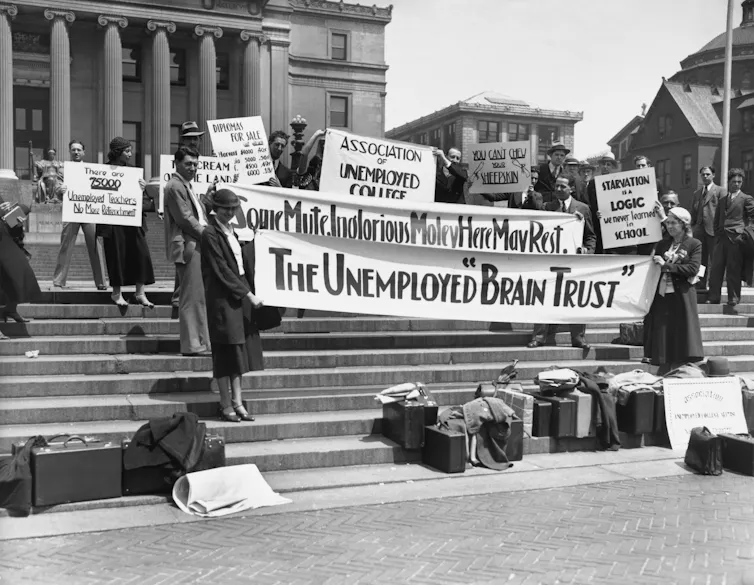
People dressed formally hold signs, including a banner that says 'The unemployed brain trust,' as they stand on steps outside a building with tall columns in a black and white photo.

Columbia University alumni in New York City prepare to protest unemployment rates of college graduates in 1931. UPI/Bettmann Archive/Getty Images

Tuition kept rising, but wages did not

The highest tuition hike of 241% over a 10-year period occurred in the 1980s. In that decade, the average college tuition rose from $2,686 to $6,467.

Yet until 1980, tuition grew in sync with the median family income. Because median family income grew as fast as tuition, the share of the median family income that American families dedicated to paying college tuition remained rather low.

Up until 1980, college tuition accounted on average for only 14% of a family’s median income.

While tuition growth slowed in the 1990s, the growth of median family income plummeted. To give one example, in the 1980s tuition grew by 241%, but family income grew only by 153%.

While Americans in 1980 spent only about 14% of their median family income on college tuition, it rose to 43% in 2020.

The pain of high tuition charges

My data analysis of the evolution of college tuition shows that even though college tuition growth in the past two decades appears to be out of control, tuition growth has actually significantly slowed over the past few decades.

The pain from high tuition does not stem from extraordinary tuition growth but rather from the lack of a commensurate growth rate in median family income. All of this, though, does not remove the anxiety that can come with affording a college degree.

Thomas Adam, Professor of Political Science, University of Arkansas

This article is republished from The Conversation under a Creative Commons license. Read the original article.
The Conversation

Colleges and Universities Education inflation
Share. Facebook Twitter Pinterest LinkedIn Tumblr Email Copy Link

Related Articles

‘Redollarization,’ not ‘dedollarization’: Standard Chartered thinks U.S. dollar fears are overstated

‘Redollarization,’ not ‘dedollarization’: Standard Chartered thinks U.S. dollar fears are overstated

15 July 2026
A year after Fred Smith’s death, FedEx’s CEO charts his own path

A year after Fred Smith’s death, FedEx’s CEO charts his own path

15 July 2026
Kevin Ryan’s AlleyCorp raises new 5 million fund, all in on early-stage bets

Kevin Ryan’s AlleyCorp raises new $335 million fund, all in on early-stage bets

15 July 2026
Richard Branson warns copying his 5 a.m. routine will cause ‘more burnouts than breakthroughs’

Richard Branson warns copying his 5 a.m. routine will cause ‘more burnouts than breakthroughs’

15 July 2026
The 4 trillion Great Wealth Transfer means more businesses are now being inherited than purchased

The $124 trillion Great Wealth Transfer means more businesses are now being inherited than purchased

15 July 2026
Muangthai Capital’s new CEO Parithad Petampai navigates succession and microfinance scrutiny

Muangthai Capital’s new CEO Parithad Petampai navigates succession and microfinance scrutiny

15 July 2026
Don't Miss
Unwrap Christmas Sustainably: How To Handle Gifts You Don’t Want

Unwrap Christmas Sustainably: How To Handle Gifts You Don’t Want

By Press Room27 December 2024

Every year, millions of people unwrap Christmas gifts that they do not love, need, or…

Exclusive: DeFi platform Azura launches after raising .9 million from Initialized

Exclusive: DeFi platform Azura launches after raising $6.9 million from Initialized

22 October 2024
Sam Altman’s World Wants To Scan Your Eyes To Prove You’re Human

Sam Altman’s World Wants To Scan Your Eyes To Prove You’re Human

22 October 2024
Stay In Touch
  • Facebook
  • Twitter
  • Pinterest
  • Instagram
  • YouTube
  • Vimeo
Latest Articles
Veloce Adds Extreme H Hydrogen Racing To Motorsport Promotions Empire

Veloce Adds Extreme H Hydrogen Racing To Motorsport Promotions Empire

15 July 20262 Views
Kevin Ryan’s AlleyCorp raises new 5 million fund, all in on early-stage bets

Kevin Ryan’s AlleyCorp raises new $335 million fund, all in on early-stage bets

15 July 20261 Views
Heralding The Next Chapter Of AI Governance For The Public Sector

Heralding The Next Chapter Of AI Governance For The Public Sector

15 July 20261 Views
Richard Branson warns copying his 5 a.m. routine will cause ‘more burnouts than breakthroughs’

Richard Branson warns copying his 5 a.m. routine will cause ‘more burnouts than breakthroughs’

15 July 20263 Views

Recent Posts

  • AI Killed The Startup Video Star
  • ‘Redollarization,’ not ‘dedollarization’: Standard Chartered thinks U.S. dollar fears are overstated
  • ​Who’s Accountable When An AI Agent Approves A Discount?
  • A year after Fred Smith’s death, FedEx’s CEO charts his own path
  • Veloce Adds Extreme H Hydrogen Racing To Motorsport Promotions Empire

Recent Comments

No comments to show.
About Us
About Us

Alpha Leaders is your one-stop website for the latest Entrepreneurs and Leaders news and updates, follow us now to get the news that matters to you.

Facebook X (Twitter) Pinterest YouTube WhatsApp
Our Picks
AI Killed The Startup Video Star

AI Killed The Startup Video Star

15 July 2026
‘Redollarization,’ not ‘dedollarization’: Standard Chartered thinks U.S. dollar fears are overstated

‘Redollarization,’ not ‘dedollarization’: Standard Chartered thinks U.S. dollar fears are overstated

15 July 2026
​Who’s Accountable When An AI Agent Approves A Discount?

​Who’s Accountable When An AI Agent Approves A Discount?

15 July 2026
Most Popular
A year after Fred Smith’s death, FedEx’s CEO charts his own path

A year after Fred Smith’s death, FedEx’s CEO charts his own path

15 July 20262 Views
Veloce Adds Extreme H Hydrogen Racing To Motorsport Promotions Empire

Veloce Adds Extreme H Hydrogen Racing To Motorsport Promotions Empire

15 July 20262 Views
Kevin Ryan’s AlleyCorp raises new 5 million fund, all in on early-stage bets

Kevin Ryan’s AlleyCorp raises new $335 million fund, all in on early-stage bets

15 July 20261 Views

Archives

  • July 2026
  • June 2026
  • May 2026
  • April 2026
  • March 2026
  • February 2026
  • January 2026
  • December 2025
  • November 2025
  • October 2025
  • September 2025
  • August 2025
  • July 2025
  • June 2025
  • May 2025
  • April 2025
  • March 2025
  • February 2025
  • January 2025
  • December 2024
  • November 2024
  • October 2024
  • September 2024
  • August 2024
  • July 2024
  • June 2024
  • May 2024
  • April 2024
  • March 2024
  • February 2024
  • January 2024
  • December 2023
  • March 2022
  • January 2021
  • March 2020
  • January 2020

Categories

  • Blog
  • Business
  • Entrepreneurs
  • Global
  • Innovation
  • Leadership
  • Living
  • Money & Finance
  • News
  • Press Release
© 2026 Alpha Leaders. All Rights Reserved.
  • Privacy Policy
  • Terms of use
  • Advertise
  • Contact

Type above and press Enter to search. Press Esc to cancel.