

Close Menu
Alpha Leaders
  • Home
  • News
  • Leadership
  • Entrepreneurs
  • Business
  • Living
  • Innovation
  • More
    • Money & Finance
    • Web Stories
    • Global
    • Press Release
What's On
Feral hogs are running wild in 35 states and the Senate is debating whether to triple funding

Feral hogs are running wild in 35 states and the Senate is debating whether to triple funding

24 August 2026
Meet Flock, the  billion startup facing growing backlash against surveillance capitalism

Meet Flock, the $8 billion startup facing growing backlash against surveillance capitalism

24 August 2026
The Complex Psychology Of People Choosing To Trust Either Humans Or AI

The Complex Psychology Of People Choosing To Trust Either Humans Or AI

24 August 2026
Facebook X (Twitter) Instagram
Alpha Leaders
newsletter
  • Home
  • News
  • Leadership
  • Entrepreneurs
  • Business
  • Living
  • Innovation
  • More
    • Money & Finance
    • Web Stories
    • Global
    • Press Release
Alpha Leaders
Home » Companies See China as a Safe Harbor Amid Trump’s Tariffs
Business

Companies See China as a Safe Harbor Amid Trump’s Tariffs

Press RoomBy Press Room10 April 20255 Mins Read
Facebook Twitter Copy Link Pinterest LinkedIn Tumblr Email WhatsApp
Companies See China as a Safe Harbor Amid Trump’s Tariffs

Even as President Trump heaped additional tariffs on China, his barrage of trade levies on countries across Asia and unpredictability about what he might do next have encouraged some companies to hunker down in China, exactly the opposite of what he had hoped.

Mr. Trump has steadily ratcheted up the pressure on China. As of Wednesday, his new tariffs on China exceed 100 percent, including a last-minute escalation serving as punishment for Beijing’s retaliation on earlier levies.

However, in contrast to what happened during his first term, Mr. Trump has accompanied the tariff campaign on China with steep import duties on dozens of other countries, including a handful of Asian countries that became popular alternatives in the earlier trade war between Beijing and Washington as a way to circumvent levies and limit supply chain disruptions.

But for some companies, the so-called reciprocal tariffs have had the unexpected effect of making China an even more appealing place to produce in and buy from. It has eliminated some of the motivation to diversify production or sourcing to places like Vietnam, India or other Asian countries.

In addition, the chaos that has followed last week’s announcement has made companies wary about adding more upheaval with a drastic change to their supply chains. Faced with constant flux and unpredictability, companies are choosing to stay with what they know: longstanding relationships with Chinese suppliers or manufacturing partners.

“Staying in China and making China work is everyone’s strategy right now,” said Travis Luther, founder of MOSO Pillow, a Denver-based maker of bedding made from bamboo fiber.

Mr. Luther, who attended a conference for American entrepreneurs this week, said he, like other business owner attendees, was not devoting time to searching for new partners or ways to move from China. Instead, he was working with his Chinese business partner to find ways to save costs or develop new products. Cost advantages are only one part of what makes China the go-to destination for making goods.

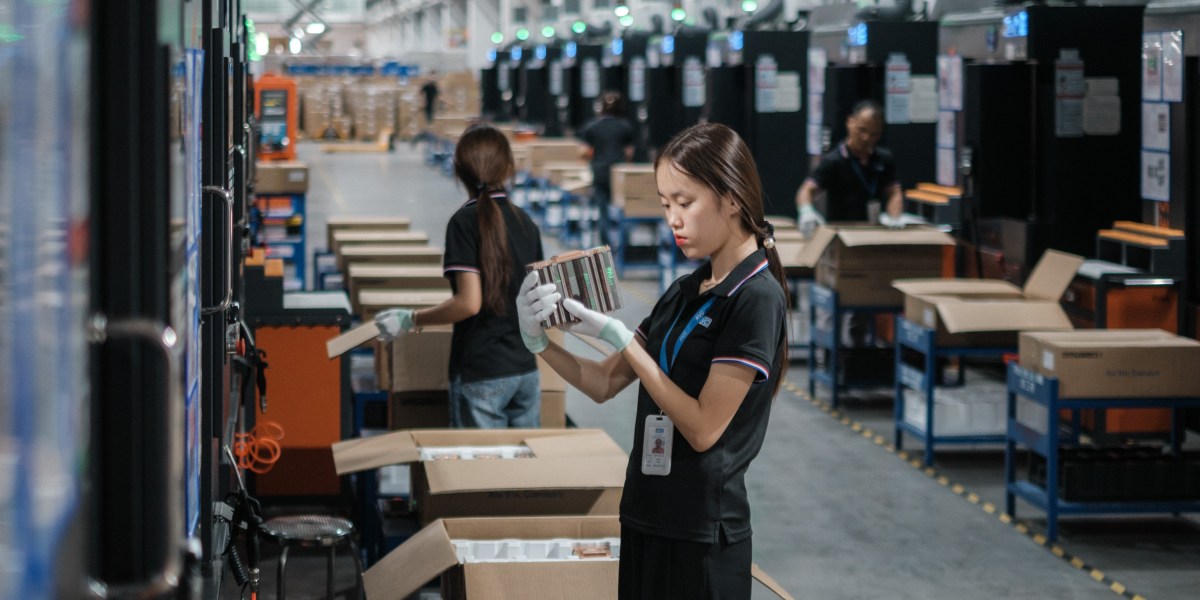
“That’s not even why most people are in China anymore,” Mr. Luther said. “It’s because they have very sophisticated manufacturing and engineering processes.”

Mr. Trump has said the tariffs will help bring manufacturing back to the United States, but that remains a difficult proposition. Currently, most American factories cannot match China’s manufacturing capability, capacity and speed even if the tariffs eat into its cost advantages.

As trade tensions escalated in the first Trump presidency, many American and multinational companies opted to move some production away from China to less adversarial countries. For most, America was not a viable option.

But changing suppliers is a difficult, expensive and time-consuming process. Mr. Luther said a consultant had told him that it would cost at least $6 million to build a U.S. facility to grow and process bamboo fibers. And in the several years it would take for the bamboo trees to grow, he would have to pay the tariffs to import fibers from China.

A complete supply chain overhaul to another country requires time and money — something companies are reluctant to pursue unless they know where government policy is heading.

“It’s like the fog of war, but it’s the fog of trade war,” said Kit Conklin, the global head of risk and compliance at Exiger, a supply chain mapping firm. “There’s got to be policy certainty for industry to react.”

A top executive at an international contract manufacturer said it was impossible to make any long-term decisions about shifting outside China based on what feels like haphazard decision-making from the United States.

“The rules of the game seem to change every day. It feels we have no option but to sit tight,” said this executive, who asked not to be identified given the sensitive nature of tariff discussions in the U.S. and China.

When American and multinational companies started to move some production from China several years ago, many Chinese factory owners opened facilities in neighboring Asian countries or Mexico. It was a way to reroute some of the flow of goods through countries with significantly lower duties.

But the recent tariffs on about 60 countries that imposed duties of 46 percent on Vietnam, 36 percent on Thailand and 27 percent on India “greatly diminish” the incentive to relocate factories away from China, according to a research note from Nomura Securities, a Japanese investment bank.

Nomura said that while China still faces substantial challenges from the higher tariff, “the broader tariff net cast over its competitors may inadvertently preserve its position in global supply chains.”

Sarah Massie, who runs a consulting practice advising American companies on foreign trade, said that when tariffs are harsh everywhere, people tend to stick with the status quo. In the manufacturing world, China is the status quo.

“If everybody is getting hit, then that’s definitely stopping some of the looking,” Ms. Massie said. “Because people think at least we already know what this supplier gives us and we were happy with them before the tariffs hit, so why don’t we just stay happy. But whether they can continue at that cost is a whole different story.”

China Customs (Tariff) Donald J Factories and Manufacturing Far East India International Trade and World Market Japan South and Southeast Asia and Pacific Areas Thailand Trump United States Vietnam
Share. Facebook Twitter Pinterest LinkedIn Tumblr Email Copy Link

Related Articles

Ambient AI And The Next Frontier

Ambient AI And The Next Frontier

23 August 2026
The AI boom is lifting Asia’s economies, but for Southeast Asia, it might be a ‘short-term blip’

The AI boom is lifting Asia’s economies, but for Southeast Asia, it might be a ‘short-term blip’

21 August 2026
Harry and Meghan’s homecoming comes with a multimillion-dollar tax catch

Harry and Meghan’s homecoming comes with a multimillion-dollar tax catch

21 August 2026
Supermicro investigation clears CEO in .5 billion alleged smuggling scheme

Supermicro investigation clears CEO in $2.5 billion alleged smuggling scheme

20 August 2026
Unitree surges 460% in trading debut, and hits B valuation, more than U.S. peers like Figure AI

Unitree surges 460% in trading debut, and hits $66B valuation, more than U.S. peers like Figure AI

19 August 2026
Cybercrime Enforcement Is Now Open To Private Bidders

Cybercrime Enforcement Is Now Open To Private Bidders

19 August 2026
Don't Miss
Trump’s Tariffs Will Make AI Data Centers More Expensive

Trump’s Tariffs Will Make AI Data Centers More Expensive

By Press Room4 April 2025

Donald Trump’s administration has gone all-in on AI: A day after his inauguration, the newly-elected…

Unwrap Christmas Sustainably: How To Handle Gifts You Don’t Want

Unwrap Christmas Sustainably: How To Handle Gifts You Don’t Want

27 December 2024
NYT ‘Connections’ Hints And Answers For October 23 (#500)

NYT ‘Connections’ Hints And Answers For October 23 (#500)

23 October 2024
Stay In Touch
  • Facebook
  • Twitter
  • Pinterest
  • Instagram
  • YouTube
  • Vimeo
Latest Articles
How To Design Multi-Agent Workflows That Actually Work

How To Design Multi-Agent Workflows That Actually Work

24 August 20261 Views
Hints, Clues And Answer For Monday August 24

Hints, Clues And Answer For Monday August 24

24 August 20261 Views
How To Solve Today’s NYT Pips Puzzles, Monday August 24

How To Solve Today’s NYT Pips Puzzles, Monday August 24

24 August 20261 Views
Outstanding ‘Into The Woods’ Explores Forests Anew And Stirs Ways That AI Can Reimagine Nature Journeys

Outstanding ‘Into The Woods’ Explores Forests Anew And Stirs Ways That AI Can Reimagine Nature Journeys

24 August 20261 Views

Recent Posts

  • Feral hogs are running wild in 35 states and the Senate is debating whether to triple funding
  • Meet Flock, the $8 billion startup facing growing backlash against surveillance capitalism
  • The Complex Psychology Of People Choosing To Trust Either Humans Or AI
  • National debt interest expense has exploded 14% in just 9 months
  • How To Design Multi-Agent Workflows That Actually Work

Recent Comments

No comments to show.
About Us
About Us

Alpha Leaders is your one-stop website for the latest Entrepreneurs and Leaders news and updates, follow us now to get the news that matters to you.

Facebook X (Twitter) Pinterest YouTube WhatsApp
Our Picks
Feral hogs are running wild in 35 states and the Senate is debating whether to triple funding

Feral hogs are running wild in 35 states and the Senate is debating whether to triple funding

24 August 2026
Meet Flock, the  billion startup facing growing backlash against surveillance capitalism

Meet Flock, the $8 billion startup facing growing backlash against surveillance capitalism

24 August 2026
The Complex Psychology Of People Choosing To Trust Either Humans Or AI

The Complex Psychology Of People Choosing To Trust Either Humans Or AI

24 August 2026
Most Popular
National debt interest expense has exploded 14% in just 9 months

National debt interest expense has exploded 14% in just 9 months

24 August 20261 Views
How To Design Multi-Agent Workflows That Actually Work

How To Design Multi-Agent Workflows That Actually Work

24 August 20261 Views
Hints, Clues And Answer For Monday August 24

Hints, Clues And Answer For Monday August 24

24 August 20261 Views

Archives

  • August 2026
  • July 2026
  • June 2026
  • May 2026
  • April 2026
  • March 2026
  • February 2026
  • January 2026
  • December 2025
  • November 2025
  • October 2025
  • September 2025
  • August 2025
  • July 2025
  • June 2025
  • May 2025
  • April 2025
  • March 2025
  • February 2025
  • January 2025
  • December 2024
  • November 2024
  • October 2024
  • September 2024
  • August 2024
  • July 2024
  • June 2024
  • May 2024
  • April 2024
  • March 2024
  • February 2024
  • January 2024
  • December 2023
  • March 2022
  • January 2021
  • March 2020
  • January 2020

Categories

  • Blog
  • Business
  • Entrepreneurs
  • Global
  • Innovation
  • Leadership
  • Living
  • Money & Finance
  • News
  • Press Release
© 2026 Alpha Leaders. All Rights Reserved.
  • Privacy Policy
  • Terms of use
  • Advertise
  • Contact

Type above and press Enter to search. Press Esc to cancel.