

For most of us, telecommunications infrastructure is largely invisible—only noticed when something goes wrong and we lose Wi-Fi or phone signal. Allison Kirkby wants to change that.
As CEO of BT, the Most Powerful Women honoree is overseeing one of the biggest infrastructure transformations in the U.K., from fiber expansion to the country’s shift away from legacy landlines. But she is also trying to make a deeply technical business feel culturally relevant again.
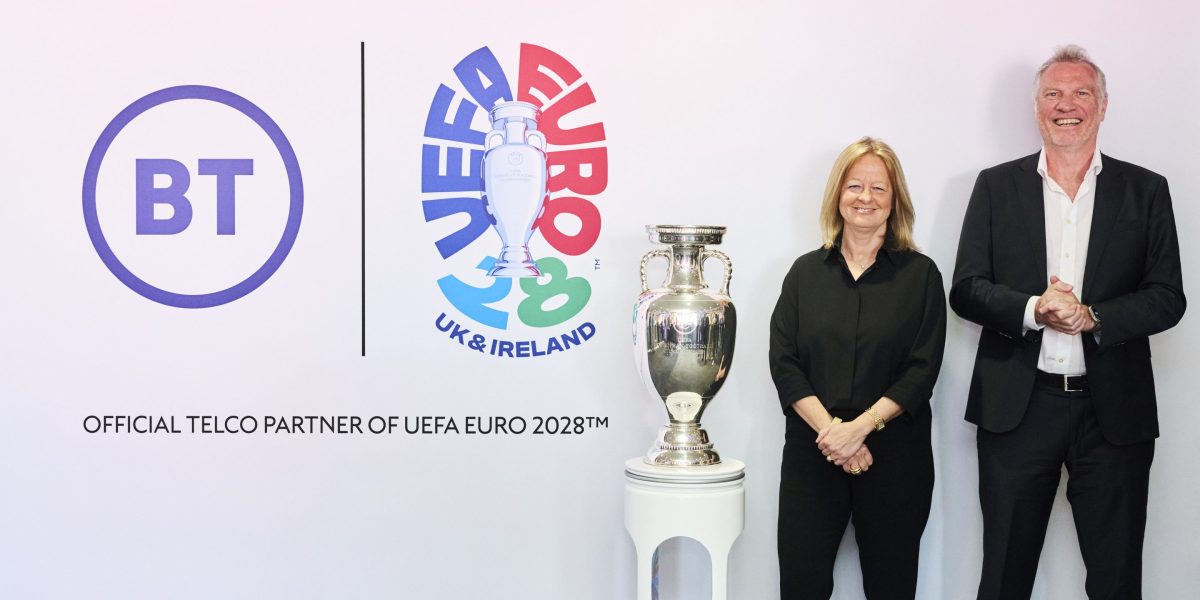
This ambition is what lies behind BT’s growing number of major sporting partnerships, most recently with UEFA. For Kirkby, these flagship moments that bring together millions of people are more than simple branding exercises; they are live demonstrations of the power and reliability of the digital networks underpinning modern life.
66
Allison Kirkby’s rank on Most Powerful Women
“We’ve always been the connectivity providers,” she says. “From the 2012 Olympics to the Queen’s funeral—these are big events that unite the nation. It’s a great way to show people: ‘if an organization like UEFA trusts them to run safe, secure, resilient connectivity for these massive events, then I trust them as well.’”
“We need more strikers”
And elite sports have more to offer than lucrative partnerships, they also provide apt metaphors for business performance.
“I think of great sports outfits both from an individual player point of view and from a team capability point,” she says. In BT’s case, the “individual players” are the company’s four brands: BT, EE, Plusnet and Openreach. As CEO, she must operate like a football manager, deciding where the team needs greater investment and where to pull back. (When I joke that she is the Gareth Southgate of telecoms, Glasgow-born Kirkby replies that she sees herself more as an Alex Ferguson).
“You can’t evolve technologically and take advantage of the growth potential of AI if you don’t have a brilliant digital backbone”
Allison Kirkby, CEO of BT
“In recent years, we’ve probably over-emphasized investment in EE as a brand and £25 billion has gone into the fiber and mobile networks,” she says. “We have relatively underinvested in BT and in the business segment. Now I’m investing in BT as a brand to strengthen those parts of my team so we can get the best value out of the investment we’ve put into the networks and EE.”
To borrow from the sporting world again, Kirkby describes the strategy thus: “The networks provide all the defense the team needs—now we need a few more strikers to win a few more matches.”
Britain’s digital backbone
The stakes, of course, are a bit higher than those of a football match—whatever fans may think. Kirkby and BT are responsible for making the U.K.’s digital future possible.
“We need to ensure that the U.K. has the best quality networks so the country is powered in the best possible way,” says Kirkby. “You can’t evolve technologically and take advantage of the growth potential of AI if you don’t have a brilliant digital backbone.”
The challenge, she says, is that for years there has been too much focus on competition and not enough incentive to invest in infrastructure. As a result, Britain’s digital infrastructure is deeply fragmented, with a large number of companies involved in its running. “Fragmentation brings resilience risk,” she says. “The countries with the best digital infrastructure probably have three key players in fiber and mobile. That’s what the U.K. will need over time.”
And as a telecoms CEO, Kirkby sees her role as far greater than simply ensuring success for BT. “We all have to take responsibility for providing critical national infrastructure,” she says. “We have to shift the country onto modern-day technologies.” This includes shutting down the landline telephone system by January 2027, but also helping the communities that rely on it to learn the digital skills they will need in the future, from online banking to booking doctors’ appointments digitally.
“Influence is something you only build through delivering on your promises, being a thought leader and taking your stakeholders on a journey with you.”
Allison Kirkby
Doing this means lobbying for the industry as a whole to pull together. “I’m very focused on having a market structure that ensures this fundamental infrastructure is well invested in and that those taking the risk of investment are getting a fair return.”
Power, influence, and the long game
This responsibility is one Kirkby takes very seriously, and her approach to it offers a clear reason why her place on this year’s Most Powerful Women list was so well deserved. When it comes to being “powerful,” she says: “You need to show you’re making an impact, which is clearly easier when you’re in a scale business—particularly in telco, I could have a lot of negative impact if I’m not careful.”
So far, this worry would seem to be completely without foundation. Since Kirkby took the helm in February 2024, BT’s stock has more than doubled and the company posted fiscal year 2026 pretax profits of roughly $1.9 billion. Nevertheless, she will not be resting on her laurels. “Influence is something you only build through delivering on your promises, being a thought leader and taking your stakeholders on a journey with you.”
If Kirkby succeeds, BT will achieve something few telecom companies ever truly manage: becoming not just part of the country’s infrastructure, but of how the country imagines its future.