For years, the American power grid was a bastion of predictable stability. Throughout the 2010s, U.S. electricity demand remained flat as efficiency gains and declines in energy-intensive sectors such as manufacturing helped obscure the dawning digital age.
But the power grid as it once was might be no match for the technological demands of the 2020s. Retail electricity prices have soared in recent years, an increase fast outpacing inflation over the same period, in part due to the rising power costs associated with the artificial intelligence-driven infrastructure boom. Electricity costs have been one of the factors fueling the recent nosedive AI has taken in public polling, and a new study suggests residential utility pain tied to the technology needs of this decade might be just getting started.
Between 2018 and 2023, the share represented by data centers in total U.S. electricity use rose from 1.9% to 4.4%, according to a study published last week in the journal Environmental Research Letters.
By the end of the decade, the national average wholesale electricity cost could rise between 6% and 29%, according to the study, which modeled several different energy use scenarios based on existing power demand forecasts. This increase in utility prices is primarily tied to data center expansion, with cryptocurrency mining also included in the modeling of higher costs.
In some areas, those price hikes could be even steeper. In Virginia, for example, one of the epicenters of the country’s data center boom, electricity generation costs could spike as much as 57%.
Dire energy needs
Grid power directed to data centers surged 22% last year, according to S&P Global research, and could account for up to 17% of all U.S. electricity usage by the end of the decade.
To meet that demand, the study’s modeling projects that utilities will lean heavily on natural gas—a fuel source whose price volatility adds its own layer of uncertainty to future consumer costs.
Jeremiah Johnson, an associate professor of civil and environmental engineering at North Carolina State University and lead author of the study, also found that data centers were likely to turn in part to underutilized coal plants to supply their energy needs. Data center expansion could in fact push CO2 emissions from electricity generation up as much as 28% by 2030, according to the study, reversing some of the power sector’s work over the past two decades to retire coal.
Renewable energy would also play an important role in meeting that demand, although wind and solar’s ability to compensate has grown heavily dependent on policy.
The study modeled scenarios both with and without federal clean energy incentives comparable to those established under the Inflation Reduction Act—subsidies that Congress largely repealed earlier this year. In the absence of those incentives, natural gas would supply roughly 70% of the additional generation needed to power new data centers, with coal, wind, and solar splitting the remainder. Restore those incentives, and natural gas’s share drops to around 41%, with wind picking up 29% and solar 15% of the incremental load.
The energy mix matters for costs as much as for emissions. The study found that in regions where renewable development is slow or constrained, such as Virginia, legacy fossil plants stay online longer and consumers will likely have to import power from neighboring states, pushing wholesale costs higher for everyone on the grid.
“The challenge here is the magnitude of this demand we’re talking about is really big. It’s at a scale that dwarfs some of the other changes we’ve experienced to the power sector in recent years,” Johnson told Fortune.
“It’s a little bit of an all-hands-on-deck to get the generation necessary to meet that magnitude of demand.”
Not in my backyard
With electricity prices expected to surge, economic anxiety among American households is already starting to show up in public opinion.
In 2025, utilities requested states to approve a record $31 billion in rate increases across the country. While electricity prices have been rising well before the current data center boom—spurred in part by investments towards modernizing grid infrastructure and improving weather resilience—AI and the related infrastructure buildout have emerged as a clear scapegoat.
Seven in 10 Americans push back against the idea of an AI data center being built close to their home, according to Gallup polling released last week. The primary source of concern was how construction would affect local resources, including electricity usage. 15% of respondents specifically mentioned fears over higher utility and energy costs.
The results are part of a larger souring of opinion towards AI, with other recent polling by YouGov and The Economist finding that more than half of Americans say AI development is happening too fast, and that the technology is largely unlikely to deliver significant universal economic gains.
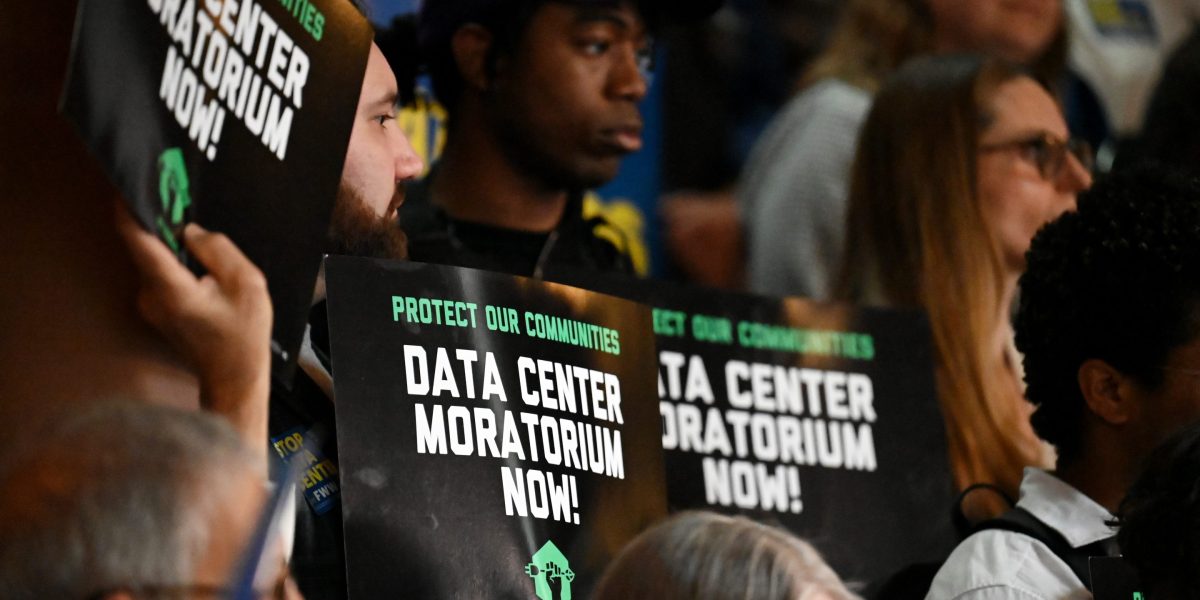
The pushback has manifested as a rising number of communities across the country begin protesting and blocking data centers. Last year alone, opposition stalled or halted more than $156 billion in planned construction spanning 48 data center projects, according to the research firm Data Center Watch.
“There’s been lots of local pushback on siting data centers, and this finding that we have where proximity to these large centers leads to local increase in power bills, I think will make the siting processes more contentious and more important,” Johnson said. “I think it’s a really important aspect of the siting to understand who pays for the increased costs associated with power generation, and who bears the benefits.”