



In 2013, as Michael Dell fought Carl Icahn to take his company private, we asked a simple question in the New York Times: how do you keep the revolution forever young? It’s the same question Thomas Jefferson wrestled with when he argued no generation should be bound by the last one’s answers. Dell just gave his own answer again last week.
Four years ago, while others were playing with chatbots, treating AI as parlor games or sounding cataclysmic alarms over LLMs’ threats to society, Dell saw AI’s emerging utility as a new pillar of the economy and prepared his company accordingly, culminating in perhaps the 12th strategic reinvention of his enterprise strategy since he launched his business in 1984 as a 19-year-old in his college dorm room.
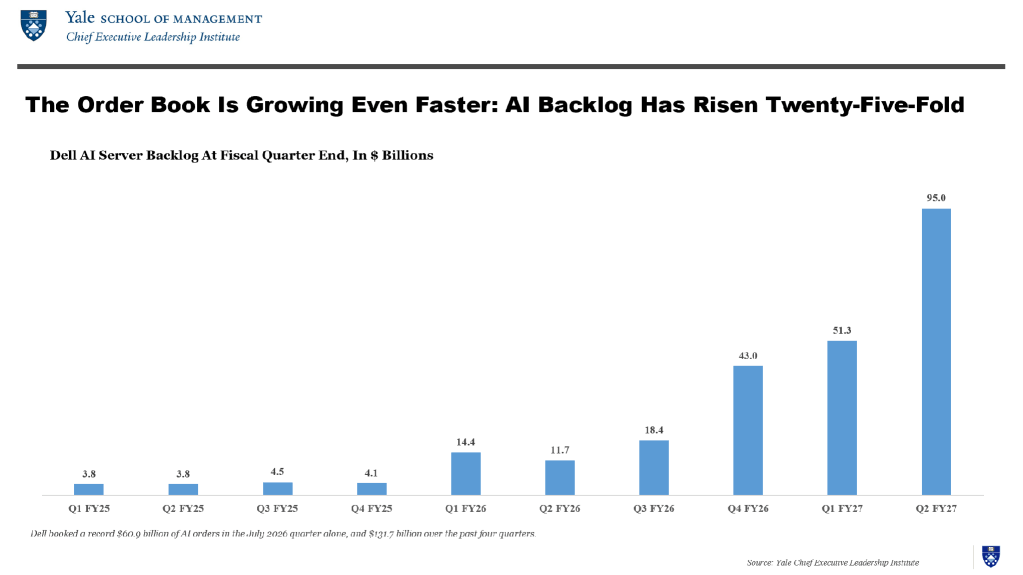
Last week, Dell Technologies delivered one of the most lopsided beats of this earnings season. Revenue of $47 billion rose 58%, and adjusted earnings of $7.04 per share crushed already enthusiastic expectations of roughly $4.90. Dell booked a record $60.9 billion of AI server orders in a single quarter, exited with a record $95 billion backlog and raised its full-year outlook by $25 billion to $192 billion, roughly 70% y/y growth.
The skeptics’ story about Dell has always been the same: a heritage as a mere assembler of parts, a legacy PC maker rather than an AI innovator. For years it traded below the multiple of its AI peers, and below the S&P 500. This bearish narrative was already dead in the water, but with this latest earnings release, there should be no doubt that Dell Technologies is positioned to be one of the biggest winners as the provider of the critical infrastructure on which the AI build-out physically runs.
Dell sits at the center of the data-center wave as the world’s largest server maker, assembling the compute, storage, and networking that hyperscalers and enterprises are buying as fast as it can ship them. What the skeptics missed is that Dell’s role spans the full range of how firms deploy AI, from the public-cloud and co-location facilities that anchor large-scale training to the hybrid configurations that let a company keep some critical workloads close to home.
And now, Dell is readying the firm to ride the tailwind of a new secular growth wave: the shift of enterprise AI spending to “on-premise” and the most smoothly integrated tech titan across IT segments in the world.
What are these mysterious words, on-premise, what does this actually mean and why is this important? Simply put, companies are moving their AI away from computers they rent in someone else’s data center – that of the hyperscalers Amazon, Microsoft and Google – and onto AI machines that they buy, control, and keep in their own buildings – closer to their own data, under their own lock and key, with heightened security guardrails. It is this shift that positions Dell as one of the biggest beneficiaries in the months and years to come.
With shifts in business risk and decision making, the significant majority of mission-critical data is now stored on premises, despite all the “cloud” computing activity. As Amazon CEO Andy Jassy said on their last earnings call: “Remember, by the way, that 85% of the global IT spend is still on premises.” Now as data is being created in the real world vs the cloud, faster than ever before, the major change is that this data can now be converted into a competitive advantage using AI. Customers are figuring out they want to bring AI to the data, not the other way around. This is increasingly true for physical AI like robotics and advanced manufacturing.
Companies are bringing AI home for three plain reasons. First, this is where every company’s most sensitive enterprise data lives — the files, contracts, telemetry and patient charts generally already sit on private servers companies own, not in the netherworld of some public hyperscaler cloud. Needless to say, it is cheaper, faster and safer to bring AI agents to the data than the data to the AI. Second, on premise AI provides much greater control — banks, hospitals, defense contractors and entire governments wisely resist letting sensitive data leave the building or the country.
As Michael Dell put it in May, “The risk is losing control of your data, your cost, your security, your intellectual property and your speed.” Third, money: training a model is a burst of computing you might sensibly rent, but running agents never stops, and renting around the clock is the most expensive way to own anything. As AI agents proliferate and as they continue to run 24/7, companies want to optimize their spending on AI agents, which means setting them up closest to home in the fully-owned, secure way which Dell provides, rather than renting compute by the hour driving costs up unnecessarily.
And this is only the beginning, because AI agents, by definition, drive exponentially more demand: unlike humans, AI agents don’t need to eat, sleep, take bathroom breaks, shop online, or play office politics. AI agents work continuously, and every new task generates more data to store and secure. All this creates a virtuous flywheel where more use of AI agents creates more demand for Dell’s servers, and vice versa. No wonder Dell now counts more than 6,500 AI enterprise customers, 3,300 added in the last three quarters, and its pipeline grew again even after $131.7 billion of orders. Traditional servers grew fully 122%. Storage grew by 26%.
That is also why Dell’s margins have expanded, with infrastructure operating margin expanding 620 basis points to 15%, which Morgan Stanley called “unprecedented.” That is the dividend of an integrated portfolio no rival can match: Dell sells AI servers, storage, networking, PCs and services, and buys components for all of them together — a weapon in a year of unprecedented memory shortages, providing Dell with the preferential access to crucial memory chips and purchasing power that few competitors have.
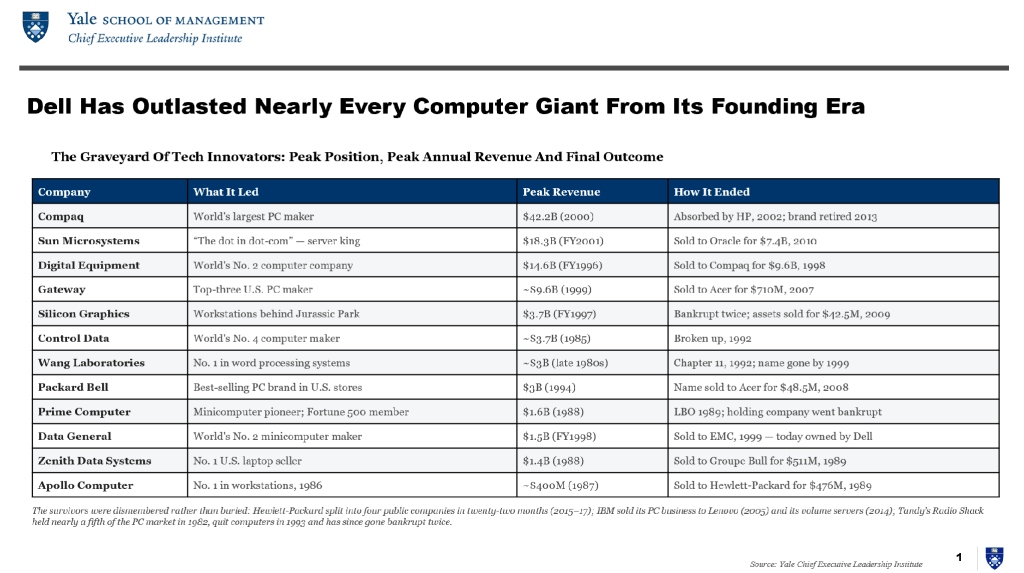
None of this happened by accident, and the proof is in the long list of former Dell competitors from its founding era, who have faded into oblivion. Just consider some of the many names from the chart below: Wang Labs went bankrupt; Control Data was broken up; Sun Microsystems peaked at $18.3 billion and was sold to Oracle. Compaq, the world’s largest PC maker at $42 billion in 2000, was swallowed by Hewlett-Packard, which then dismembered itself into four public companies. Digital Equipment, once the second largest IT giant overall met a similar fate. And Data General, the inspiration for the cult-like worship in Tracy Kidder’s 1981 book The Soul of a New Machine, once the world’s second-largest minicomputer maker and many times Dell’s size, was bought by EMC in 1999 — and Dell bought EMC in 2016. Dell did not merely outlast its rivals; in some cases; it ended up owning them.
Almost every one of these once mighty competitors was a specialist stranded by a shift it did not see coming. Michael Dell built the opposite kind of company – an integrated generalist spanning diverse business lines – and smartly maintained the governance control needed to transform the company through changing eras when its competitors lacked that governance flexibility, thanks to Dell’s dual class share structure, which provides Michael Dell with substantive control of the business. We have previously taken a look at cases when dual class shares work and when dual class shares don’t work, and Dell stands as a shining exemplar of all that is possible when dual class shares are used correctly.
As Michael Dell himself told us this week:
“Dell Technologies leads not only in servers but also in data storage (the EMC acquisition was exactly 10 years ago). After all, data is the fuel for AI. Bad data, bad AI. No data, no AI….In data storage and servers we’re bigger than #2, #3 and #4 combined. We happily maintain a lower gross margin percent, delivering enduring value to our customers and shareholders through a far lower cost structre and massive scale advantages that grow every day ”
Of course, all of Dell’s successes are further vindication of Michael Dell’s triumph over activist investor Carl Icahn’s objections in 2013 when Dell attempted to take the company private, when Icahn tried to carve up the company for spare parts. Dell told us back then ““It’s a big poker game to him. It’s not about the customers. It’s not about the people. It’s not about changing the world. He doesn’t give a crap about any of that.” We argued then that Dell should prevail over Icahn’s financial engineering.
He did! Dell led the way in design, production, and distribution of personal computers, laptops, tablet devices, servers, enterprise systems and cloud computing, steering his company through bold moves into cloud computing, networks, data storage, analytics and services. Most notably, he bet $67 billion on EMC, the largest technology buyout in history, that enterprises would want to own their infrastructure rather than rent it. This prescience reads as astounding prophecy today, amidst the shift of enterprise AI spending towards on-premise.
That shift of enterprise AI spending towards on-premise is one which markets have largely missed, exactly as it pessimistically misread the “SaaSpocalypse” earlier this year. As we argued in the pages of Fortune in our prior piece critiquing the magnitude of the frenzied Saaspocalypse, the test separating AI’s winners from its roadkill is whether a company owns something AI cannot operate without. For Salesforce, that scarce asset is trusted proprietary data. For Dell, it is becoming the AI server provider of choice for the on-premise AI buildout, the next secular growth wave within AI.
Fully 32 years ago, we confidently awarded the then 29-year Michael Dell with our Legend in Leadership award, to the surprise of many, and we feel quite vindicated. The humble, candid, generous, and patriotic Michael Dell never jumps in front of cameras to make his case breathlessly like some boastful tech evangelists, nor does he preannounce his strategic triumphs with Silicon Valley’s infamous preemptive and often misleading “vaporware” tactics. He merely delivers the future – repeatedly. As Mark Twain famously observed “Action speaks louder than words, but not nearly as often.”
The opinions expressed in Fortune.com commentary pieces are solely the views of their authors and do not necessarily reflect the opinions and beliefs of Fortune.
This story was originally featured on Fortune.com