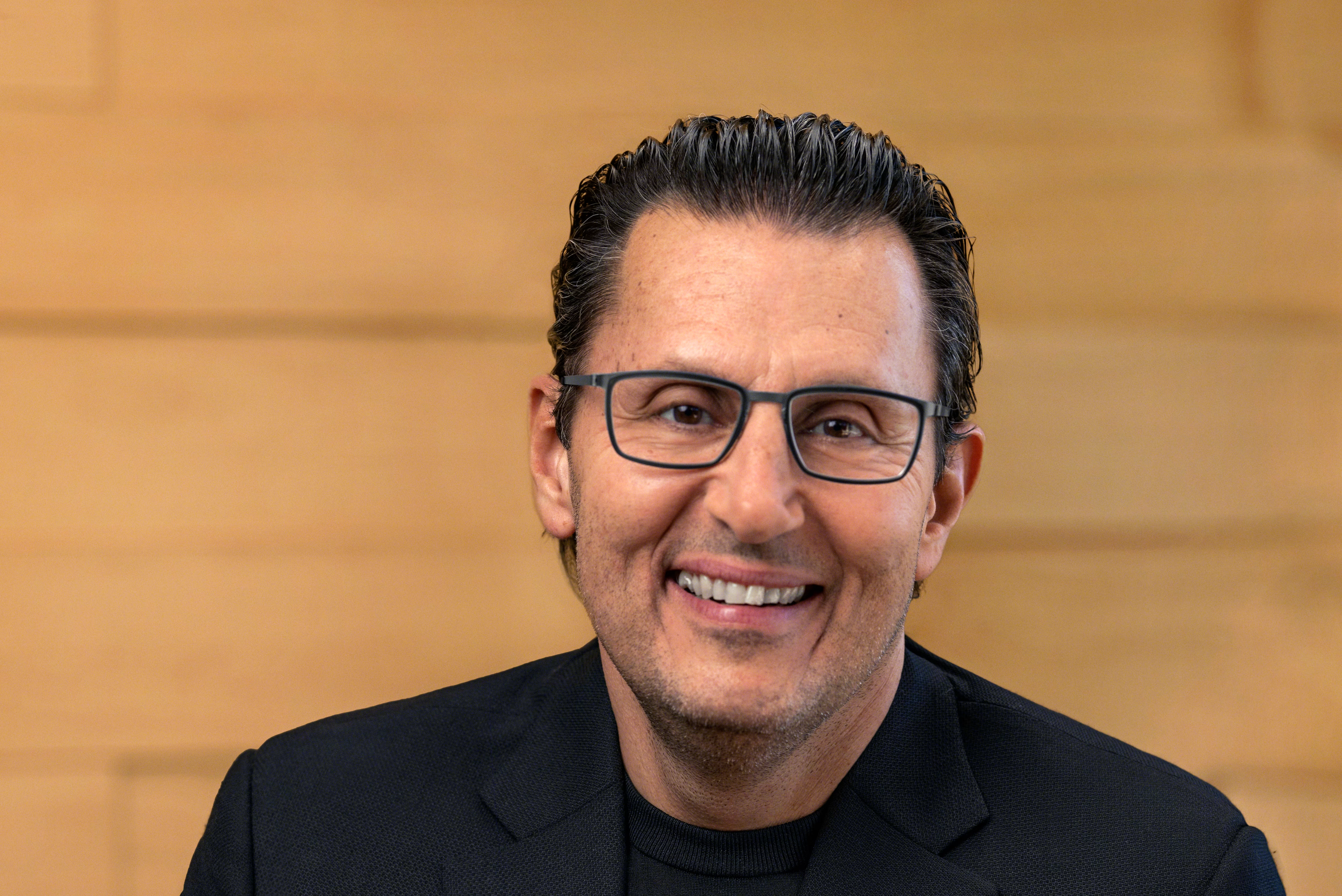





When a CEO tells his team, “AI is coming for your jobs, even mine,” you pay attention. It is rare to hear that level of blunt honesty from any leader, let alone the head of one of the world’s largest freelance platforms. Yet this is exactly how Fiverr co-founder and CEO Micha Kaufman has chosen to guide his company through the most significant technological shift of our lifetimes. His blunt assessment: AI is coming for everyone’s jobs, and the only response is to get faster, more curious, and fundamentally better at being human.
Why The Blunt Warning
Kaufman doesn’t apologize for his directness. As someone who’s built four companies over 25 years and took Fiverr public seven years ago, he’s developed a communication style that prioritizes authenticity over comfort. When asked why he chose such a stark message, Kaufman explained, “If you stand in the middle of the road and you see a car coming to run you over, it’s probably better to shout or just take someone and throw them out of the way or take action than just saying, you know what, I think, you know, you see the car?”
His perspective stems from a fundamental belief about leadership. “You should have radical transparency. You should just say things for what they are,” Kaufman told me. He acknowledges uncertainty about the future, noting that while he’s confident in his views about AI’s trajectory, he’s not presumptuous enough to claim certainty about exactly how things will unfold.
The message resonated beyond Fiverr. Months after Kaufman’s internal memo, Sam Altman gave an interview making a similar point, suggesting that AI would eventually surpass even the best CEOs alive today. The convergence of these warnings from leaders building and using AI systems suggests we’re facing a genuine inflection point.
The Steam Engine On A Carriage Problem
Kaufman frames our current moment with AI through a compelling historical analogy. “What’s happening with AI right now is in many ways similar to what happened in 1769 with the steam engine,” he explains. When compact steam engines first appeared, the obvious solution was to attach them to horse carriages. It made perfect sense at the time, but it wasn’t revolutionary. The true transformation came later with the actual automobile.
We’re in that intermediate phase now, putting metaphorical steam engines on carriages. We’re applying AI to existing workflows and platforms, seeing improvements, but not yet experiencing the fundamental restructuring that’s coming. “It is mostly replacing the things we used to do as human beings, acting as robots,” Kaufman observes. The repetitive tasks, the research gathering, the document summarizing, these elements where humans brought judgment but little humanity are being automated first.
This creates what Kaufman calls an elevation of the floor. “What was considered to be hard is the new simple. What was considered to be almost impossible is the new hard,” he says. The paradigm itself is shifting, and with it, the definition of valuable skills.
The Superpowers Illusion
One of Kaufman’s most interesting arguments challenges the popular narrative that AI gives us superpowers. His counter: “Even if it’s true, it’s giving superpowers for everyone, which means that it doesn’t give superpowers to anyone.” If everyone can write better, create images, or produce basic content through AI, then none of those capabilities provides a competitive advantage.
This insight cuts to the heart of how AI transforms work. It’s not enough to use the obvious AI tools in obvious ways. The real value emerges from those who push boundaries, combine systems creatively, or bring exceptional judgment to AI-assisted workflows. Kaufman points to viral videos created with advanced AI tools, noting that their quality stems not from the AI itself but from the operator’s genius, experience, creativity, and taste developed over years.
The democratization of AI access means the bar for acceptable work has risen dramatically. What once impressed now represents baseline competency. This reality extends beyond creative fields into every domain where AI can replicate human output.
Velocity As Competitive Advantage
In an environment of extreme uncertainty where everyone has access to similar AI tools, Kaufman identifies velocity, not just speed, as the critical differentiator. Drawing on physics, he emphasizes that velocity combines speed with direction. Companies that can experiment rapidly, learn quickly, and pivot based on results will have what he calls “a smaller cost of failure.”
“Nobody knows where this is going, and no one actually knows how a carriage will transform into a car,” Kaufman explains. “Then you need to experiment a lot, and when you have a lot of hypotheses, and you want to run experiments, if you can do this really fast and with very few bugs, then you have the advantage.”
This philosophy shapes how Fiverr approaches AI internally. Rather than adopting generalized AI tools as they come, the company focuses on building personalized AI systems. Kaufman envisions AI that knows him specifically, his communication style, his preferences, and his decision-making patterns, continuously learning and improving its assistance.
The same principle applies across functions. A legal team reviewing contracts needs AI trained on Fiverr’s specific approaches and priorities. Developers need AI that understands their complete codebase context, not just generic coding assistance. The magic happens in the fine-tuning, in the specificity that transforms capable AI into genuinely powerful AI.
What Replaces The Automated Work
When Kaufman tells his team to aim for replacing 100% of their current work with AI, the obvious question emerges: Why would the company still need them? His answer reveals his vision for the future of work.
“Now I need you because you have a higher value. Because now you have 100% of your time free, which means that you can actually figure out what are you good at that is not automated, that cannot be automated,” he explains. It’s about rediscovering humanity, identifying unique judgment, instinct, or non-linear thinking that creates competitive advantage.
This isn’t abstract philosophy. Kaufman actively works to replace time-consuming aspects of his own role. Managing communications, reviewing documents, taking meeting notes, converting those notes into action items, following up on tasks, these elements consume executive time without necessarily requiring executive judgment. Automating them, even imperfectly, frees capacity for strategic thinking and decision-making only humans can provide.
The current limitation is that AI still makes too many mistakes to operate completely unsupervised. But even requiring supervision and tweaking rather than original creation saves substantial time. As the technology improves, this balance will continue shifting.
The Skills That Matter
Kaufman identifies curiosity as perhaps the most important attribute for thriving in an AI-augmented world. “How can I break it? How can I do something with it that no one thought of? How can I, if people thought that its limit is here, how can I extend it?” he asks. The people doing remarkable things with AI are those diving deep into understanding why it works the way it does, experimenting with combinations, and pushing beyond obvious applications.
He also notes a generational advantage. Younger workers, particularly Gen Z, grew up with AI as a natural part of their educational and professional toolkit. They’re more fluent and adaptive with the technology. But regardless of age, adaptability and flexibility in approaching problems matter enormously.
Interestingly, Kaufman warns against AI making us collectively dumber. The ease of generating content without understanding it, of accepting outputs without validation, creates a lazy default. “People are becoming their laziest version of lazy,” he cautions. Those who resist this temptation and maintain rigorous thinking habits will stand out.
The fundamentals haven’t changed. “There’s no shortcuts for crying out loud. There’s no shortcuts in life. It’s hard work, and it’s creating mastery,” Kaufman says. The illusion that AI eliminates the need for deep expertise is just that, an illusion.
The Societal Concerns
While Kaufman feels relatively confident about how his company and the freelance ecosystem will adapt, he harbors deeper concerns about broader societal impacts. Job displacement will happen, and it will happen faster than previous technological transitions. “Human beings are not programmed to deal with stuff that happens super-fast, which is why you have very few Formula One drivers and fighter pilots,” he notes.
Consider autonomous vehicles. “Truck driver, I think, is the number one most popular job in the U.S.,” Kaufman points out. Add in rideshare drivers and related roles, and you’re looking at millions of people potentially facing displacement within years. “What concerns me is that I don’t see the government saying, alright, we need to think about how to work with this cohort,” preparing them for new skills and careers.
He also raises questions about the concentration of AI development in private hands. The companies racing toward artificial general intelligence and superintelligence are, in his view, conducting the equivalent of the Manhattan Project outside government control. Whether governments will ultimately allow such powerful technology to remain in the private sector remains an open question.
Looking Ahead Without Certainty
Ask Kaufman about the future five years from now, and he laughs. “Are you crazy? Who knows? Seriously, who knows what’s gonna be in a year?” The pace of change makes confident predictions foolish. He predicts 99 out of 100 AI startups will fail within a year, victims of an AI bubble where marginal differences between companies can’t sustain the current abundance of venture capital.
What will persist are those with genuine competitive advantages, skills that create value others can’t easily replicate. The arbitrage between time and talent continues; AI simply reshapes what skills command premium value. Those who stay agile, adaptable, and focused on capabilities customers genuinely need will find opportunities.
For workers concerned about their future, Kaufman’s advice is simultaneously sobering and liberating. The change is real, and it’s fast. Pretending otherwise serves no one. But those who embrace learning, maintain curiosity, and push themselves to understand what makes them uniquely valuable will navigate the transition successfully.
His final message carries both challenge and possibility. “Those who love what they’re doing and find it fulfilling and find purpose in what they’re doing are gonna be fine. They’ll reinvent themselves,” he says. It’s not the end of work, it’s the elevation of what work means, requiring us to be more human, not less, in an increasingly AI-augmented world.