


Hyperliquid is one of the buzziest blockchains in crypto. Known for its perpetual futures trading platform, it has also achieved a rare feat: building a digital asset treasury, or DAT, that has delivered positive returns for its shareholders. DATs are corporate vehicles designed to acquire and hoard a specific cryptocurrency—Michael Saylor’s Bitcoin behemoth Strategy is the most famous example—but in the past year, their share prices have slumped badly, and some DATs have flamed out altogether. The exception is the DAT called Hyperliquid Strategies, ticker symbol PURR, whose shares have climbed 251% since the start of the year.
Since Hyperliquid Strategies launched 10 months ago—less than two years after the Hyperliquid blockchain went live—its market capitalization has climbed past $3 billion. The DAT now holds more than 35 million HYPE tokens, the blockchain’s native token, worth roughly $3.3 billion. This twin achievement of expanding its treasury and posting outsize shareholder returns puts the Hyperliquid DAT in stark contrast to its peers. As the chart below shows, the year-to-date returns of the leading DATs dedicated to Bitcoin, Ethereum, and Solana have been dismal:
So why has Hyperliquid’s DAT flourished while the others have stumbled? Unlike other DATs, Hyperliquid Strategies does more than accumulate tokens and wait for their value to rise. The company has built an operating model that runs like an active business rather than a passive vault. By earning revenue from its holdings, the company can add to its HYPE reserves, increasing the amount of cryptocurrency tied to each share of stock over time. Whether by design or circumstance, Hyperliquid Strategies may have finally cracked the code on how to make DATs viable.
The remarkable rise of Hyperliquid
In the short time since the Hyperliquid blockchain launched in 2023, its HYPE token has vaulted into the top 10 most valuable cryptocurrencies. A big reason is that, unlike many other crypto projects that seek to build value with hype or vague future promises, Singapore-based Hyperliquid—founded by Harvard grad and physics whiz Jeff Yan—offers a valuable real-world service.
Its decentralized platform offers 24/7 derivatives trading at rapid speed, and is based around perpetual futures, a novel type of option that doesn’t expire. Following its launch, Hyperliquid initially drew crypto speculators, but soon after attracted a new group of customers: traders who use Hyperliquid to trade tokenized versions of oil, gold, and other commodities.
This new class of traders has carried out huge numbers of transactions on Hyperliquid, which charges small fees in the form of the HYPE token. Hyperliquid uses a portion of those fees to pay the so-called validators who operate the blockchain, but most of the HYPE it collects is “burned”—diminishing the overall supply and increasing the value of the token. All of this has led the price of HYPE to surge more than 2,200%, according to data analytics platform CoinGecko.
Even as Hyperliquid thrived, however, it faced an obstacle to further growth: It was not (and still is not) legally available in the United States, leaving many American investors without an easy way to gain exposure to the platform. Meanwhile, many investors of all sorts who are unfamiliar with crypto find buying HYPE tokens can be cumbersome, typically requiring them to create a crypto wallet and connect it to a decentralized exchange.
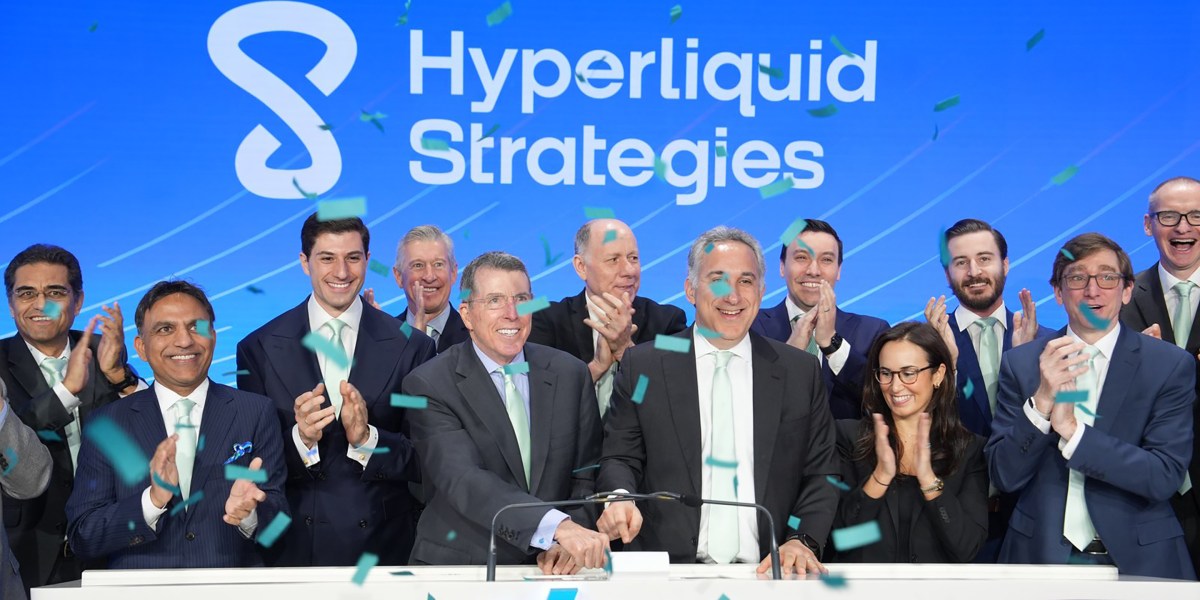
Spotting this gap in the market, David Schamis, a founding partner at private equity firm Atlas Merchant Capital and former Barclays executive, launched Hyperliquid Strategies. The publicly traded company was created to stockpile HYPE, allowing traditional investors to buy into the ecosystem through equity shares. It was a new DAT, in other words.
In July 2025, Atlas Merchant Capital and venture firm Paradigm announced an $888 million capital raise for the DAT, and Schamis became its CEO. By December, Hyperliquid Strategies was trading on the Nasdaq under the ticker “PURR.” Buying shares of PURR—named after a cat-themed meme token that was the first to be launched on Hyperliquid’s blockchain—became the only easy path for American investors to gain exposure to HYPE until last May, when asset managers started rolling out Hyperliquid exchange-traded funds.
“That timing explains much of the success Hyperliquid Strategies has experienced since Q4 of last year, accumulating billions of dollars in treasury assets,” Eliezer Ndinga, global head of research at crypto asset manager 21shares, told Fortune. “Given … the success of the Hyperliquid ecosystem, they were well positioned to ride that wave.”
‘Adding some alpha’
Unlike its DAT predecessors, Hyperliquid Strategies did not simply sit on its HYPE stash and wait for the token to rise. That has been the model employed by Strategy and numerous copycat DATs, which have counted on steadily rising asset prices to issue new shares that pay for their operating costs. The flaw in that approach became apparent this year, however, as slumping crypto prices saw the market capitalizations of DATs fall below the value of the crypto assets they held—triggering a potentially existential spiral.
In the case of Hyperliquid Strategies, its New York–based team of four—CEO Schamis, CFO Brett Beldner, COO Jeroen Nieuwkoop, and director of corporate affairs Rob Diamond—drew on their experience in traditional finance to structure an operating model around the company’s token reserve.
Hyperliquid Strategies operates its own network validator, a specialized computer system that helps process transactions and secure the Hyperliquid blockchain. In return, it earns ongoing fees, turning its HYPE holdings into a source of operating revenue rather than a passive reserve.
In addition to validator fees, the company stakes its 35 million HYPE tokens in the network, earning ongoing token rewards. Similar to interest earned on a deposit, those rewards increase the company’s HYPE holdings over time, adding to the amount of cryptocurrency backing each share.
“For the DATs that can do that well, they actually have the ability to outperform the market over the long term because they’re taking the underlying holding and adding some alpha on top of that,” said Ryan Rasmussen, head of research at asset manager Bitwise.
The model also depends on investors valuing Hyperliquid Strategies’ stock at more than the HYPE and cash behind each share. When PURR trades above that underlying value, its multiple to net asset value, or mNAV, is above one. That premium gives the company an additional way to grow its HYPE holdings.
“When the mNAV is above one, [the company] can issue more shares on the open market to raise cash and then buy more HYPE, and that becomes this … self-fulfilling loop,” Rasmussen told Fortune.
An analyst at crypto research firm Artemis earlier this year published a detailed breakdown of how Hyperliquid Strategies has so far been able to thread this needle.
Avoiding the DAT trap
According to Ndinga, Hyperliquid’s most notable contribution was showing investors that cryptocurrency could serve a purpose beyond price speculation by expanding access to global financial markets in response to a real necessity.
“Crypto has had a marketing problem for a while … [People assume] cryptocurrencies are trying to be like gold or the dollar,” Ndinga said. “But not all cryptocurrencies are currencies. You have crypto equities [and] crypto commodities … Hyperliquid has made the industry more tangible by showing what blockchain technology can do.”
Previous DATs strayed from this approach. Strategy initially gave traditional investors a way to gain Bitcoin exposure before spot ETFs were available. Over time, however, it built its model around passive accumulation and a “hold on for dear life” philosophy. It expanded its Bitcoin reserve through financing such as convertible notes and preferred stock, leaving its returns heavily dependent on Bitcoin’s price appreciation rather than income generated from the holdings.
As share prices dropped below so-called NAV, or net asset value, Strategy and other DATs could no longer issue stock without diluting existing shareholders. With less access to new capital, some also struggled to cover operating costs. Many ended up dying out.
When Fortune asked Hyperliquid Strategies whether it would go down a similar path in the case of a market downturn, Schamis’s answer was concise: “We’re not religious zealots,” he said in an interview.
“Our primary responsibility is to our shareholders … and if the circumstances ever arose where it was beneficial to our shareholders to be selling our tokens … we certainly would,” Schamis added.
For practical purposes, as Schamis explained on an earnings call, this means Hyperliquid Strategies only issues new shares when its mNAV is 1.1 or higher, and buys back shares when it falls below that.
A cash cushion of roughly $292 million also gives the company a financial buffer during a severe downturn, reducing the likelihood that it will have to dump its HYPE holdings or make desperate trades.
A narrow monopoly
Hyperliquid Strategies is now entering a new chapter as the market structure around it matures.
That shift was on full display in late August, when Trump said at a White House crypto and technology summit that the Commodity Futures Trading Commission was working to create a legal path for Hyperliquid to operate in the United States.
At the time, Schamis was in Wyoming, attending Anthony Scaramucci’s SALT Conference. After finishing a panel presentation on Hyperliquid, he stepped offstage, checked his phone, and saw PURR shares had suddenly jumped 30%.
“For about 30 seconds, I was incredibly impressed with myself, thinking my panel speech had moved the market,” Schamis recalled with a laugh. “Then I opened the news and realized President Trump had just publicly commented on bringing Hyperliquid to the U.S. at that exact same minute.”
But that mainstream attention also signals stiffer competition ahead. As spot HYPE ETFs continue to roll out in the U.S. and perpetual futures access expands, PURR’s initial monopoly on institutional access will naturally narrow.
That said, not all investment vehicles are created equal, and, according to Rasmussen, Hyperliquid’s business strategy will continue to hold off competition, at least for now.
“The DATs that perform the best over the long term are those that add some level of operational boost to the underlying holds,” he said. “Investors are willing to pay a premium above HYPE performance to have a company … putting their assets [to work] on their behalf in generating incremental returns.”