


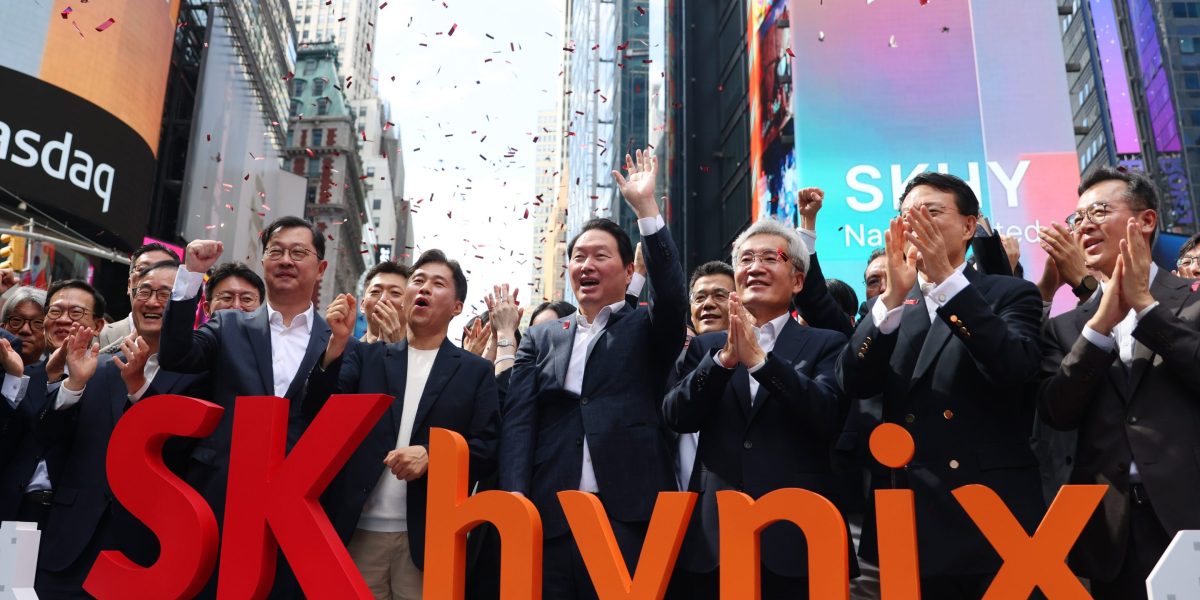
SK Hynix, the world’s leading manufacturer of high-bandwidth memory, debuted on the Nasdaq yesterday, after raising $26.5 billion in the largest U.S. listing ever by a foreign company and the second-largest share sale in U.S. history, trailing SpaceX’s $86 billion IPO last month. Shares rose 12.8% in their first day of trading.
The listing gives U.S. investors direct access to a chipmaker that’s closely tied to the AI boom, making the specialized memory chips that sit inside almost every Nvidia processor, and now command high prices amid a major shortage.
“We’ve announced plans to double production capacity within five years, but every customer says, ‘That’s still not enough—we need more’,” SK Group Chair Chey Tae-won told CNBC on Friday, the day of the listing.
SK Hynix’s shares, currently traded in Korea, have surged more than 630% over the past 12 months, pushing its market value past $1 trillion, only the second Korean company to hit that milestone after Samsung Electronics.
Yet SK Hynix, like many other Korean companies, suffers from what’s been called the “Korea Discount,” where shares are traded at a discount compared to global peers—and, at worst, trade below book value. U.S. chipmaker Micron Technology, for example, boasts a $1.1 trillion valuation, despite SK Hynix being significantly more profitable.
Analysts tend to blame the country’s chaebols—the vast family-controlled conglomerates that dominate the economy—for corporate governance practices that prioritize group cohesion over shareholder returns.
SK executives argue the U.S. listing will attract global investors who cannot easily access the Korean market. Analysts at HSBC estimate that the listing of SK Hynix American depository receipts could lift the chipmaker’s valuation by as much as 20%.
From bailouts to AI dominance
SK Hynix’s path to a U.S. listing was long and troubled. The company was founded in 1983 as Hyundai Electronics, a division of the larger Hyundai Group. After the Asian Financial Crisis of 1997 left the Korean semiconductor sector dangerously overextended, Seoul pressed the industry to consolidate. Hyundai absorbed LG Semiconductor and renamed the merged entity Hynix, a portmanteau of “high” and “electronics.”
The LG merger loaded Hynix with debt. The company required bailouts from both creditors and the Korean government, was spun off by Hyundai in 2003, and spent nearly a decade as an independent company before the SK Group, South Korea’s second-largest conglomerate, acquired it in 2012.
The path for Hynix’s eventual boom came in 2013, when the company co-developed the world’s first high-bandwidth memory chip with U.S. chip designer AMD. At the time, HBM was a niche product, yet SK Hynix continued to invest in it. When the AI boom arrived and processor companies realized they needed HBM to quickly train large language models at speed, SK Hynix had a decade-long lead on its competitors Samsung and Micron.
HBM can deliver much more bandwidth than conventional dynamic random-access memory (DRAM), making the chips perfect for the processing demands of AI model training. Every major AI processor contains HBM chips, and most of those are supplied by SK Hynix. The company controls roughly 60% of the global HBM market by revenue.
“What I really wanted to accomplish when we acquired Hynix was to transform it from a commodity memory producer into a mainstream semiconductor company whose products are indispensable,” Chey wrote in a book published in January. “If SK Hynix’s HBM is replaced with another product, the AI system may not function properly. What used to be a peripheral component has become a core component.”
SeongJoon Cho—Bloomberg via Getty Images
SK Hynix reported 97.1 trillion won ($64.1 billion) in revenue in 2025, a record for the company and much higher than the revenue reported the year before (which was, itself, a record). It also reported net income of 42.9 trillion won ($28.3 billion), implying a net profit margin of 44%.
The company has now become a key source of talent for other semiconductor companies. Last month, Intel appointed Lee Seok-hee, SK Hynix’s former CEO, as the new leader for its chipmaking Foundry division, reporting directly to CEO Lip Bu-Tan.
How SK Hynix is helping drive a Korean rally
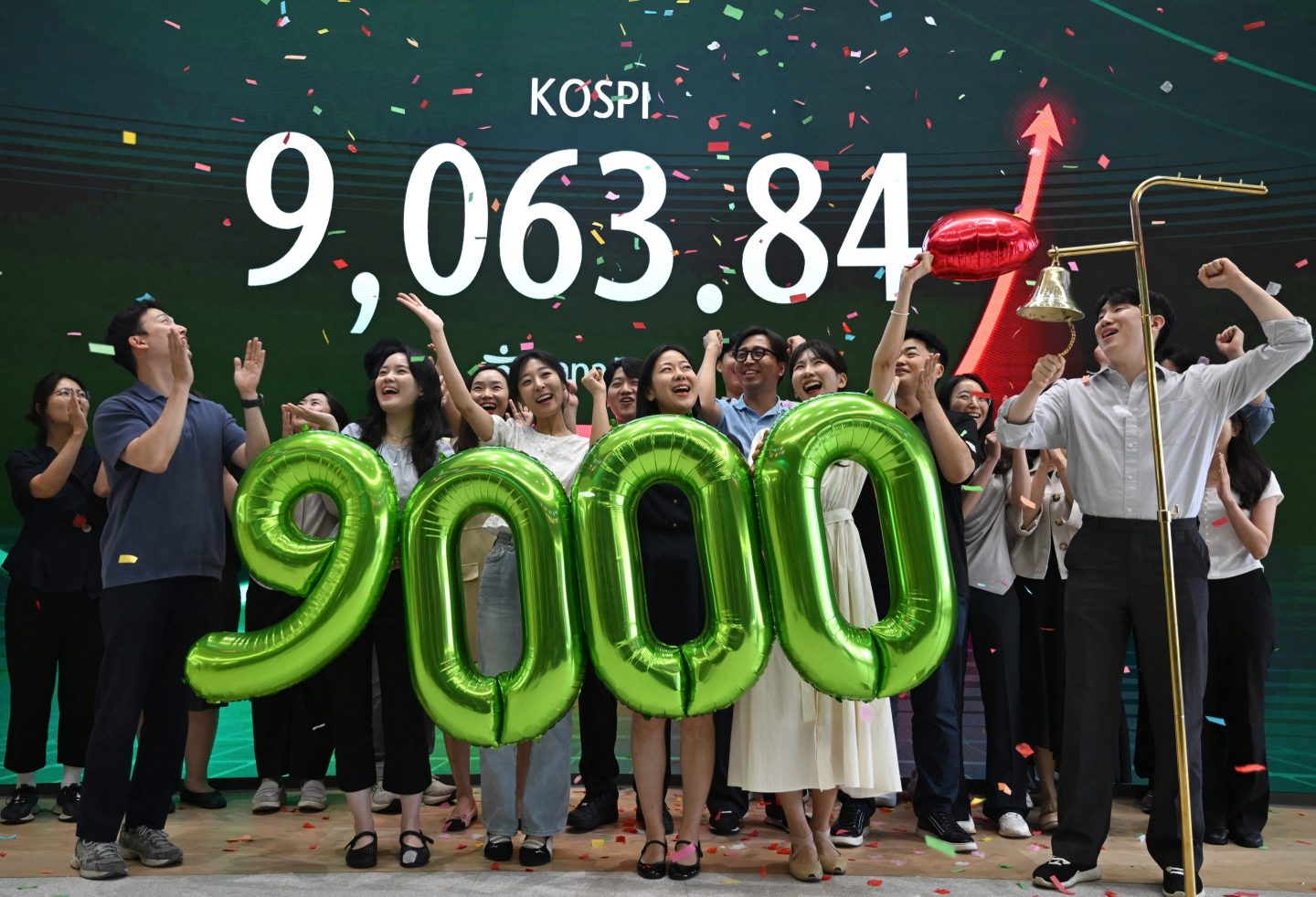
South Korea’s KOSPI is one of the world’s best-performing market indices, rising 135% in the past 12 months. Yet that rise is almost entirely due to two companies: SK Hynix and its chipmaking peer, Samsung Electronics. Together, the two firms make up more than half of the KOSPI’s total market capitalization.
The country’s stock market is also intensely volatile. The exchange has tapped its circuit-breaker mechanism—which is triggered when the KOSPI falls by more than 8%—six times this year so far.
In April, South Korea’s government approved the creation of single-stock leveraged ETFs—products that deliver twice the daily return of an individual stock—to keep retail investors from chasing these same bets offshore.
In Hong Kong, a leveraged SK Hynix ETF managed by CSOP swelled to more than $17 billion in assets, overtaking the city’s flagship Tracker Fund to become its largest ETF.
Jung Yeon-je—AFP via Getty Images
South Korean regulators are already expressing regret about the leveraged ETFs. Lee Chan-jin, governor of South Korea’s Financial Supervisory Service, said publicly in June that he wished he had “laid down to protest the launch by any means necessary.” The Bank of Korea warned that the ETFs risked deepening the market’s already dangerous concentration in a handful of names.
While leveraged ETFs are common in markets like the U.S., Korea’s strict eligibility rules ensured that only Samsung and SK Hynix qualified for such funds—in turn driving the country’s retail investors, sometimes dubbed “ants,” into just two stocks.
Beyond chips, South Korea is also positioning itself as a global center for physical AI and robotics. Hyundai Motor Group, which owns U.S. robotics company Boston Dynamics, has seen its shares rise around 120% over the past year.
Can Korea survive an AI boom?
SK Hynix, along with Samsung and Micron, is benefiting from a shortage of memory chips. AI manufacturers are willing to pay top dollar for the limited supply for memory out there, lifting prices across the entire industry. Even lower-end memory chips are getting more expensive, forcing device manufacturers like Apple, Sony and Nintendo to hike prices to keep pace.
“We forecast that next year will be the worst year in the industry’s history from the supply perspective,” SK Hynix CEO Kwak Noh-jung told Reuters on Friday.
The AI boom is playing out in Korean society and politics as well, not just its stock markets.
In late 2025, SK Hynix agreed to allocate 10% of its annual operating profits to employee bonuses. The first payout averaged around 140 million won ($93,000) per employee. If SK Hynix’s profits keep increasing, so too will employee bonuses. (Samsung earlier this year also agreed to share operating profits with its chip workforce, which has irked those working in the company’s other divisions.)
That’s helped increase the stature of chip workers in the dating scene, with Koreans joking that an SK Hynix jacket is the best thing to wear on a blind date. “If SK Hynix and Samsung Electronics employees used to be classified as B+ or A-grade candidates, today they are closer to A+,” Son Dong-gyu, chief executive of matchmaking agency Bien Aller, told Reuters earlier this year.
The Bank of Korea is less enthusiastic. In mid-June, the central bank warned that bonuses could have an inflationary effect.
Peter Kim, global strategist at KB Financial Group, suggested in late June that empowered labor unions, seeking similar mega-bonuses, could be a new factor behind the “Korea Discount.”
“The agreement for profit-sharing on future profits is unprecedented, to the extent that it calls into question the long-term viability of such a pay structure in a CAPEX-intensive industry, where striking the capital allocation equilibrium between CAPEX/investments and dividends is an ongoing debate,” he wrote.
More broadly, Kim warned that Korea’s government will need to grapple with “worsening social division” caused by bumper profits at chip companies—and bumper bonuses for chip workers.
South Korea’s government is considering how it might spread the benefits of the AI boom across more of society. The country is exploring setting up a new investment vehicle backed by the additional tax revenue from Samsung and SK Hynix’s booming profits.
Metin Akta/Pool—AFP via Getty Images
Last month, Samsung and SK Hynix jointly announced plans to invest 800 trillion won ($517 billion) with their suppliers to build two new semiconductor fabrication complexes in southwestern South Korea.
Still, some analysts are skeptical that the memory shortage will last forever. Companies like SK Hynix are now hurriedly investing in more capacity, fostering the old boom-and-bust cycles that plagued chip revenues in the pre-ChatGPT era.
“Demand outpaces supply initially as fresh capacity takes two to three years at the minimum to come online but often leads to oversupply in tail years as peak capacity is brought up at the moment demand tapers off,” Morningstar analyst Jing Jie Yu wrote in late June, after Samsung and SK Hynix announced their 800 trillion won investment in new chip fabs.